

High Value Lead Prioritization System
Identify Which Sales Opportunities Deserve Attention First
Not every new lead represents the same opportunity. One customer may be ready to purchase a high value service this week. Another may be researching something the business does not specialize in. A repeat customer may submit a substantial project while several smaller inquiries arrive at the same time.
When every lead enters the same queue, the most important opportunities can become buried inside ordinary activity. The problem becomes more noticeable when a small business has limited sales capacity.
Employees cannot call every prospect simultaneously. Owners cannot personally review every inquiry. Salespeople eventually have to decide what deserves attention first. Without a consistent system, those decisions are often based on whichever lead arrived first, called most recently or simply caught someone’s attention.
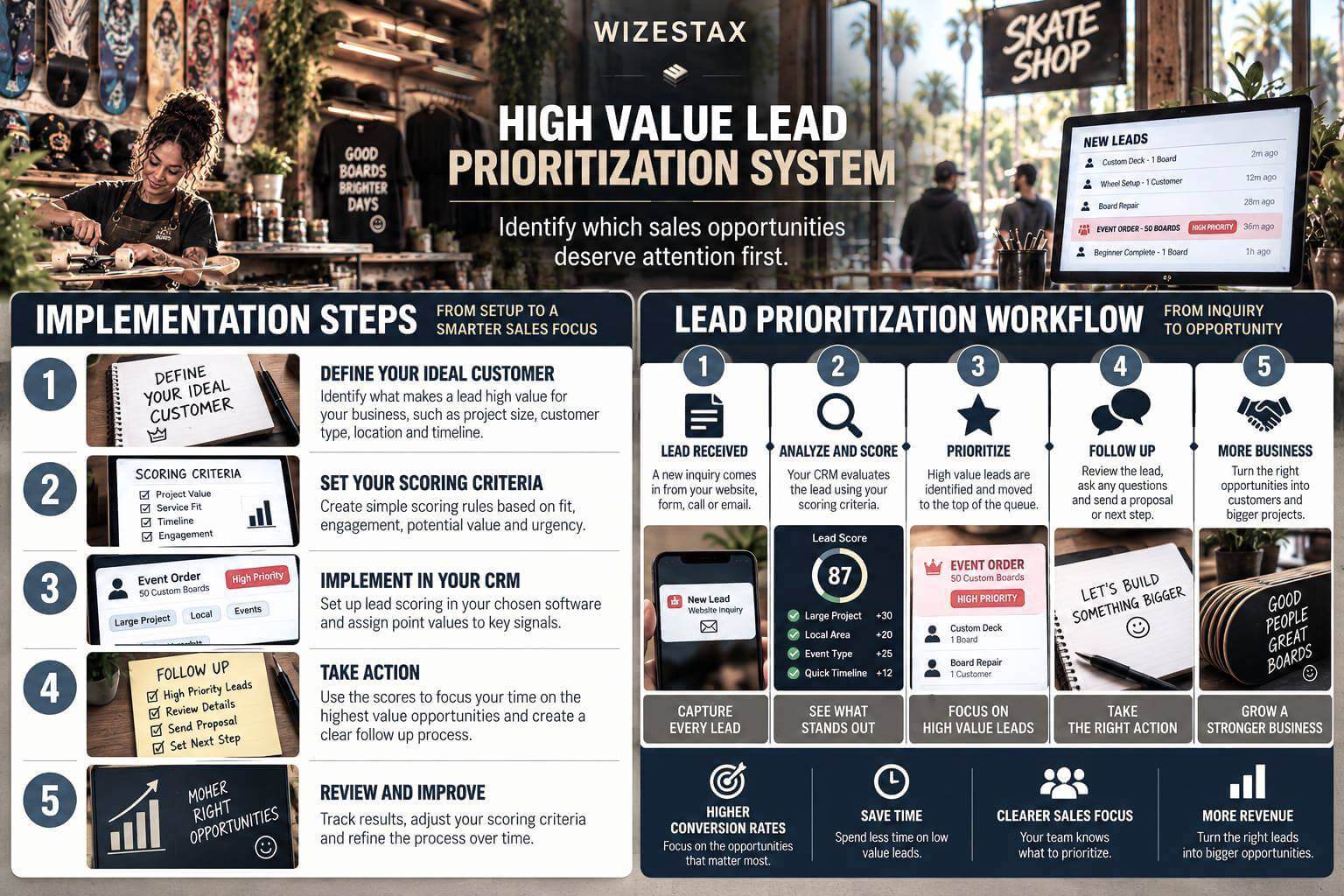
A High Value Lead Prioritization System creates a structured method for evaluating leads using signals such as customer fit, potential value, urgency and demonstrated interest. The objective is not to ignore lower scoring leads. It is to help the business allocate limited sales attention more deliberately.
Which Stax Fits Your Business
| Business Need | Stax | Software | Cost |
|---|---|---|---|
| Connected CRM with fit and engagement scoring | Starter Stax | HubSpot | Free CRM with qualifying paid scoring features |
| Sales focused deal prioritization | Growth Stax | Pipedrive | Varies by plan and users |
| Flexible rule based scoring across CRM records | Pro Stax | Zoho CRM | Varies by edition and users |
Pricing, availability and capabilities can change. Confirm current requirements directly with each provider.
Software Linx
Starter
Growth
Pro
Blueprint Overview
| Metric | Value |
|---|---|
| Category | Sales |
| Business Problem | High value opportunities compete with lower priority leads for limited attention |
| Primary Objective | Prioritize leads using consistent business criteria |
| Core Signals | Fit, potential value, intent, engagement and urgency |
| Setup Time | Approximately 60 to 120 minutes |
| Difficulty | Intermediate |
| Maintenance | Weekly review with periodic scoring adjustments |
| Best For | Service businesses, contractors, agencies and sales teams |
| Primary Output | Prioritized lead queue |
The Hidden Revenue Leak
| Without This Blueprint | With This Blueprint |
|---|---|
| Every inquiry can appear equally important | Leads receive structured priority signals |
| Staff decide what to pursue from memory | Prioritization follows documented criteria |
| Large opportunities can become buried | High value leads become easier to identify |
| Fast response goes to whoever is noticed first | Response effort can reflect business importance |
| Sales attention becomes fragmented | Limited capacity can be allocated intentionally |
| Lead quality is difficult to compare | Fit and engagement become measurable |
A high score does not guarantee that a prospect will buy.
Likewise, a lower score does not mean a lead has no value.
Scoring provides an additional decision signal. Human judgment remains necessary.
Business Impact Snapshot
| Area | Potential Impact |
|---|---|
| Response Prioritization | Surfaces opportunities requiring earlier attention |
| Sales Capacity | Directs limited time toward stronger opportunities |
| Consistency | Reduces purely subjective prioritization |
| Visibility | Shows why a lead received priority |
| Follow Up | Helps organize sales activity around lead characteristics |
| Revenue | Reduces the chance that valuable opportunities disappear inside a crowded queue |
Real World Example
A residential roofing company receives 27 inquiries over two days.
Several are requests for minor repairs.
Some customers are simply requesting information.
One homeowner needs a complete roof replacement following storm damage.
Another inquiry comes from a property manager requesting estimates for three buildings.
Without prioritization, all 27 inquiries enter essentially the same queue.
The company creates a scoring model.
Complete roof replacement adds points.
Commercial or multi property work adds points.
Service area match adds points.
A requested project timeline within 30 days adds points.
Returning customers add points.
Incomplete contact information subtracts points.
Out of 27 inquiries, four emerge as substantially stronger opportunities based on the company’s own criteria.
The remaining leads are not discarded.
The system simply makes the four higher priority opportunities visible sooner.
WIZESTAX Stax Options
Starter Stax
HubSpot
Best For
Businesses that want lead prioritization connected to customer records, marketing activity and sales operations.
| Function | Software |
|---|---|
| CRM | HubSpot |
| Fit Analysis | Lead Scoring |
| Engagement Analysis | Lead Scoring |
| Prioritization | Score Properties |
| Segmentation | CRM Segments |
| Automation | Workflows Depending On Plan |
Advantages
| Benefit |
|---|
| Fit and engagement can be evaluated separately |
| Scores remain connected to CRM records |
| Business attributes can contribute to prioritization |
| Behavioral activity can contribute to scoring |
| Scores can feed other CRM processes |
HubSpot currently allows businesses to build lead scores using record attributes and behavior. Its documentation gives the example of creating a company fit score using region, company size and industry. Score properties can subsequently be used in segments, workflows and reports. (HubSpot Knowledge Base)
Limitations
| Limitation |
|---|
| Lead scoring requires qualifying paid subscriptions |
| Scoring quality depends on accurate CRM data |
| Poorly designed rules can exaggerate weak signals |
| High engagement does not necessarily equal high economic value |
| Models require periodic review |
Growth Stax
Pipedrive
Best For
Sales teams that want prioritization closely connected to active deals and day to day prospecting.
| Function | Software |
|---|---|
| CRM | Pipedrive |
| Prioritization | Scores |
| Scoring Criteria | Custom Criteria |
| Prospecting Workspace | Pulse |
| Data Completion | Data Enrichment |
| Follow Up | Pulse Feed And Sequences |
Advantages
| Benefit |
|---|
| Scoring sits close to the active sales workflow |
| Businesses can define criteria around their own sales strategy |
| Scores provide a common way to compare opportunities |
| Pulse combines prioritization with prospecting activity |
| Data enrichment can strengthen the information used for scoring |
Pipedrive’s Pulse toolkit currently combines custom scoring, data enrichment, sequences and a prioritized feed. Its Scores feature lets businesses define criteria around their own sales needs and applies a 0 to 100 score to deals. Scoring access currently depends on subscription level. (Pipedrive Support)
Limitations
| Limitation |
|---|
| Current Scores functionality is deal focused |
| Scores require Premium or higher according to current documentation |
| Some Pulse capabilities depend on subscription |
| Scoring still depends on appropriate criteria |
| Scores should not replace review of individual opportunities |
Pro Stax
Zoho CRM
Best For
Businesses that want flexible rule based scoring across multiple types of CRM records.
| Function | Software |
|---|---|
| CRM | Zoho CRM |
| Prioritization | Scoring Rules |
| Lead Signals | Attributes And Behavior |
| Record Types | Leads, Contacts, Accounts And Deals |
| Automation | Score Based Workflow Rules |
| Advanced Analysis | Zia Scoring Where Available |
Advantages
| Benefit |
|---|
| Scoring can incorporate multiple business factors |
| Positive and negative points can be assigned |
| Different scoring models can support different business needs |
| Scores can apply beyond leads |
| Workflow rules can respond to score changes |
Zoho currently supports scoring rules based on behavior, attributes, insights and other customer information. Its documentation also describes manual scoring and Zia based scoring, while workflow rules can trigger when record scores change. (Zoho Corporation)
Limitations
| Limitation |
|---|
| Availability and rule limits vary by edition |
| More flexible scoring requires more careful configuration |
| Too many criteria can make the model difficult to interpret |
| Historical data may not contain every desired signal |
| Scores identify priority rather than guaranteeing conversion |
How The Three Stax Differ
| Stax | Primary Approach |
|---|---|
| HubSpot | Fit and engagement scoring within a connected CRM |
| Pipedrive | Deal focused scoring connected to active prospecting |
| Zoho CRM | Flexible rule based scoring across CRM records |
These are different architectures rather than rankings.
The appropriate approach depends on where leads originate, how much information the business captures, sales volume, existing CRM infrastructure and what characteristics actually make an opportunity valuable to that particular business.
Copy And Paste Priority Alert
“High priority lead identified. {{lead_name}} currently has a priority score of {{lead_score}} based on {{priority_factors}}. Review the lead details, confirm the information and determine the appropriate next action.”
Copy And Paste Internal Review
“Review this lead before outreach. Confirm service fit, potential opportunity value, customer timeline, location, recent engagement and any existing relationship. Use the score as a prioritization signal rather than assuming the opportunity will convert.”
Copy And Paste AI Prompt
You are assisting a small business with lead prioritization.
Review the provided lead information using the business’s stated scoring criteria.
Evaluate customer fit, potential economic value, urgency, demonstrated intent and engagement only when those signals are present in the supplied data.
Explain which factors increased or decreased priority.
Do not assume that a high value project will close.
Do not treat website activity or email engagement as proof of purchase intent.
Do not invent missing revenue, budget, customer behavior or project details.
Flag missing information that could materially change the assessment.
Return the priority factors, relevant concerns and information that should be confirmed by a person before outreach.
Step By Step Implementation Guide
The following setup demonstrates one implementation path using HubSpot.
It is not a WIZESTAX recommendation or preferred Stax.
HubSpot is used here because its current scoring architecture clearly separates fit and engagement signals, making it a practical example for building a transparent prioritization model. (HubSpot Knowledge Base)
Step 1: Define What High Value Actually Means
Before assigning points, define what makes an opportunity valuable to the business.
Possible factors include:
Project value
Service fit
Geographic fit
Customer type
Purchase timeline
Repeat customer status
Decision authority
Relevant engagement
Avoid using criteria simply because the CRM can measure them.
Step 2: Separate Fit From Engagement
A prospect can fit the business extremely well without being ready to purchase.
Another prospect can interact heavily with marketing material while being a poor fit.
Treat these as different signals.
HubSpot currently supports scores built around both fit and engagement criteria. (HubSpot Knowledge Base)
Step 3: Assign Point Values
Create a simple scoring model.
For example:
Large project type: +20
Existing customer: +15
Inside primary service area: +10
Purchase timeline within 30 days: +15
Requested consultation: +20
Outside service area: minus 25
Incomplete contact information: minus 10
These numbers are illustrative.
The actual weighting should reflect the economics and sales process of the business.
Step 4: Establish Priority Thresholds
Create practical groups such as:
Immediate Review
High Priority
Standard Queue
Needs Qualification
Do not create more categories than employees can meaningfully use.
Step 5: Build The Score
Configure the CRM to evaluate the available attributes and behaviors.
HubSpot’s current scoring tool creates numerical score properties based on selected criteria. Those properties can then be used elsewhere within the CRM. (HubSpot Knowledge Base)
Step 6: Connect Priority To Action
A score becomes valuable when it changes what happens next.
A high priority lead might create a sales task.
A standard lead might remain in the normal queue.
A lead missing critical information might trigger qualification rather than immediate sales outreach.
The workflow should reflect the business’s actual capacity.
Step 7: Review Outcomes
Periodically compare scores against real outcomes.
Ask:
Did high scoring leads actually become good customers?
Are profitable customers consistently receiving low scores?
Are certain signals receiving too much weight?
Are salespeople ignoring the scoring system?
Adjust the model when evidence shows that the priorities do not reflect reality.
Revenue At Risk Snapshot
| High Value Leads Delayed | Average Potential Project | Opportunity Value Represented |
|---|---|---|
| 2 | $8,000 | $16,000 |
| 5 | $8,000 | $40,000 |
| 10 | $8,000 | $80,000 |
Illustrative scenario only. Opportunity value represented is not guaranteed, forecast or recoverable revenue.
WIZESTAX Diagnostic Scorecard
| Category | Assessment |
|---|---|
| Economic Problem | Limited sales attention can be spent on lower value opportunities while stronger leads wait |
| Signal Quality Required | High |
| Automation Potential | High |
| Human Judgment Required | High |
| Data Dependency | High |
| Scalability | High |
| Primary Value | More deliberate allocation of sales attention |
| Primary Risk | Mistaking a scoring model for certainty |
Common Mistakes
| Mistake | Result |
|---|---|
| Scoring every available data point | Noise overwhelms meaningful signals |
| Giving engagement too much weight | Curious prospects can outrank stronger opportunities |
| Never subtracting points | Nearly every lead eventually appears valuable |
| Treating scores as conversion predictions | Staff become overconfident |
| Ignoring missing information | Weak data produces misleading priorities |
| Never reviewing the model | Old assumptions continue controlling the queue |
| Automatically abandoning lower scoring leads | Potential customers can be unnecessarily lost |