

Job Rework Detection System
Identify Repeat Service Work Caused by Incomplete or Defective Jobs Before Hidden Labor Costs Accumulate
Completing a service job does not always mean the original problem has been resolved. A plumbing repair may require another visit because a connection continues leaking. A cleaning company may need to return because sections of a property were overlooked. An equipment technician may discover that the original repair did not correct the reported malfunction.
Some return visits are legitimate new assignments. Others represent rework that the business must perform to correct an earlier service. The distinction matters because corrective work can consume labor, materials and scheduling capacity without generating additional revenue.
Many businesses record each visit separately. When a customer contacts the company again, the new appointment may appear as an ordinary service request even when it relates directly to a recently completed job.
The Job Rework Detection System connects corrective work with the original assignment, identifies recurring quality problems and measures the operational cost of completing work more than once.
Its purpose is not to classify every return visit as employee error. Equipment failures, changing customer requirements, defective materials and incomplete initial information can all create additional work.
The system establishes a consistent process for determining when a repeat assignment represents preventable rework and what the business can learn from it.
Software Linx
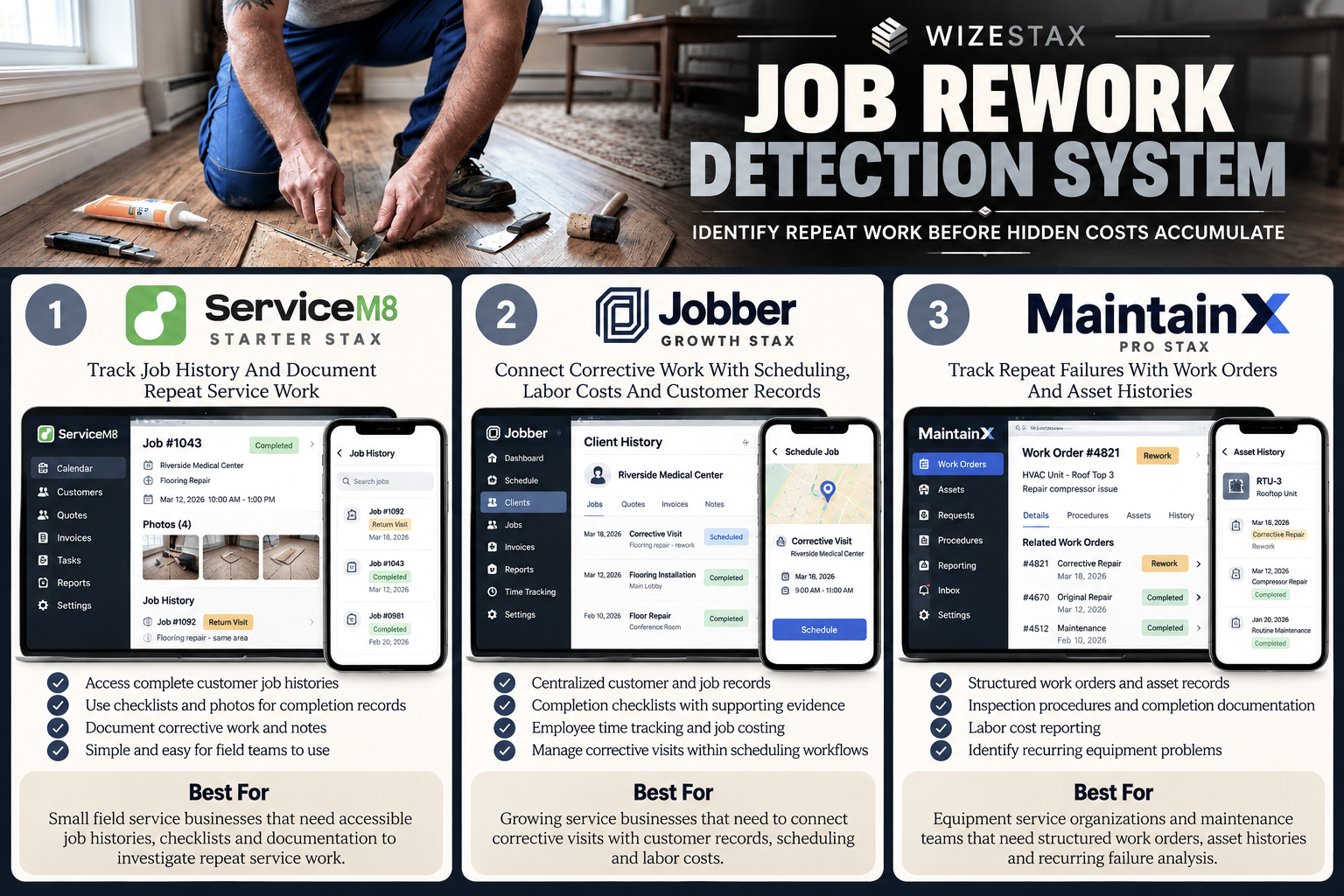
Starter: ServiceM8
Growth: Jobber
Pro: MaintainX
Blueprint Overview
| Metric | Value |
|---|---|
| Category | Service Quality And Operations |
| Business Problem | Corrective work is recorded without consistently identifying its connection to previous jobs |
| Primary Objective | Detect, classify and measure rework associated with completed assignments |
| Core Signals | Original job, repeat request, defect category, completion evidence and corrective labor |
| Setup Time | Approximately 3 to 6 hours |
| Difficulty | Intermediate |
| Maintenance | Daily repeat work review and monthly quality analysis |
| Best For | Service businesses performing repairs, installations, maintenance or other work with measurable completion requirements |
| Primary Output | Rework records, corrective cost reporting and recurring defect analysis |
The Hidden Revenue Leak
| Without This Blueprint | With This Blueprint |
|---|---|
| Corrective visits appear as unrelated jobs | Repeat work is connected to the original assignment |
| Extra labor is difficult to measure | Corrective hours are recorded |
| Recurring defects remain unnoticed | Quality patterns become visible |
| Responsibility for follow up is unclear | Corrective actions have assigned owners |
| Managers rely on individual complaints | Rework is reviewed systematically |
| Original job records lack context | Completion evidence supports investigation |
| Estimates ignore repeated corrective work | Rework costs inform operating decisions |
A business may complete hundreds of service appointments while quietly absorbing the cost of correcting a portion of them.
Consider a company that completes an installation and receives a customer call several days later.
The customer reports that the equipment is not operating correctly.
A technician returns, investigates the problem and discovers that a component installed during the original visit was not properly secured.
The company completes the correction without charging the customer.
The second visit consumes technician time, transportation expenses and potentially replacement materials. It also occupies a schedule opening that could have been used for another assignment.
If the corrective visit is entered as an ordinary job, management may never recognize that the original service required additional work.
When similar situations occur repeatedly, the business can underestimate the true cost of its services.
A Job Rework Detection System makes these costs visible by distinguishing new customer demand from work required to correct previous assignments.
Business Impact Snapshot
| Area | Potential Impact |
|---|---|
| Labor Costs | Better visibility into unpaid corrective hours |
| Service Capacity | Fewer repeated assignments consuming available appointments |
| Quality Control | Identification of recurring completion defects |
| Customer Retention | More consistent resolution of service problems |
| Profitability | More accurate understanding of job costs |
| Training | Evidence for targeted process improvements |
| Management | Clearer reporting of rework frequency and causes |
Real World Example
A commercial flooring contractor completes a vinyl flooring installation for a small medical office.
The crew documents the completed work and closes the assignment.
Four days later, the customer reports that several floor sections are beginning to lift.
The company schedules another visit.
During the inspection, the technician discovers that surface preparation was insufficient in one area before the flooring was installed.
The company must remove the affected sections, prepare the surface and reinstall the material.
Without rework tracking, the corrective appointment may be recorded as a separate service job.
The original installation appears completed, while the additional labor and materials are assigned elsewhere.
With a Job Rework Detection System, the corrective visit is linked to the original installation.
The business records the defect, determines its cause and measures the resources required to complete the correction.
Management can then review whether similar problems are occurring on other flooring installations.
If insufficient surface preparation becomes a recurring cause, the company can revise its installation checklist and completion inspection process.
The objective is not simply to resolve one customer complaint. It is to identify whether a correctable operational problem is repeatedly creating additional work.
WIZESTAX Stax Options
Starter Stax
ServiceM8
Best For
Small field service businesses that need accessible job histories, completion checklists and photographic records to investigate repeat service work.
| Function | Software |
|---|---|
| Original Job Records | Job Cards |
| Customer Service History | Job History |
| Completion Requirements | Checklists |
| Work Documentation | Photos And Videos |
| Corrective Actions | Tasks And Job Notes |
| Follow Up Review | Job Search And Job Diary |
ServiceM8 combines job management with customer histories, checklists and documentation captured by field employees.
Businesses can review previous assignments associated with a customer and inspect the information recorded during earlier visits.
Job records can include photographs, notes, communications and completed checklist items.
This information provides context when a customer reports that previously completed work requires correction.
A service company can establish a process requiring employees to review recent job history before classifying a repeat request.
When the new assignment involves correcting the original work, employees can record the original job reference and document the reason for the corrective visit.
ServiceM8 also supports checklists that help standardize completion requirements.
These checklists can be used to establish evidence of what employees inspected before marking a job complete.
The platform does not automatically establish that a return visit represents rework. The business must define its classification rules and consistently connect related records.
Advantages
| Benefit |
|---|
| Accessible customer job histories |
| Photos and notes support defect investigations |
| Customizable completion checklists |
| Field employees can document corrective work |
| Suitable for smaller service teams |
Limitations
| Limitation |
|---|
| Rework classification requires an internal process |
| Related jobs may require manual cross referencing |
| Root cause analysis is not automatic |
| Advanced reporting may require exports or additional tools |
| Documentation quality depends on employee participation |
Growth Stax
Jobber
Best For
Growing field service companies that need to connect corrective visits with customer records, scheduled work and labor costs.
| Function | Software |
|---|---|
| Customer History | Client Records |
| Original Assignments | Jobs And Visits |
| Quality Documentation | Checklists |
| Defect Evidence | Notes And Attachments |
| Corrective Scheduling | Job Scheduling |
| Labor Analysis | Timesheets And Job Costing |
Jobber provides operational records for service businesses managing customer requests, scheduled visits and employee assignments.
Managers can review completed jobs and associated documentation when customers report a problem following service.
Checklists support structured completion records, including photographs, signatures and other information collected during a visit.
These records help determine whether the original assignment was completed according to the agreed scope.
When corrective work is necessary, the business can create or schedule the appropriate follow up activity and document its connection to the original job.
Jobber also supports employee time tracking and job costing on eligible plans.
These capabilities can help businesses evaluate the labor and financial impact of corrective assignments.
However, standard job costing does not automatically distinguish warranty corrections from unrelated service work.
A company implementing rework detection should establish consistent naming, documentation and reporting procedures so corrective costs are identified separately.
Advantages
| Benefit |
|---|
| Centralized customer and job records |
| Completion checklists with supporting evidence |
| Employee time tracking |
| Job costing capabilities |
| Corrective visits can be managed within scheduling workflows |
Limitations
| Limitation |
|---|
| Rework classification is not automatic |
| Job costing availability depends on subscription |
| Separate corrective jobs require consistent references |
| Root cause categories require business configuration |
| Rework analysis may require manual reporting |
Pro Stax
MaintainX
Best For
Equipment service organizations, facilities teams and maintenance operations that need structured work orders, asset histories and recurring failure analysis.
| Function | Software |
|---|---|
| Maintenance Assignments | Work Orders |
| Equipment Records | Asset Management |
| Completion Procedures | Work Order Procedures |
| Inspection Evidence | Inspection Checks |
| Historical Analysis | Work Order History |
| Labor Reporting | Work Order Reports |
| Recurring Problems | Asset Maintenance History |
MaintainX is designed for organizations managing maintenance activities, equipment records and structured work orders.
Each work order can document the activity performed, the responsible employee and the associated equipment or location.
This creates a historical record that can be reviewed when an asset requires another repair shortly after maintenance was completed.
A maintenance team can compare the new failure with previous work orders to determine whether the original problem was resolved.
Procedures and inspection checks help standardize the steps required during maintenance activities.
MaintainX reporting also provides information about work order completion, labor costs and equipment maintenance history.
For a rework detection process, managers can establish procedures that identify corrective work associated with earlier maintenance.
A recurring equipment failure should not automatically be classified as defective service.
The organization must investigate whether the new failure resulted from incomplete work, component deterioration, operating conditions or an unrelated problem.
MaintainX is particularly relevant when repeated work involves identifiable equipment and maintenance histories rather than general customer service appointments.
Advantages
| Benefit |
|---|
| Structured maintenance work orders |
| Asset specific service histories |
| Inspection and procedure documentation |
| Labor cost reporting |
| Supports investigation of recurring equipment problems |
Limitations
| Limitation |
|---|
| More specialized than general service scheduling software |
| Requires consistent asset and work order records |
| Repeat failures do not automatically establish rework |
| Advanced reporting availability varies by plan |
| Root cause classification still requires investigation |
How The Three Stax Differ
Each platform provides a different foundation for identifying corrective work.
ServiceM8
Uses customer job histories, photographs and completion checklists to investigate whether a return visit is connected to previous service. This approach is suited to smaller field service companies that need accessible operational records.
Jobber
Connects customer service history with scheduling, employee time tracking and job financial information. This approach is suited to growing service businesses that need to understand both the operational and financial consequences of corrective work.
MaintainX
Uses maintenance work orders, asset histories and inspection procedures to investigate repeated equipment problems. This approach is suited to businesses where rework involves technical maintenance and identifiable assets.
These are different implementation architectures rather than rankings. The appropriate system depends on the type of work performed, how defects are discovered and what evidence is required to establish that corrective work relates to a previous assignment.
Copy And Paste Rework Investigation Alert
Potential job rework identified.
Customer: {{customer_name}}
Original job: {{original_job_id}}
Original completion date: {{completion_date}}
New service request: {{new_request_id}}
Reported problem: {{reported_problem}}
Assigned reviewer: {{assigned_employee}}
Review the original scope, completion documentation and new customer report.
Determine whether the new assignment represents corrective work, an unrelated issue or an additional customer request.
If rework is confirmed, record the cause, corrective action and expected labor requirements.
Do not classify the return visit as defective work without reviewing the available evidence.
Copy And Paste Customer Follow Up
Hello {{customer_name}},
Thank you for contacting us regarding the service completed on {{original_service_date}}.
We have recorded your concern about {{reported_issue}} and are reviewing the original work details.
Our next step is {{next_action}}.
We will provide an update by {{next_update_date}}.
Thank you for giving us the opportunity to investigate and address the issue.
Copy And Paste AI Prompt
You are assisting a service business with job rework detection and quality analysis.
Review the completed job records, subsequent service requests and corrective work records provided.
Identify new assignments that may relate to recently completed work.
Compare customer information, service locations, equipment identifiers, original job descriptions and reported problems.
Distinguish between confirmed rework, possible rework, unrelated new service and additional customer requested work.
Review completion photographs, inspection records, technician notes and customer reports when available.
Identify cases where the original problem appears unresolved or where a documented defect required correction.
Calculate corrective labor and material costs only when sufficient information is available.
Do not assume that every repeat visit represents defective work.
Do not assign employee responsibility without supporting evidence.
Do not invent missing job relationships, defect causes or financial information.
Present the findings in a table containing the original job, repeat request, reported problem, relationship to previous work, rework classification, available evidence, corrective cost and required action.
Identify recurring defect categories and explain where additional investigation is necessary.
Step By Step Implementation Guide
The following setup demonstrates one implementation path using ServiceM8.
It is not a WIZESTAX recommendation or preferred Stax.
ServiceM8 is used here because its job histories, checklists and field documentation provide a straightforward foundation for investigating repeat work.
Step 1: Define What Qualifies As Rework
Establish a consistent definition before monitoring repeat appointments.
Rework should represent additional work required to correct an incomplete, defective or improperly performed original assignment.
Examples may include:
-
Correcting an improperly installed component
-
Repairing a connection that was not secured correctly
-
Repeating a cleaning task that failed the agreed inspection
-
Replacing materials damaged during installation
-
Completing an original service requirement that was overlooked
Do not automatically include routine maintenance, new customer requests or unrelated equipment failures.
Step 2: Establish A Review Window
Choose a period after job completion during which related customer requests receive additional review.
For example, a business may investigate requests involving the same equipment or service location within thirty days of completion.
The review window is a screening tool, not proof of rework.
Some defects become visible much later, while unrelated problems can occur immediately after service.
Warranty obligations and service agreements may require longer review periods.
Step 3: Standardize Original Job Records
Ensure each service assignment contains enough information to support later investigation.
| Field | Purpose |
|---|---|
| Job Number | Identifies the original assignment |
| Customer | Connects the work to the correct account |
| Service Location | Identifies where work occurred |
| Equipment Or Area | Defines the subject of the service |
| Work Description | Records the original scope |
| Completion Date | Establishes the service timeline |
| Assigned Employee | Identifies the service team |
| Completion Evidence | Supports later quality review |
Consistent records make it easier to determine whether a new request concerns previously completed work.
Step 4: Create Completion Checklists
Use ServiceM8 checklists to document important completion requirements.
For a flooring installation, the checklist might include:
-
Surface preparation verified
-
Materials inspected before installation
-
Installation completed according to scope
-
Finished surface inspected
-
Required photographs captured
-
Customer instructions provided
The checklist should reflect the actual work being performed.
Avoid creating unnecessary steps that employees cannot realistically complete.
Step 5: Capture Completion Evidence
Require employees to document work that may need future verification.
Evidence can include photographs, equipment readings, inspection results and service notes.
For example, an electrician might record a completed electrical test, while a cleaning company might photograph areas requiring customer approval.
Completion evidence should support quality review without creating excessive administrative work.
Step 6: Review New Requests Against Job History
When a customer reports a problem, examine recent service records before treating the request as unrelated work.
Compare the reported issue with the original assignment.
Review the location, equipment, completed tasks and available photographs.
If the new problem may relate to the earlier job, flag it for investigation.
Do not confirm rework solely because the same customer requested another appointment.
Step 7: Classify The Repeat Assignment
Establish categories that distinguish corrective work from legitimate new service.
| Classification | Meaning |
|---|---|
| Confirmed Rework | Original work requires correction |
| Possible Rework | Relationship requires investigation |
| New Service | Unrelated customer requirement |
| Scope Addition | Customer requests additional work |
| Material Failure | Component failed independently |
| Maintenance | Expected recurring service |
The classification may change when additional evidence becomes available.
Step 8: Link Corrective Work To The Original Job
When rework is confirmed, record the original job number in the corrective assignment.
Use consistent job notes or a designated record field to establish the relationship.
Document the reported defect, investigation findings and required correction.
This connection allows managers to identify how many completed assignments required additional work.
Step 9: Track Corrective Labor And Materials
Record the resources consumed during the corrective assignment.
| Field | Purpose |
|---|---|
| Original Job | Identifies the related assignment |
| Corrective Hours | Measures additional labor |
| Labor Rate | Estimates labor exposure |
| Replacement Materials | Captures additional material costs |
| Travel Expense | Identifies return visit costs |
| Defect Cause | Supports recurring problem analysis |
| Resolution | Confirms corrective work completion |
Distinguish internal costs from amounts billed to the customer.
Some corrective work may be covered by warranties, supplier reimbursement or other contractual arrangements.
Step 10: Review Recurring Defect Patterns
At the end of each reporting period, group confirmed rework records by service category and cause.
Look for repeated installation problems, incomplete inspections, material failures or unclear work instructions.
Investigate whether defects are associated with particular service procedures, equipment types or operating conditions.
Use the findings to improve training, checklists, material selection and quality control.
The objective is to reduce avoidable corrective work while maintaining fair and accurate assessments of employee performance.
Job Rework Cost Exposure Snapshot
| Monthly Jobs | Rework Visits | Additional Labor Cost |
|---|---|---|
| 100 | 5 | $300 |
| 200 | 10 | $600 |
| 300 | 15 | $900 |
Illustrative scenarios assuming 5% of completed jobs require one corrective visit, each visit consumes two labor hours and labor is valued at $30 per hour. The figures exclude travel, materials, overhead and any reimbursed or billable work. They represent potential labor exposure rather than guaranteed savings.
WIZESTAX Diagnostic Scorecard
| Category | Assessment |
|---|---|
| Economic Problem | Corrective work consumes additional labor and service capacity |
| Signal Quality Required | High |
| Automation Potential | Moderate |
| Human Judgment Required | High |
| Data Dependency | Moderate To High |
| Scalability | High |
| Primary Value | Visibility into recurring defects and corrective costs |
| Primary Risk | Misclassifying legitimate new service as employee error |
Common Mistakes
| Mistake | Result |
|---|---|
| Treating every repeat visit as rework | Quality reports become inaccurate |
| Failing to link corrective jobs | Rework costs remain hidden |
| Recording only customer complaints | Internal corrections are overlooked |
| Closing jobs without evidence | Defects become difficult to investigate |
| Ignoring material failures | Incorrect causes are assigned |
| Failing to measure corrective labor | Financial exposure is underestimated |
| Blaming employees before investigation | Operational causes remain unidentified |
| Using inconsistent defect categories | Recurring patterns become difficult to measure |
| Tracking rework without improving procedures | The same problems continue |
Get New WIZESTAX Blueprints Every Monday
Subscribe to receive new WIZESTAX Blueprints covering Customer Retention, Marketing, Sales, Finance and Operations directly to your inbox.