
Employee Performance Issue Detection System
Identify Developing Performance Problems Before They Become Larger Operational Issues
Employee performance problems are often recognized later than they should be. A deadline is missed. Work quality begins changing. Responsibilities require more follow up. Goals stop progressing. Customers or coworkers begin reporting similar concerns. Managers notice individual incidents, but the information remains scattered across conversations, tasks, reviews and memory.
The Employee Performance Issue Detection System creates a structured way to document relevant performance signals over time. Expectations, goals, completed work, manager observations, feedback and recurring issues can be reviewed together so developing patterns become easier to recognize.
This Blueprint is not designed to automatically label an employee as a poor performer. Performance can be affected by unclear expectations, inadequate training, workload, management problems, missing resources and other circumstances. The purpose is to make meaningful changes visible so a manager can investigate them fairly and respond with human judgment.
Which Stax Fits Your Business
| Business Need | Stax | Software | Cost |
|---|---|---|---|
| Straightforward goals, feedback and structured performance management inside an HR platform | Starter Stax | Zoho People | Varies by plan and users |
| Integrated HR records, goals, assessments, feedback and performance reporting | Growth Stax | BambooHR | Varies by package and users |
| Dedicated performance management with reviews, check ins, objectives and broader performance analysis | Pro Stax | 15Five Perform | $11 per user per month annually at time of research |
Pricing and capabilities change over time and should be confirmed directly with each software provider before purchase. 15Five currently publishes Perform at $11 per user per month on an annual plan. (15Five)
Software Linx
Starter
Growth
Pro
Blueprint Overview
| Metric | Value |
|---|---|
| Category | Workforce Management |
| Business Problem | Developing employee performance problems remain fragmented or informal |
| Primary Objective | Identify meaningful performance patterns earlier |
| Core Signals | Goal progress, work quality, missed expectations, manager observations, feedback and recurring performance events |
| Setup Time | Approximately 60 to 120 minutes |
| Difficulty | Intermediate |
| Maintenance | Regular manager updates and periodic calibration |
| Best For | Businesses with employees whose responsibilities and performance expectations can be meaningfully defined |
| Primary Output | Structured performance history and manager review trigger |
The Hidden Operational Leak
| Without This Blueprint | With This Blueprint |
|---|---|
| Performance concerns remain in manager memory | Relevant observations become documented |
| Individual problems appear unrelated | Recurring patterns become easier to recognize |
| Expectations can differ between employees or managers | Defined expectations create a more consistent reference point |
| Reviews can overemphasize recent events | Performance can be examined across a broader period |
| Feedback happens primarily after problems become serious | Developing concerns can receive earlier attention |
| Management decisions rely heavily on impressions | Documented evidence can contribute to human evaluation |
Performance should normally be evaluated using multiple relevant observations over an appropriate period rather than one incident or a single automated metric.
Business Impact Snapshot
| Area | Potential Impact |
|---|---|
| Detection | Developing performance concerns become visible earlier |
| Management | Managers gain a more consistent performance record |
| Coaching | Employees can receive more specific feedback about documented issues |
| Operations | Recurring work problems can be investigated before they become larger |
| Fairness | Decisions can rely on defined expectations and broader evidence |
| Development | Managers can distinguish areas requiring coaching, training or additional support |
Real World Example
A small property management company employs several maintenance technicians.
One technician has historically completed assigned work consistently. Over several weeks, however, some jobs require additional follow up. A few completion deadlines are missed and documentation is occasionally incomplete.
No single event represents a serious performance problem.
Because each incident occurs on a different property, the pattern is difficult for the manager to see.
The performance system brings relevant observations and goal information into the employee’s performance history. The manager notices that several similar issues have occurred within a relatively short period.
The system does not determine why.
The manager reviews the underlying work, speaks with the employee and discovers that the technician has recently been assigned substantially more complex jobs without additional training.
The appropriate response may therefore involve training or workload changes rather than discipline.
The value of the system is making the pattern visible while leaving interpretation and employment decisions to people.
WIZESTAX Stax Options
Starter Stax
Zoho People
Best For
Businesses that want structured goals, performance criteria and recurring feedback without implementing a more specialized performance platform.
| Function | Software |
|---|---|
| Employee Records | Zoho People |
| Performance Goals | Goals |
| Role Expectations | KRAs |
| Skill Tracking | Skill Sets |
| Progress | Goal Progress |
| Feedback | Manager And Peer Feedback |
Zoho People’s performance functionality supports goals, KRAs, skills and recurring manager and peer feedback. Goals can include due dates, priority and progress percentages, providing a relatively straightforward architecture for documenting expectations and progress. (Zoho Corporation)
Advantages
| Benefit |
|---|
| Goals and performance information remain connected with employee management |
| KRAs can connect evaluation with role responsibilities |
| Goal progress creates a consistent reference point |
| Manager and peer feedback can provide additional context |
| Suitable for businesses wanting broader HR functionality |
Limitations
| Limitation |
|---|
| Performance criteria still require careful design |
| Goal completion alone does not determine employee performance |
| Managers must document relevant observations consistently |
| Different roles may require different evaluation criteria |
| Human review remains necessary before drawing conclusions |
Growth Stax
BambooHR
Best For
Businesses that want employee records and performance management within the same HR environment.
| Function | Software |
|---|---|
| Employee Records | BambooHR |
| Expectations | Goals |
| Manager Conversations | One On Ones |
| Assessments | Performance Reviews |
| Broader Perspective | 360 Feedback |
| Analysis | Performance Reports |
BambooHR supports individual and team goals, one on ones, customizable review cycles, self and manager assessments, peer and skip level feedback, reminders and performance reporting. Its own performance guidance emphasizes ongoing management rather than treating an annual review as the entire process. (BambooHR)
Advantages
| Benefit |
|---|
| Performance management connects with broader employee records |
| Goals can be tracked continuously |
| Multiple feedback perspectives can provide additional context |
| Review cycles can vary between teams |
| Performance reports support manager review |
Limitations
| Limitation |
|---|
| Performance Management may require an eligible package or add on |
| Managers still need to interpret the underlying evidence |
| Poorly designed goals can create misleading signals |
| Feedback can contain subjective judgments |
| More HR infrastructure than some very small businesses require |
Pro Stax
15Five Perform
Best For
Businesses that want a dedicated performance architecture with recurring check ins, reviews, objectives, broader feedback and structured analysis.
| Function | Software |
|---|---|
| Performance Reviews | 15Five Perform |
| Ongoing Monitoring | Check Ins |
| Manager Context | One On Ones |
| Goals | OKRs |
| Broader Feedback | 360 Feedback |
| Performance Analysis | Ratings, Reporting And Talent Tools |
15Five Perform combines performance reviews, 360 feedback, standardized ratings, goal and OKR tracking, reporting and talent review tools. Its review system can incorporate self, manager, peer and upward reviews, while reporting and calibration tools are intended to provide broader context than one manager’s isolated impression. (15Five)
Advantages
| Benefit |
|---|
| Dedicated performance management architecture |
| Multiple information sources can contribute to reviews |
| Goals and objectives can contribute to performance context |
| Calibration tools support more consistent evaluation |
| Reporting can reveal patterns across roles and teams |
Limitations
| Limitation |
|---|
| Greater process complexity than many small teams require |
| Requires consistent participation from managers and employees |
| More performance data does not automatically create better decisions |
| AI assisted analysis still requires human evaluation |
| Costs increase with employee count |
How The Three Stax Differ
| Stax | Primary Approach |
|---|---|
| Zoho People | Configurable HR based goals and performance tracking |
| BambooHR | Integrated HR and ongoing performance management |
| 15Five Perform | Dedicated continuous performance management and analysis |
These are different implementation architectures rather than rankings.
Zoho People provides a relatively straightforward HR based performance structure. BambooHR connects goals, feedback, reviews and reporting with broader employee records. 15Five provides a more specialized environment for businesses that want continuous performance management and deeper review infrastructure.
Copy And Paste Performance Review Alert
“Performance review notice for {{employee_name}}. Recent documented activity shows a possible change from established expectations. Review the underlying goals, work records, manager observations and relevant feedback before determining whether additional action is appropriate.”
Copy And Paste Manager Review Note
“Review the documented performance information for {{employee_name}}. Identify the specific expectations involved, confirm that the information is accurate and determine whether the pattern reflects a performance issue, training need, workload problem, unclear expectation or another circumstance requiring discussion.”
Copy And Paste AI Prompt
You are assisting a manager with employee performance analysis.
Review the documented performance information provided and identify meaningful patterns that deserve human review.
Consider defined job expectations, goal progress, work quality, recurring missed responsibilities, manager observations, documented feedback and other relevant work related evidence.
Do not assume that one mistake, missed deadline or negative comment establishes a performance problem.
Separate isolated events from recurring patterns.
Identify the specific evidence contributing to each concern.
Consider whether unclear expectations, inadequate training, workload, missing resources or other operational circumstances could reasonably explain the pattern.
Do not infer protected characteristics or use personal information unrelated to job performance.
Do not recommend automatic discipline, termination, compensation changes or promotion decisions.
Do not invent employee information.
If the evidence is insufficient, state that additional manager review is required.
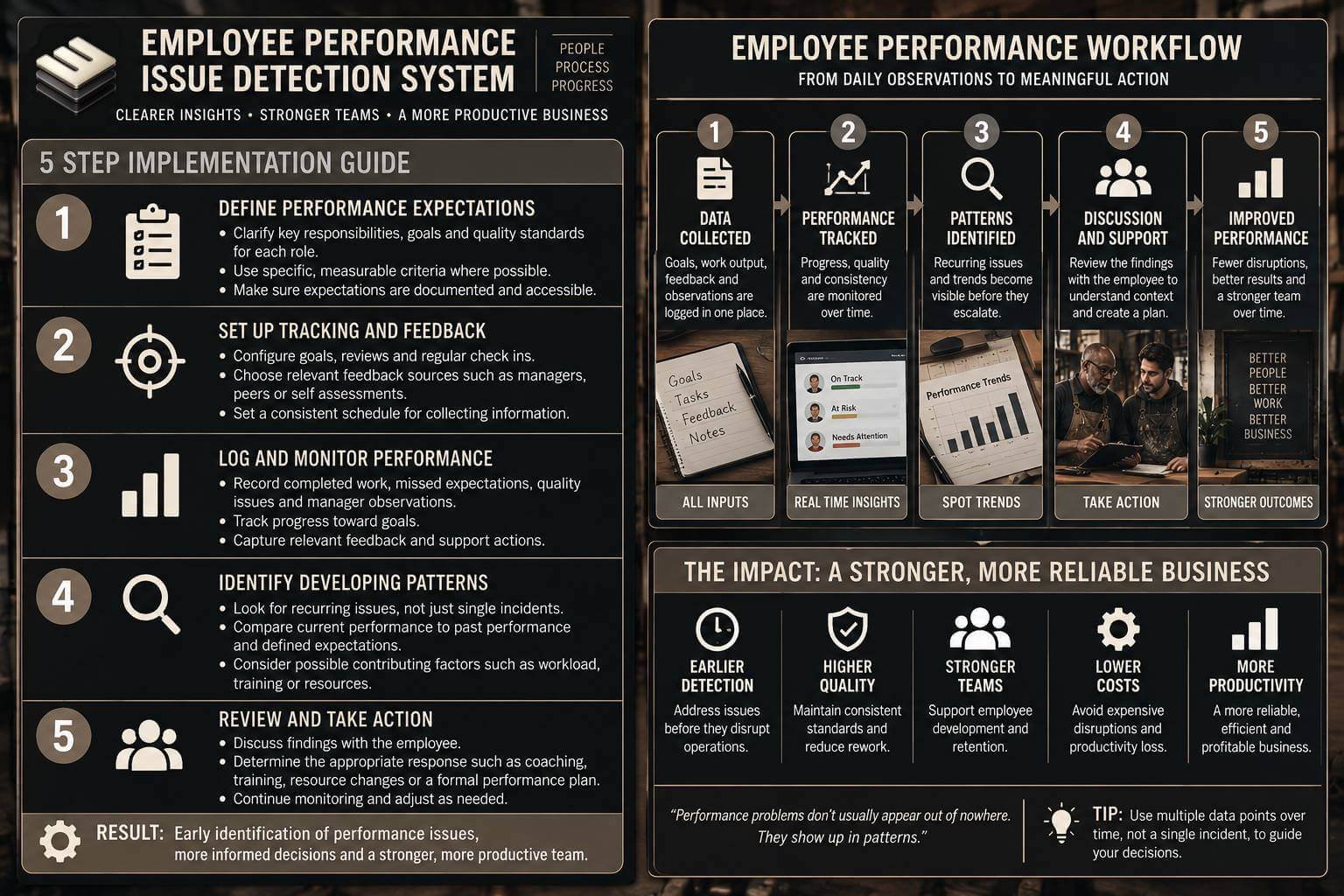
Step By Step Implementation Guide
The following setup demonstrates one implementation path using BambooHR.
It is not a WIZESTAX recommendation or preferred Stax.
BambooHR is used here because its performance system combines goals, one on ones, assessments, feedback and reporting, making it a useful example of how separate performance signals can become a structured manager review process. (BambooHR)
Step 1: Define Performance Expectations
Start with the actual responsibilities of each role.
Identify the work outcomes, responsibilities, quality expectations and goals that employees can reasonably be expected to influence.
Avoid vague standards such as attitude or good performance when a more specific work related expectation can be documented.
BambooHR’s performance guidance emphasizes clear goals and work standards as core components of a performance management system. (BambooHR)
BambooHR Performance Management Guide
Step 2: Create Relevant Goals
Create individual or team goals that represent meaningful work outcomes.
Goals should provide useful context rather than becoming the entire definition of employee performance.
Assign appropriate time frames and review progress during normal manager conversations.
BambooHR supports creating and tracking individual and team goals. (BambooHR)
BambooHR Performance Management
Step 3: Establish Regular Performance Touchpoints
Choose an appropriate rhythm for manager conversations, assessments and feedback.
Do not wait until an annual review to reconstruct months of employee performance from memory.
BambooHR supports one on ones, configurable review cycles and scheduled performance feedback. (BambooHR)
Step 4: Review Patterns Rather Than Incidents
When a possible performance issue appears, inspect the underlying evidence.
Look at relevant goals, previous feedback, documented expectations and similar events across the review period.
Determine whether the concern represents a recurring work related pattern.
Also examine whether workload, training, resources or unclear expectations may be contributing.
The software should organize information for review. It should not make the employment decision.
Step 5: Document The Human Response
After reviewing the evidence, the manager should document what was found and what happens next.
That may involve clarifying expectations, coaching, training, changing resources, monitoring a goal or following an established performance process.
Continue collecting information after the response so management can determine whether conditions improve.
Periodically review the system itself for inconsistent standards or patterns of subjective evaluation.
Operational Performance Exposure Snapshot
The primary economic value of this system is not automatically reducing payroll.
It is operational work affected by recurring performance problems that become visible earlier.
| Affected Work Events Monthly | Average Operational Impact | Monthly Exposure Represented |
|---|---|---|
| 4 | $100 | $400 |
| 10 | $100 | $1,000 |
| 25 | $100 | $2,500 |
Illustrative scenario using an average operational impact of $100 for each affected work event. Exposure represented is not guaranteed savings. Actual impact varies according to the employee’s role, the nature of the work, rework, delays, management time, customer consequences and other business factors.
WIZESTAX Diagnostic Scorecard
| Category | Assessment |
|---|---|
| Economic Problem | Recurring employee performance problems can affect operations before management recognizes a pattern |
| Signal Quality Required | High |
| Automation Potential | Moderate |
| Human Judgment Required | Very High |
| Data Dependency | High |
| Scalability | Moderate To High |
| Primary Value | Earlier visibility and better documented management review |
| Primary Risk | Mistaking incomplete, subjective or biased information for objective evidence of poor performance |
Common Mistakes
| Mistake | Result |
|---|---|
| Treating one mistake as a performance pattern | Employees can be evaluated unfairly |
| Using vague or subjective expectations | Managers evaluate different employees inconsistently |
| Measuring only easily counted activity | Important aspects of job performance can disappear from evaluation |
| Ignoring workload and training conditions | Operational problems can be misclassified as employee problems |
| Overweighting recent events | Earlier performance receives too little consideration |
| Allowing software to determine disciplinary action | Human judgment is removed from a consequential employment decision |
| Collecting feedback without context | Opinions can be mistaken for evidence |
| Never reviewing evaluation criteria | Outdated standards continue influencing decisions |
Related WIZESTAX Categories
| Category | Related Business Problem |
|---|---|
| Workforce | Employee Overtime Warning |
| Workforce | Employee Certification Expiration |
| Workforce | New Hire Candidate Screening |
| Workforce | Training Completion Tracking |
| Workforce | Employee Scheduling Demand Forecast |
| Operations | Recurring Task Failure Alert |
| Operations | Operational Exception Dashboard |
These remain separate problems.
The Employee Performance Issue Detection System identifies broader patterns indicating that an existing employee may not be meeting defined work expectations. Employee Overtime Warning identifies excessive labor hours. Employee Certification Expiration protects against expired credentials. New Hire Candidate Screening organizes information before employment. Training Completion Tracking identifies unfinished required training. Recurring Task Failure Alert identifies repeated process failures regardless of which employee is involved.
The distinction is particularly important here because a recurring operational failure should not automatically be attributed to an employee. The performance system exists to surface evidence for human investigation, not to assign blame.
Each Blueprint therefore owns a different economic or operational leak.
Get New WIZESTAX Blueprints Every Monday
Subscribe to receive new WIZESTAX Blueprints covering Customer Retention, Marketing, Sales, Finance and Operations directly to your inbox.