

Underbooking Detection System
Identify Unfilled Appointment Capacity And Declining Booking Demand Before They Become Recurring Revenue Gaps
A business can have an organized appointment calendar and still lose revenue through unused service capacity. Employees may have open hours, treatment rooms may sit empty and scheduled classes may operate with fewer customers than the business expected.
These gaps are not always obvious. A busy Monday can create the impression of strong demand while several afternoons remain consistently underbooked. A business may also receive a normal number of inquiries without recognizing that fewer customers are converting those inquiries into confirmed reservations.
The Underbooking Detection System monitors available booking capacity against confirmed reservations and identifies where occupancy is falling below established operating expectations.
Its purpose is not to fill every available appointment. Some open capacity is necessary for scheduling flexibility, employee breaks, unexpected requests and normal fluctuations in customer demand.
The system provides an early signal when unused capacity becomes frequent enough to justify investigation. Businesses can then review booking patterns, customer demand, availability settings and potential scheduling adjustments before making changes.
Software Linx
Starter: SimplyBook.me
Growth: Fresha
Pro: Mindbody
Blueprint Overview
Metric | Value |
|---|---|
Category | Scheduling And Revenue Operations |
Business Problem | Available appointment capacity remains unfilled without timely detection |
Primary Objective | Identify recurring booking gaps and declining occupancy |
Core Signals | Available slots, confirmed bookings, service demand, cancellations and occupancy |
Setup Time | Approximately 2 to 5 hours |
Difficulty | Intermediate |
Maintenance | Daily availability review and weekly trend analysis |
Best For | Appointment and class based businesses with measurable service capacity |
Primary Output | Underbooking alerts and booking utilization reports |
The Hidden Revenue Leak
Without This Blueprint | With This Blueprint |
|---|---|
Open appointments go unnoticed | Unfilled capacity becomes visible |
Managers judge demand by busy periods | Occupancy is measured across the schedule |
Booking declines are discovered late | Declining demand can trigger investigation |
Staff schedules remain unchanged | Staffing can be reviewed against demand |
Cancellations leave unused openings | Vacated appointments can be identified |
Promotional activity lacks timing | Booking gaps inform outreach decisions |
Underbooking creates an economic problem when a business maintains the capacity to serve customers but does not generate enough reservations to use that capacity effectively.
A salon may schedule four stylists for a full afternoon even though customer demand supports only two. A fitness studio may operate several classes with consistently low attendance. A wellness clinic may have treatment rooms available while appointment requests are concentrated into a narrow portion of the week.
In each case, some operating costs may continue regardless of how many appointments are booked.
These costs can include employee wages, facility expenses, equipment availability and administrative overhead.
However, an empty appointment does not automatically represent lost revenue. The business must have realistic customer demand, suitable staffing and enough contribution margin for an additional booking to create economic value.
The system therefore separates unused capacity from confirmed financial loss.
Its purpose is to identify where capacity and demand appear misaligned so the business can investigate whether a scheduling or commercial adjustment is justified.
Business Impact Snapshot
Area | Potential Impact |
|---|---|
Appointment Occupancy | Earlier identification of unfilled service periods |
Staff Scheduling | Better alignment between staffing and demand |
Customer Outreach | More targeted communication about available appointments |
Cancellation Recovery | Greater visibility into newly opened slots |
Revenue Planning | Clearer estimates of unused booking potential |
Management | Better understanding of recurring demand patterns |
Real World Example
A wellness studio operates four treatment rooms and offers appointments throughout the week.
The studio has enough employees to deliver 80 appointments during a typical week.
Its booking calendar shows that 58 appointments have been confirmed for the upcoming week, leaving 22 available appointments unfilled.
The overall booking rate is 72.5%.
However, the unused capacity is not evenly distributed.
Monday and Tuesday are nearly full, while Wednesday and Thursday afternoons contain most of the open appointments.
Without a monitoring process, the studio manager may view the weekly calendar and assume that demand is reasonably consistent.
With an Underbooking Detection System, the studio compares available capacity with confirmed bookings by day, service and employee.
The system identifies that Wednesday afternoon occupancy has remained below the studio’s operating target for several consecutive weeks.
The manager can investigate whether the pattern reflects customer preferences, inconvenient appointment times, insufficient awareness or a mismatch between available services and demand.
Possible responses include adjusting employee schedules, promoting existing availability to interested customers or reconsidering the service mix.
The system does not guarantee additional bookings. It makes the recurring capacity gap visible so the business can evaluate its options.
WIZESTAX Stax Options
Starter Stax
SimplyBook.me
Best For
Small appointment businesses that need visibility into service bookings, provider availability and recurring gaps in their schedules.
Function | Software |
|---|---|
Appointment Records | Booking Calendar |
Provider Availability | Service Provider Schedules |
Booking Performance | Insights Custom Feature |
Daily Activity | Daily Report |
Customer Records | Client Report |
Booking Analysis | Booking Details Report |
SimplyBook.me provides online appointment scheduling alongside reporting tools that help businesses review reservations and employee activity.
Its Insights feature includes charts covering booking performance, provider availability and related operational measures.
For an Underbooking Detection System, a business can use these reports to compare available service periods with confirmed appointments and identify employees or time periods experiencing weaker demand.
The business can then establish its own occupancy thresholds and review schedule exceptions.
This distinction is important because SimplyBook.me’s reporting capabilities do not necessarily provide a dedicated automated underbooking warning for every business scenario.
The detection process may require scheduled reviews or additional reporting outside the platform.
Advantages
Benefit |
|---|
Centralized appointment records |
Visibility into provider availability |
Booking and employee performance insights |
Daily booking reports |
Suitable for smaller appointment operations |
Limitations
Limitation |
|---|
Underbooking thresholds may require manual analysis |
Reporting features may need activation |
Some features depend on subscription limits |
Not designed primarily for complex class occupancy |
Available hours must be configured accurately |
Software: Explore SimplyBook.me
Growth Stax
Fresha
Best For
Salons, spas and wellness businesses that want to monitor appointment demand while managing cancellations and newly available booking slots.
Function | Software |
|---|---|
Appointment Management | Scheduling Calendar |
Staff Availability | Team Scheduling |
Resource Capacity | Rooms And Equipment |
Schedule Gaps | Calendar Availability |
Cancellation Recovery | Waitlist |
Performance Review | Reporting And Insights |
Fresha combines appointment scheduling with tools for managing staff, resources and customer bookings.
Its scheduling features include resource assignments and reporting on resource utilization.
The platform also offers a waitlist designed to match newly available appointment times with customers seeking bookings.
For an Underbooking Detection System, these capabilities support two related activities.
First, the business can monitor which appointment periods or resources are experiencing unused capacity.
Second, when an existing appointment becomes available through a cancellation, the waitlist can help notify interested customers.
These functions address different causes of underbooking. Persistent low demand requires investigation, while a cancellation creates a newly available appointment that may be suitable for an existing customer.
The business should distinguish between these situations before deciding how to respond.
Advantages
Benefit |
|---|
Centralized staff and appointment scheduling |
Resource utilization reporting |
Waitlist support for newly available appointments |
Visibility into available service periods |
Designed for salon and wellness operations |
Limitations
Limitation |
|---|
Primarily suited to beauty and wellness services |
Waitlists depend on customer interest |
Low occupancy may still require manual investigation |
Reporting and automation access can vary |
Promotional actions do not guarantee bookings |
Software: Explore Fresha
Pro Stax
Mindbody
Best For
Fitness, wellness and multi location service businesses that need to analyze appointment occupancy, class attendance and recurring demand patterns.
Function | Software |
|---|---|
Appointment Reservations | Appointment Scheduling |
Class Reservations | Class Scheduling |
Capacity Analysis | Class Fill Rate |
Appointment Utilization | Appointment Occupancy |
Demand Patterns | Peak And Off Peak Reporting |
Performance Monitoring | Reporting And Analytics |
Mindbody provides scheduling and business reporting capabilities for fitness, wellness and related service organizations.
Its reporting tools include class fill rates, appointment occupancy and comparisons between peak and off peak periods.
These measurements are directly relevant to identifying underbooking.
A fitness studio can examine how many spaces are available in each class and how many have been reserved. A wellness business can review the proportion of available appointment time occupied by customers.
For an Underbooking Detection System, the business can establish occupancy targets for different classes, employees or locations and compare actual booking performance against those expectations.
Repeatedly low occupancy can indicate a need to investigate class schedules, appointment availability, customer demand or operating costs.
Mindbody provides the underlying reporting capabilities, but custom warning thresholds and escalation procedures may require additional configuration or management review.
Advantages
Benefit |
|---|
Class fill rate reporting |
Appointment occupancy measurement |
Peak and off peak analysis |
Multi location performance visibility |
Reporting across bookings and attendance |
Limitations
Limitation |
|---|
More extensive than some small businesses require |
Primarily designed for fitness and wellness |
Occupancy targets require business judgment |
Automated exception alerts may need additional configuration |
Pricing and implementation require evaluation |
Software: Explore Mindbody
How The Three Stax Differ
Each platform provides a different operating environment for identifying unused booking capacity.
SimplyBook.me
Connects appointment records, employee availability and booking performance reports. This approach is suited to smaller service businesses that need a structured way to review unused appointment capacity.
Fresha
Combines appointment availability, resource utilization and waitlist capabilities. This approach is suited to salon and wellness operations where schedule gaps and cancellations create opportunities to offer appointments to interested customers.
Mindbody
Measures class fill rates, appointment occupancy and demand patterns across fitness and wellness operations. This approach is suited to businesses that need broader utilization reporting across classes, services or locations.
These are different implementation architectures rather than rankings. The appropriate system depends on how capacity is measured, how customers book services and whether the business manages individual appointments, shared resources or group classes.
Copy And Paste Underbooking Alert
Underbooking review for {{business_location}}.

Service or resource: {{service_name}}
Review period: {{review_period}}
Available booking capacity: {{available_capacity}}
Confirmed reservations: {{confirmed_bookings}}
Current occupancy: {{occupancy_percentage}}
Operating target: {{target_occupancy}}

Review the unfilled capacity and compare it with recent booking patterns.

Determine whether the gap reflects weak demand, scheduling restrictions, cancellations or planned operational availability.

Identify any appropriate scheduling or customer outreach actions.

Assigned reviewer: {{review_owner}}
Copy And Paste Customer Availability Message
Hello {{customer_name}},

We currently have appointment availability for {{service_name}} during {{available_period}}.

If you have been planning to schedule a visit, you can review the available times here:

{{booking_link}}

Appointments are subject to availability.

Thank you,
{{business_name}}
Copy And Paste AI Prompt
You are assisting a small business with appointment capacity monitoring.

Review the booking and availability data provided.

Calculate occupancy by comparing confirmed bookings with the capacity genuinely available for customer reservations.

Identify services, employees, classes or time periods with occupancy below their established operating targets.

Compare the current period with previous comparable periods when historical data is available.

Separate recurring underbooking from isolated cancellations, planned closures and normal seasonal fluctuations.

Identify capacity gaps that may justify further investigation.

Do not assume that every empty appointment represents lost revenue.

Do not assume that discounts or promotional campaigns will increase profitability.

Do not invent missing reservations, operating costs, customer demand or capacity figures.

Present the findings in a table containing the service, review period, available capacity, confirmed bookings, occupancy rate, operating target and required follow up.

Where the available information is insufficient, identify what additional data is required.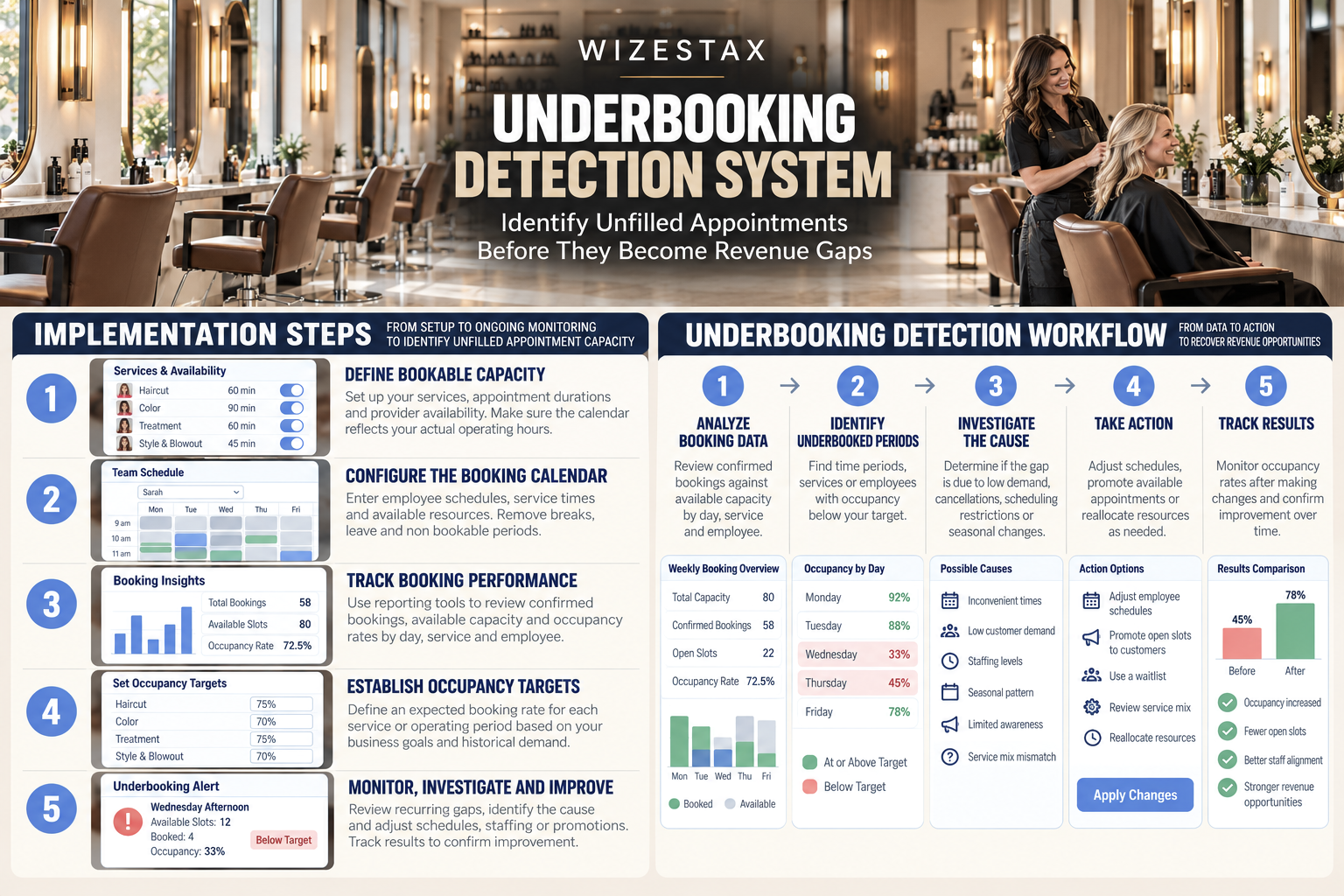
Step By Step Implementation Guide
The following setup demonstrates one implementation path using SimplyBook.me.
It is not a WIZESTAX recommendation or preferred Stax. SimplyBook.me is used because its appointment records, provider schedules and reporting features provide a clear example of measuring unused booking capacity.
Step 1: Define Bookable Capacity
Identify the services and appointment periods the business intends to make available to customers.
Capacity may be measured through:
Individual appointments
Employee service hours
Treatment room reservations
Class attendance spaces
Equipment reservations
Use a consistent measurement for each service category.
Step 2: Configure The Booking Calendar
Create or review the relevant services and service providers in SimplyBook.me.
Enter operating hours, appointment durations and provider availability.
Ensure unavailable periods are excluded from customer booking capacity.
Step 3: Verify Appointment Availability
Review each employee’s calendar to confirm that available appointment times reflect actual operating capacity.
Exclude employee breaks, approved leave, preparation periods and planned closures.
An unavailable appointment should not be counted as an underbooking opportunity.
Step 4: Enable Booking Insights
Review the Insights Custom Feature in SimplyBook.me.
Where available under the selected subscription, enable the feature and examine the dashboard charts covering bookings and provider availability.
Identify which measurements can support recurring occupancy reviews.
Step 5: Establish Occupancy Targets
Define an expected booking rate for each relevant service or operating period.
Targets should reflect historical demand, operating costs and scheduling requirements.
For example, a business may establish a provisional target of 75% occupancy for a particular service.
This is an internal operating benchmark, not a universal industry standard.
Step 6: Calculate Booking Occupancy
Use the following calculation:
Booking Occupancy (%) = Confirmed Booked Capacity ÷ Available Bookable Capacity × 100
For example:
Metric | Value |
|---|---|
Available appointments | 40 |
Confirmed appointments | 26 |
Unfilled appointments | 14 |
Booking occupancy | 65% |
Internal occupancy target | 75% |
The business is operating 10 percentage points below its chosen target.
This difference signals a potential capacity problem requiring investigation.
Step 7: Identify Recurring Gaps
Compare occupancy across similar days, services and employees.
Look for patterns that persist across multiple reporting periods.
Avoid treating a single quiet afternoon as evidence of a structural demand problem.
Step 8: Establish Underbooking Alerts
Define conditions that should trigger management review.
For example:
Occupancy falls below 60% for three comparable operating periods.
A class remains below its minimum attendance target.
A particular service experiences declining bookings over four weeks.
A recurring afternoon schedule has significantly more capacity than demand.
These are example business rules. Implementing automated alerts may require external reporting or automation tools.
Step 9: Investigate The Cause
Review each flagged period before changing operations.
Possible causes include inconvenient appointment times, insufficient customer demand, scheduling restrictions, seasonal changes or cancellations.
Determine whether the gap is temporary or recurring.
Step 10: Monitor Results
After making a scheduling or customer communication adjustment, compare subsequent occupancy with the original baseline.
Review whether the adjustment improved booking performance without creating unnecessary labor costs or reducing service quality.
Continue monitoring recurring patterns rather than focusing exclusively on isolated booking gaps.
Underbooking Cost Exposure Snapshot
Monthly Open Slots | 25% Filled | Potential Revenue |
|---|---|---|
40 | 10 | $1,000 |
80 | 20 | $2,000 |
120 | 30 | $3,000 |
Illustrative scenarios assume an average booking value of $100 and that 25% of previously unfilled slots become paid appointments. The figures represent potential gross booking revenue, not profit or guaranteed recovery. Actual results depend on customer demand, service costs, contribution margins and the ability to secure additional reservations.
WIZESTAX Diagnostic Scorecard
Category | Assessment |
|---|---|
Economic Problem | Unused bookable capacity may contribute to avoidable revenue gaps |
Signal Quality Required | High |
Automation Potential | Moderate To High |
Human Judgment Required | Moderate To High |
Data Dependency | Moderate |
Scalability | High |
Primary Value | Earlier visibility into recurring underbooking |
Primary Risk | Treating all unfilled appointments as recoverable revenue |
Common Mistakes
Mistake | Result |
|---|---|
Counting unavailable time as open capacity | Occupancy appears artificially low |
Ignoring seasonal demand patterns | Normal fluctuations trigger unnecessary action |
Measuring bookings without capacity | Demand cannot be evaluated against availability |
Using one target for every service | Different operating requirements are overlooked |
Reacting to isolated cancellations | Temporary gaps are mistaken for recurring problems |
Offering discounts without reviewing margins | Additional bookings may generate insufficient profit |
Ignoring employee scheduling constraints | Proposed changes may be difficult to deliver |
Failing to measure results | Businesses cannot determine whether adjustments worked |
Get New WIZESTAX Blueprints Every Monday
Subscribe to receive new WIZESTAX Blueprints covering Customer Retention, Marketing, Sales, Finance and Operations directly to your inbox.


