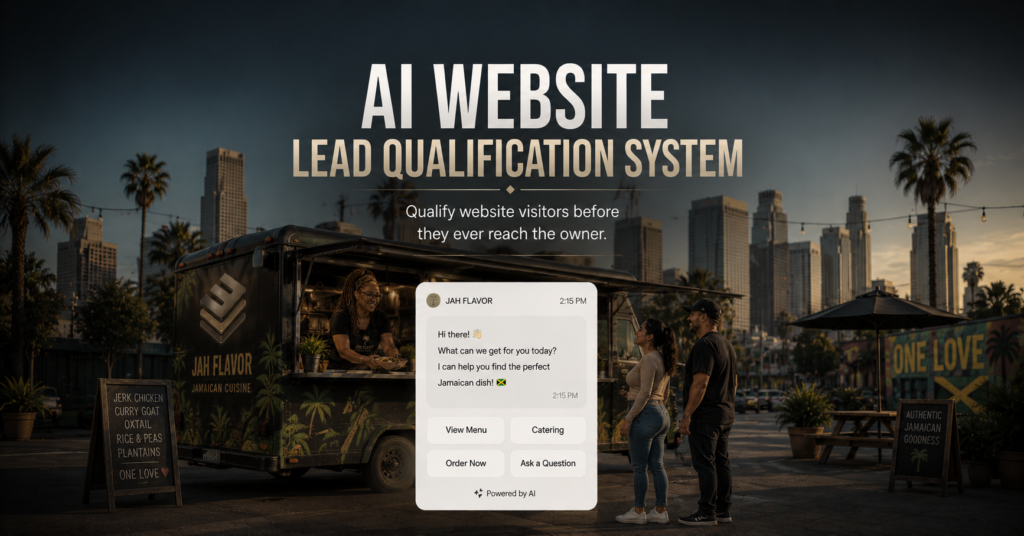
AI Website Lead Qualification System
Qualify Website Visitors Before They Consume Sales Time
Not every website inquiry represents the same opportunity. A visitor may be ready to buy, casually researching, outside the service area, requesting something the business does not provide, or missing information the team needs before deciding what should happen next. Without a qualification process, these very different inquiries often enter the same inbox and compete for the same employee attention. The original Blueprint identified this exact leak: owners can spend significant time sorting forms and answering inquiries that were never a good fit.
The AI Website Lead Qualification System creates a structured screening layer between a website visitor and the sales team. It collects a small amount of relevant information, evaluates that information against approved qualification rules, records the inquiry, and directs the visitor toward the appropriate next step. This Blueprint is not designed to replace sales judgment or automatically decide which customers deserve attention. Its purpose is to separate basic qualification that can follow defined rules from sales decisions that require a person.
Which Stax Fits Your Business
| Business Need | Stax | Software | Cost |
|---|---|---|---|
| Conversational website qualification with a lightweight setup | Starter Stax | Tidio | Varies By Plan And Usage |
| Flexible qualification connected to forms and existing business software | Growth Stax | Jotform + Make | Varies By Plan And Usage |
| Website qualification connected to a broader sales and support environment | Pro Stax | Intercom | Varies By Plan And Usage |
Pricing and capabilities change over time and should be confirmed directly with each software provider before purchase.
Software Linx
Starter
Growth
Pro
Blueprint Overview
| Metric | Value |
|---|---|
| Category | Lead Generation |
| Business Problem | Sales attention is consumed before basic website lead fit is understood |
| Primary Objective | Collect and evaluate basic qualification information before staff intervention |
| Core Inputs | Service requested, location, contact information and business specific qualification criteria |
| Setup Time | Approximately 45 To 120 Minutes |
| Difficulty | Beginner To Intermediate |
| Maintenance | Periodic qualification rule review |
| Best For | Businesses receiving meaningful website inquiry volume |
| Primary Output | Lead categorized and directed toward an appropriate next step |
The Hidden Revenue Leak
| Without This Blueprint | With This Blueprint |
|---|---|
| Every website inquiry receives similar attention | Basic fit can be evaluated first |
| Staff manually collect routine qualification information | Defined questions can collect information consistently |
| Poor fit inquiries consume sales time | Staff can focus attention where judgment creates value |
| Strong opportunities can become buried | Relevant inquiries can become easier to identify |
| Qualification varies between employees | Basic rules can be applied consistently |
| Lead information remains incomplete | Required qualification details can be collected earlier |
The economic problem is not simply that some website visitors are unqualified.
The larger leak is sales capacity being consumed before the business has enough information to know whether an inquiry deserves that capacity.
Advertising, search traffic, social media, referrals, and organic website visits can all generate inquiries.
If every inquiry requires an employee to manually determine service fit, location, timeline, and basic requirements, lead generation creates an additional screening workload alongside the opportunities it produces.
The purpose of qualification automation is to reduce that screening burden without allowing rigid rules to reject valuable opportunities incorrectly.
Business Impact Snapshot
| Area | Potential Impact |
|---|---|
| Sales Capacity | Routine screening can require less employee attention |
| Lead Information | Important qualification details can arrive earlier |
| Response Consistency | Visitors encounter the same basic qualification process |
| Opportunity Visibility | Appropriate leads can become easier to identify |
| Customer Experience | Poor fit visitors can receive a clear next step |
| Management | Qualification outcomes can become measurable |
The system should ask only questions that actually influence what happens next.
Every additional question creates friction.
Real World Example
An HVAC company receives website inquiries across several cities.
A visitor opens the website and asks for air conditioning repair.
The qualification process asks where the property is located.
The visitor provides a ZIP code inside the company’s service area.
The system asks whether the request involves residential or commercial equipment because the company currently services residential properties only.
The visitor selects residential and provides their contact information.
The inquiry satisfies the company’s basic qualification rules and is directed toward the approved booking or sales process.
Another visitor requesting commercial work would receive the business’s approved alternative response rather than occupying employee time before the mismatch is discovered.
The system did not determine which customer would ultimately purchase.
It established basic fit before requiring the sales team to investigate the inquiry manually.
WIZESTAX Stax Options
Starter Stax
Tidio
Best For
Businesses that want conversational website qualification and customer communication without building a larger custom automation architecture.
| Function | Software |
|---|---|
| Website Chat | Tidio |
| Automated Conversations | Tidio |
| AI Assistance | Tidio Lyro |
| Visitor Information | Tidio |
| Human Handoff | Tidio |
| Conversation Management | Tidio |
Advantages
| Benefit |
|---|
| Website conversations remain centralized |
| Visitors can provide information conversationally |
| Human assistance can remain available |
| Relatively lightweight implementation |
| Can also support routine website questions |
Limitations
| Limitation |
|---|
| Qualification rules require careful configuration |
| AI and usage limits depend on plan |
| Not a complete sales CRM |
| Complex routing may require additional integrations |
Growth Stax
Jotform + Make
Best For
Businesses that want structured qualification questions and flexible logic while keeping their existing CRM, scheduling platform, or sales software.
| Function | Software |
|---|---|
| Website Qualification Form | Jotform |
| Conditional Questions | Jotform |
| Qualification Logic | Jotform + Make |
| Automation | Make |
| Data Routing | Make |
| Destination | Existing CRM Or Business Software |
Advantages
| Benefit |
|---|
| Detailed qualification forms |
| Conditional logic can reduce irrelevant questions |
| Can connect to existing business software |
| Does not require replacing the current CRM |
| Qualification architecture remains flexible |
Limitations
| Limitation |
|---|
| Less conversational than dedicated chat |
| Multiple applications may be involved |
| More sophisticated routing requires configuration |
| Customer history may remain distributed |
Pro Stax
Intercom
Best For
Organizations with larger website conversation volume that need qualification connected to AI conversations, customer information, human routing, and broader sales or support processes.
| Function | Software |
|---|---|
| Website Messenger | Intercom |
| AI Conversations | Intercom |
| Customer Information | Intercom |
| Qualification | Intercom Workflows And Rules |
| Human Routing | Intercom |
| Conversation Management | Intercom |
Advantages
| Benefit |
|---|
| Conversational qualification and human communication remain connected |
| Suitable for larger conversation volumes |
| Strong routing capabilities |
| Can support more complex customer journeys |
| Sales and support teams can share customer context |
Limitations
| Limitation |
|---|
| More infrastructure than many small businesses require |
| Cost can increase with usage and capabilities |
| Requires careful workflow design |
| Complex sales organizations may still require a separate CRM |
How The Three Stax Differ
| Stax | Primary Approach |
|---|---|
| Tidio | Conversational qualification directly on the website |
| Jotform + Make | Structured qualification connected to existing software |
| Intercom | Qualification inside a broader conversational customer platform |
These are different implementation architectures rather than rankings.
Tidio fits businesses where qualification should feel primarily like a website conversation.
Jotform and Make fit businesses that prefer structured questions and want the resulting information routed into software they already use.
Intercom fits organizations where qualification is one part of a larger customer conversation and routing environment.
The appropriate architecture depends on website traffic, qualification complexity, existing software, sales team structure, and whether visitors are better served by conversational or structured screening.
Copy And Paste Qualification Questions
The qualification questions should be based on the actual decisions the business needs to make.
A service business might begin with:
Service
“What can we help you with today?”
Location
“What city or ZIP code is the service needed in?”
Timeline
“When are you hoping to have this completed?”
Relevant Service Detail
“Can you tell us a little more about what you need?”
Contact Information
“What is the best name and contact information for our team to use if we need to follow up?”
Do not automatically ask every visitor every question.
If a question does not affect qualification, routing, or the next step, consider removing it.
Copy And Paste AI Prompt
You are assisting a service business with basic website lead qualification.
Your purpose is to collect the information required to determine whether a website inquiry appears to match the business’s approved qualification rules.
Use only the service list, service area, qualification criteria, routing instructions and business information supplied to you.
Ask only questions that influence qualification or the appropriate next step.
Relevant information may include the requested service, location, timeline, important service details and customer contact information.
Keep questions short and conversational.
Do not pressure the visitor.
Never invent services, service areas, pricing, availability, guarantees, policies, appointment times or qualification rules.
Do not reject a lead based on information the business has not explicitly identified as a qualification criterion.
If the visitor clearly satisfies the approved qualification rules, provide the appropriate next step.
If the visitor clearly does not satisfy a rule, provide the approved response for that situation.
If information is incomplete, contradictory, unusual, or requires judgment, route the inquiry to a staff member rather than guessing.
Step By Step Implementation Guide
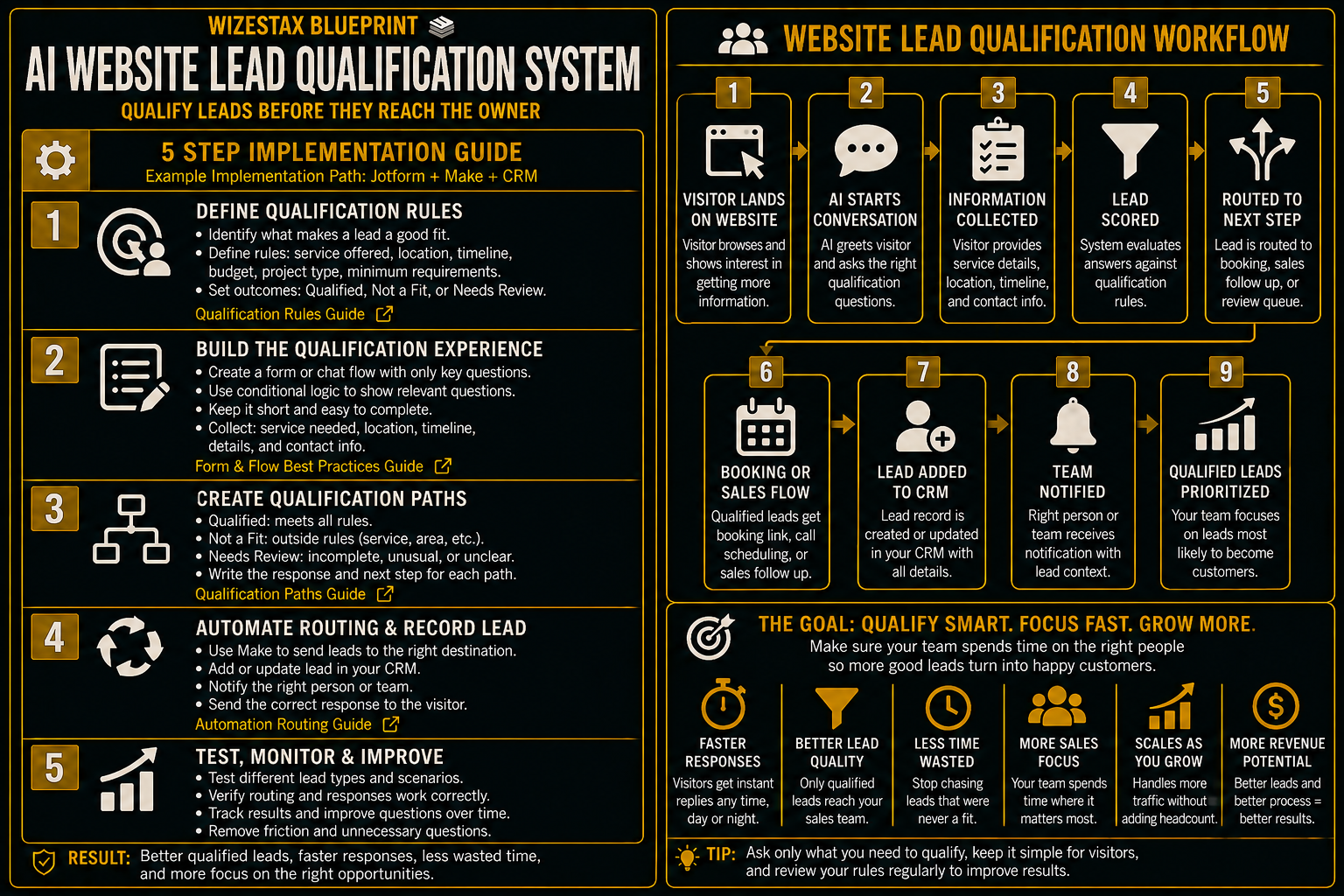
The following setup demonstrates one implementation path using Jotform and Make.
It is not a WIZESTAX recommendation or preferred Stax.
This architecture is used because it separates the qualification interface from the software that ultimately receives the lead. That makes it practical for businesses that already have a CRM or operational system they do not want to replace.
Step 1: Define The Qualification Rules
Before building the form, identify what actually determines basic fit.
Possible criteria include:
Service Requested
Does the business provide what the visitor needs?
Service Area
Is the customer located somewhere the business serves?
Customer Or Project Type
Does the business serve this type of customer or project?
Minimum Requirements
Are there legitimate requirements that must exist before the business can proceed?
Human Review Conditions
Which inquiries cannot safely be classified automatically?
Avoid using vague criteria such as “good lead.”
Every automated rule should connect to a real business decision.
Step 2: Build The Qualification Form
Create a Jotform containing only the information required for basic qualification.
Use conditional logic where appropriate so visitors see questions relevant to their previous answers.
For example, selecting one service can reveal questions specific to that service while unrelated questions remain hidden.
The goal is not to collect everything the business could eventually need.
That belongs in Customer Intake.
The goal here is to determine whether the inquiry should advance and where it should go.
Step 3: Create The Qualification Paths
Define what should happen for each supported outcome.
A simple architecture might include:
Potential Fit
The inquiry satisfies the defined basic criteria.
Clear Mismatch
The inquiry clearly falls outside an approved rule such as service area or service type.
Needs Human Review
The information is incomplete, unusual, contradictory, or cannot be evaluated safely using established rules.
Each outcome should have an approved next step.
A clear mismatch does not need to receive a harsh rejection. The business can simply explain the limitation or provide an appropriate alternative when one exists.
Step 4: Route The Lead With Make
Connect Jotform to Make.
When a submission arrives, use the qualification outcome to determine where the record should go.
A potential fit might enter the CRM or approved booking process.
A clear mismatch might be recorded without entering the primary sales queue.
An uncertain inquiry might create a task or notification for staff review.
The automation should preserve the information the visitor already provided so employees do not need to ask for it again.
Step 5: Test The Complete Qualification Path
Create test submissions representing different types of website visitors.
Test a strong potential fit.
Test a visitor outside the service area.
Test a service the business does not provide.
Test incomplete information.
Test an unusual inquiry requiring human judgment.
Confirm that each submission reaches the correct destination.
Verify that qualification rules do not accidentally reject an appropriate opportunity.
Test the form on desktop and mobile.
The system is ready when basic qualification can happen consistently without preventing uncertain or valuable opportunities from reaching a person.
Sales Capacity Snapshot
The economic value of this system is primarily the sales time spent manually screening inquiries before basic fit is understood.
Consider an illustrative business where manual qualification requires approximately 10 minutes per website inquiry.
At an illustrative staff value of $30 per hour:
| Monthly Website Inquiries | Screening Time Per Inquiry | Monthly Screening Time | Illustrative Staff Capacity |
|---|---|---|---|
| 25 | 10 Minutes | 4.2 Hours | $126 |
| 50 | 10 Minutes | 8.3 Hours | $249 |
| 100 | 10 Minutes | 16.7 Hours | $501 |
Illustrative scenario only. Actual inquiry volume, screening time, labor value and automation rates will vary.
This should not automatically be interpreted as direct cash savings.
The more important operational question is what employees can do with the capacity returned to them.
That time may become available for qualified sales conversations, estimates, customer service, operational work, or other activities where human attention creates greater value.
WIZESTAX Diagnostic Scorecard
| Category | Assessment |
|---|---|
| Economic Problem | Sales capacity is consumed before basic lead fit is understood |
| Qualification Rule Accuracy Required | Very High |
| Automation Potential | High |
| Human Judgment Required | Moderate |
| Customer Effort | Low To Moderate |
| Data Dependency | Moderate |
| Scalability | High |
| Primary Value | Reducing manual screening while improving lead organization |
| Primary Risk | Incorrect qualification rules filtering out valuable opportunities |
Common Mistakes
| Mistake | Result |
|---|---|
| Asking too many questions | Website visitors abandon the process |
| Using vague qualification criteria | Leads are classified inconsistently |
| Rejecting uncertain leads automatically | Valuable opportunities can be lost |
| Allowing AI to invent qualification rules | Business decisions become unreliable |
| Collecting full customer intake too early | Initial inquiry becomes unnecessarily difficult |
| Providing no human review path | Unusual opportunities become trapped |
| Ignoring mobile experience | Website qualification becomes harder to complete |
| Measuring qualified lead count without sales outcomes | Qualification activity is mistaken for business performance |
Related WIZESTAX Categories
| Category | Related Business Problem |
|---|---|
| Lead Generation | New Lead Response |
| Sales | Lead Contact Data Verification |
| Sales | High Value Lead Prioritization |
| Sales | Territory Lead Assignment |
| Operations | Customer Intake |
| Customer Service | FAQ And Customer Support |
These remain separate problems. The AI Website Lead Qualification System determines whether a website inquiry appears to satisfy defined basic fit criteria before significant sales attention is required. New Lead Response protects the period immediately after an inbound inquiry arrives. Lead Contact Data Verification checks whether the information required to contact a lead is usable. High Value Lead Prioritization determines which legitimate opportunities may deserve greater sales attention. Territory Lead Assignment determines which employee, team, or location should own an opportunity. Customer Intake collects the more detailed operational information required after the customer reaches the appropriate stage. FAQ And Customer Support answers routine informational questions rather than qualifying sales opportunities. Each Blueprint therefore protects a different economic or operational leak.
Get New WIZESTAX Blueprints Every Monday
Subscribe to receive new WIZESTAX Blueprints covering Customer Retention, Marketing, Sales, Finance and Operations directly to your inbox.