

Campaign Lead Quality Tracking System
Identify Campaigns Generating Leads That Are More Likely To Become Real Customers
Marketing campaigns can produce plenty of leads without producing many good prospects. A campaign might generate 100 form submissions while another generates only 30. Looking at lead volume alone makes the first campaign appear more productive. Once the business examines customer fit, engagement, qualification and eventual sales outcomes, however, the smaller campaign may be supplying substantially stronger opportunities.
The Campaign Lead Quality Tracking System connects campaign origin with consistent lead quality signals so businesses can see whether campaigns are attracting the kinds of prospects they actually want.
The purpose is not to predict with certainty which individual lead will become a customer. Lead quality depends on the business, its ideal customer, the information available and what happens after the initial inquiry. Current CRM scoring systems reflect this by allowing businesses to combine characteristics with behavioral signals rather than relying on lead volume alone. HubSpot, for example, supports separate fit and engagement scores as well as combined scoring. (HubSpot Knowledge Base)
Which Stax Fits Your Business
| Business Need | Stax | Software | Cost |
|---|---|---|---|
| Custom qualification rules inside an SMB CRM | Starter Stax | Zoho CRM | Varies by edition |
| Behavioral scoring connected with marketing automation | Growth Stax | ActiveCampaign | Varies by plan and contacts |
| Combined fit and engagement scoring across the customer lifecycle | Pro Stax | HubSpot Marketing Hub | Varies by edition and users |
Pricing and capabilities change over time and should be confirmed directly with each software provider before purchase.
Software Linx
Starter: Zoho CRM
Growth: ActiveCampaign
Blueprint Overview
| Metric | Value |
|---|---|
| Category | Marketing And Sales |
| Business Problem | Campaigns generate leads without enough visibility into whether those leads match the business and progress toward becoming customers |
| Primary Objective | Compare campaign lead quality using consistent qualification signals |
| Core Signals | Campaign source, customer fit, engagement, qualification status and sales progression |
| Setup Time | Approximately 60 to 120 minutes |
| Difficulty | Intermediate |
| Maintenance | Monthly review with periodic scoring validation |
| Best For | Businesses running multiple lead generation campaigns |
| Primary Output | Campaign lead quality profile and investigation trigger |
The Hidden Revenue Leak
| Without This Blueprint | With This Blueprint |
|---|---|
| Campaigns are compared mainly by lead volume | Campaigns can be compared using lead quality |
| Cheap leads can appear automatically attractive | Cost can be considered alongside qualification |
| Sales receives poorly matched inquiries | Fit criteria can identify stronger prospects |
| Engagement is viewed separately from campaign origin | Campaign and engagement data remain connected |
| Marketing optimizes toward form submissions | Marketing can examine downstream lead behavior |
| Weak campaigns can continue generating noise | Persistent quality differences become visible |
A campaign producing fewer leads is not automatically weaker. The relevant question is whether those leads possess characteristics and behaviors that matter to the business.
Business Impact Snapshot
| Area | Potential Impact |
|---|---|
| Marketing | Campaigns can be evaluated beyond raw lead counts |
| Sales | Poorly matched inquiries become easier to identify |
| Budget Allocation | Lead quality can provide additional context before reallocating spending |
| Qualification | Consistent criteria reduce arbitrary lead assessment |
| Customer Acquisition | Campaigns attracting stronger prospects become more visible |
| Management | Marketing and sales can work from a shared definition of lead quality |
Real World Example
A home improvement company runs two lead generation campaigns.
Campaign A produces 100 leads.
Campaign B produces 40.
Campaign A appears stronger when the business looks only at lead volume.
After the company applies the same qualification criteria to both campaigns, it finds that many Campaign A leads fall outside its service area, request services the company does not provide, or never respond after submitting the form.
Campaign B produces fewer inquiries, but a much larger portion fit the service area, request appropriate work and continue into sales conversations.
The system does not automatically declare Campaign B the better campaign.
It reveals that lead count and lead quality are describing different things, giving the business more information before changing either campaign.
WIZESTAX Stax Options
Starter Stax
Zoho CRM
Best For
Businesses that want customizable qualification rules directly inside a CRM without requiring a more elaborate marketing intelligence environment.
| Function | Software |
|---|---|
| Lead Records | Zoho CRM |
| Qualification | Scoring Rules |
| Customer Fit | Field Criteria |
| Engagement | Signal And Channel Criteria |
| Campaign Context | CRM Campaign Data |
| Automation | Workflow Rules |
Zoho CRM scoring rules can qualify prospects using attributes, behaviors, insights and other customer information. Businesses can manually define scoring criteria, and Zoho also supports scoring across different channels and factors. (Zoho Corporation)
Advantages
| Benefit |
|---|
| Qualification criteria can reflect the individual business |
| Positive and negative signals can influence scores |
| Lead information remains inside the CRM |
| Different scoring models can support different processes |
| Scores can contribute to automation |
Limitations
| Limitation |
|---|
| Scoring rules require thoughtful setup |
| Available scoring functionality varies by edition |
| Poor qualification criteria produce misleading scores |
| Campaign comparison still requires consistent campaign tracking |
| Scores require periodic validation against actual outcomes |
Growth Stax
ActiveCampaign
Best For
Businesses that want lead quality to respond dynamically to customer behavior and marketing engagement.
| Function | Software |
|---|---|
| Contact Management | ActiveCampaign |
| Lead Qualification | Contact Scoring |
| Behavioral Signals | Engagement Rules |
| Automation | ActiveCampaign Automations |
| Sales Progression | CRM And Deals |
| Qualification Threshold | Score Based Automation |
ActiveCampaign contact scoring assigns numerical values using rules based on available contact information and behavior. Scores can add or subtract points and can expire over time, allowing older engagement to carry less weight. ActiveCampaign also supports deal scoring for evaluating and prioritizing opportunities. (ActiveCampaign Help Center)
Advantages
| Benefit |
|---|
| Lead scores can change as customer behavior changes |
| Positive and negative criteria can affect qualification |
| Engagement can become part of campaign quality analysis |
| Score thresholds can trigger automation |
| Marketing activity and qualification can operate in the same environment |
Limitations
| Limitation |
|---|
| Engagement does not necessarily indicate purchase intent |
| Scoring rules need periodic review |
| Campaign attribution must remain accurate |
| High activity can inflate poorly designed scores |
| Sales feedback is still necessary to validate lead quality |
Pro Stax
HubSpot Marketing Hub
Best For
Businesses that want campaign activity, CRM information, customer fit and engagement incorporated into a broader lifecycle measurement system.
| Function | Software |
|---|---|
| CRM | HubSpot Smart CRM |
| Marketing | Marketing Hub |
| Customer Fit | Fit Scores |
| Engagement | Engagement Scores |
| Combined Qualification | Combined Scores |
| Analysis | Segments, Workflows And Reports |
HubSpot currently supports engagement scores based on interactions, fit scores based on record characteristics, and combined scores incorporating both. Those score properties can then be used in segments, workflows and reports. (HubSpot Knowledge Base)
HubSpot also allows scoring criteria to incorporate actions such as campaign interactions, while fit criteria can use properties such as industry, company size and other customer characteristics. (HubSpot Knowledge Base)
Advantages
| Benefit |
|---|
| Fit and engagement can be measured separately |
| Combined scoring provides another qualification view |
| Campaign activity remains connected with CRM records |
| Scores can participate in workflows and reporting |
| Marketing and sales can work from shared customer information |
Limitations
| Limitation |
|---|
| Advanced scoring requires qualifying subscriptions |
| More sophisticated configuration can increase complexity |
| A numerical score does not guarantee conversion |
| Historical data quality affects scoring usefulness |
| Scoring models require validation as the business changes |
How The Three Stax Differ
| Stax | Primary Approach |
|---|---|
| Zoho CRM | Custom CRM qualification rules using lead attributes and interactions |
| ActiveCampaign | Behavioral lead scoring connected with marketing automation |
| HubSpot Marketing Hub | Combined customer fit and engagement scoring across the lifecycle |
These are different implementation architectures rather than rankings.
The appropriate architecture depends on what the business considers a quality lead, how much behavioral information it collects, and whether marketing and sales data already live inside the same system.
Copy And Paste Lead Quality Alert
Campaign lead quality review for {{campaign_name}}. During {{period}}, the campaign generated {{lead_count}} leads. {{qualified_lead_count}} met the current qualification criteria. Review customer fit, engagement and sales progression before changing campaign spending or targeting.
Copy And Paste Campaign Review
Review leads generated by {{campaign_name}} during {{period}} using the same qualification criteria applied to other campaigns. Compare total leads, qualified leads, customer fit, meaningful engagement and available sales outcomes. Identify meaningful differences without assuming that the campaign producing the most leads is producing the strongest leads.
Copy And Paste AI Prompt
You are assisting a small business with campaign lead quality analysis.
Review the leads associated with each marketing campaign.
Apply the same qualification criteria to every campaign.
Compare total lead volume with qualified lead volume.
Examine customer fit, meaningful engagement and sales progression where those data are available.
Identify campaigns producing a high proportion of leads that do not meet the business qualification criteria.
Do not treat clicks, form submissions or engagement alone as proof of lead quality.
Do not assume the campaign producing the most leads is the strongest campaign.
Do not assume a numerical lead score guarantees that a prospect will become a customer.
Do not invent missing information.
If the available information is insufficient to compare campaign lead quality, state what additional information is required.
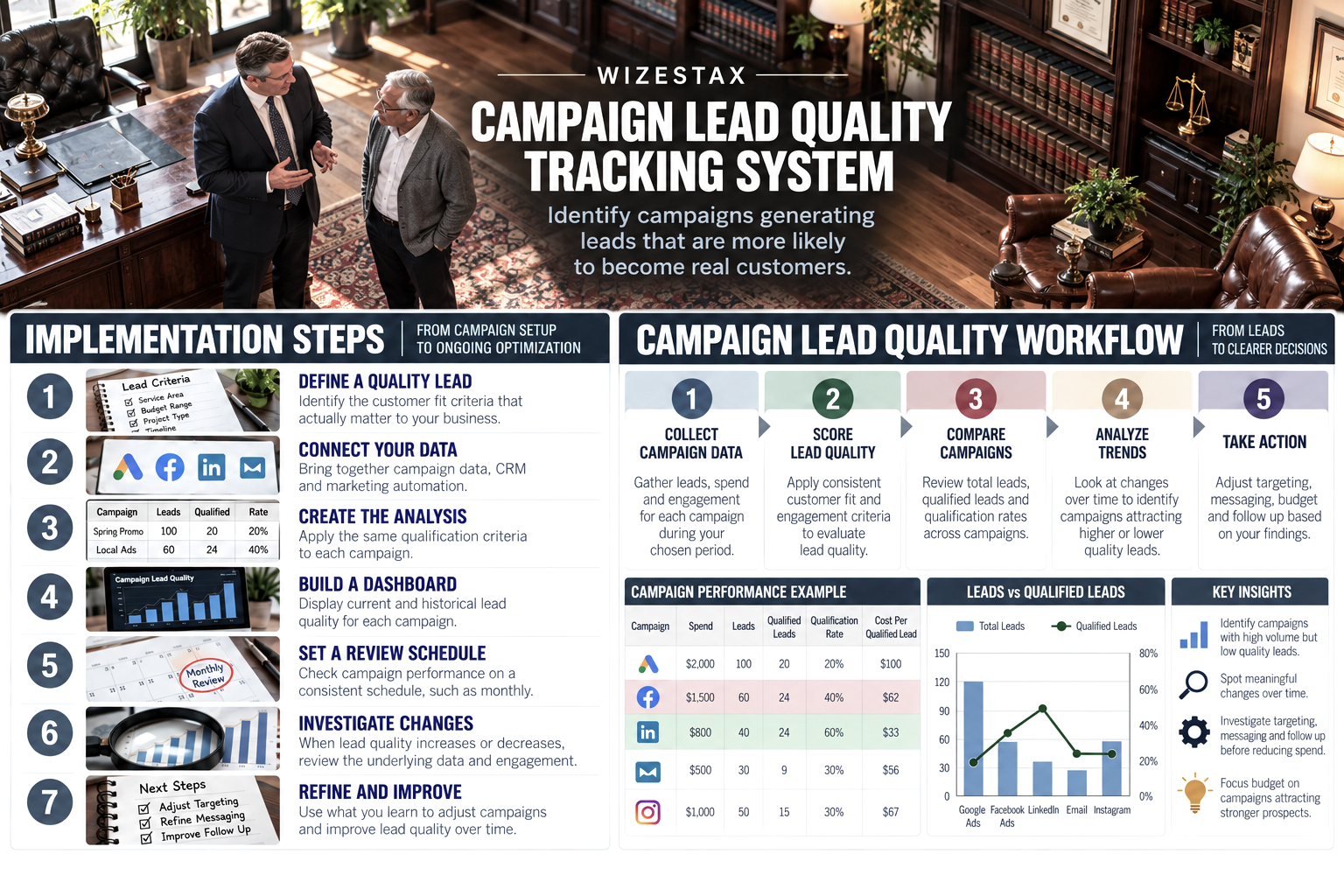
Step By Step Implementation Guide
The following setup demonstrates one implementation path using Zoho CRM.
It is not a WIZESTAX recommendation or preferred Stax.
Zoho CRM is used here because its customizable scoring rules provide a relatively straightforward example of defining lead quality using information a small business already collects about its prospects. Zoho allows scoring rules to consider record characteristics and interactions across supported channels. (Zoho Corporation)
Step 1: Define A Quality Lead
Start with the characteristics that actually matter to the business.
For a local service company, these could include service area, requested service, budget range, project timing and whether the person has provided valid contact information.
For a B2B company, the criteria could instead include industry, company size, job responsibility and business need.
The definition should reflect actual customer fit rather than characteristics that merely make a lead convenient to contact.
Step 2: Identify Meaningful Behavior
Determine which actions provide additional evidence of interest.
Examples could include responding to an email, requesting pricing, scheduling a consultation, returning to an important page or having a meaningful sales conversation.
Zoho scoring rules can incorporate different customer interactions and channel signals when the relevant integrations and features are available. (Zoho Corporation)
Step 3: Preserve Campaign Origin
Make sure every lead record retains the campaign responsible for generating the inquiry.
Use consistent campaign names so leads can later be grouped accurately.
A lead without reliable campaign attribution cannot contribute much to campaign level quality analysis.
Step 4: Build The Scoring Rules
Assign points to characteristics and behaviors associated with stronger prospects.
Subtract points where appropriate for signals that indicate poor fit.
The objective is not to create the most complicated score possible.
It is to create a repeatable qualification method that can be applied consistently across campaign leads.
Step 5: Establish Qualification Ranges
Create practical ranges for interpreting the resulting scores.
For example:
Needs Review
Potential Fit
Qualified
These ranges are operating categories, not predictions.
A lead crossing a threshold should trigger the appropriate review or workflow rather than being treated as guaranteed revenue.
Step 6: Compare Campaign Quality
At the end of the review period, compare campaigns using consistent measures.
A simple view might contain:
Total Leads
Qualified Leads
Qualification Rate
Average Lead Score
Sales Conversations
Customers
This allows the business to see whether campaign volume and campaign quality are moving together.
Step 7: Validate Against Real Outcomes
Periodically compare the scoring model with what happened afterward.
If supposedly strong leads rarely progress while lower scoring leads regularly become customers, the model needs adjustment.
The score should learn from business reality rather than becoming a permanent definition of reality.
Campaign Lead Quality Snapshot
| Campaign Leads | Qualified Leads | Qualification Rate |
|---|---|---|
| 100 | 20 | 20% |
| 60 | 24 | 40% |
| 40 | 24 | 60% |
Illustrative example only. A higher qualification rate does not establish campaign profitability or guarantee future sales. Campaign cost, customer value, conversion rate and other factors still require separate analysis.
WIZESTAX Diagnostic Scorecard
| Category | Assessment |
|---|---|
| Economic Problem | Marketing campaigns can generate large numbers of poorly matched leads that consume marketing and sales resources |
| Signal Quality Required | High |
| Automation Potential | High |
| Human Judgment Required | Moderate To High |
| Data Dependency | High |
| Scalability | High |
| Primary Value | Visibility into the quality of leads produced by individual campaigns |
| Primary Risk | Treating an imperfect scoring model as objective truth |
Common Mistakes
| Mistake | Result |
|---|---|
| Measuring only lead volume | Large campaigns can appear stronger regardless of lead quality |
| Using different criteria between campaigns | Comparisons become unreliable |
| Treating engagement as purchase intent | Active prospects can be mistaken for qualified prospects |
| Never using negative qualification signals | Poor fit leads can receive inflated scores |
| Losing campaign attribution | Lead quality cannot be traced reliably to campaigns |
| Never validating the scoring model | Outdated assumptions become embedded in the system |
| Treating scores as predictions | Human judgment and actual sales outcomes are ignored |
Get New WIZESTAX Blueprints Every Monday
Subscribe to receive new WIZESTAX Blueprints covering Customer Retention, Marketing, Sales, Finance and Operations directly to your inbox.