
Customer Consent Tracking System
Identify Missing, Outdated And Withdrawn Customer Permissions Before Unauthorized Communications Or Data Processing Occur
Small businesses collect customer permissions through website forms, newsletter subscriptions, online purchases and account registrations. These interactions can establish permission for specific activities, but the resulting records are not always maintained consistently.
A customer may subscribe to promotional emails while declining other forms of communication. Another customer may accept website analytics cookies but reject advertising trackers. Someone who previously agreed to receive marketing messages may later withdraw that permission.
Problems arise when the business cannot determine what the customer authorized, when permission was recorded or whether a later decision replaced the original choice.
The Customer Consent Tracking System creates a documented process for collecting, recording, updating and honoring customer permissions.
Its purpose is to prevent business activities from continuing under permissions that are missing, invalid, withdrawn or no longer applicable.
Software Linx
Starter: Brevo
Growth: CookieYes
Pro: Termly
Blueprint Overview
| Metric | Value |
|---|---|
| Category | Customer Data And Compliance |
| Business Problem | Permissions are missing or inconsistently maintained |
| Primary Objective | Track and honor current customer consent |
| Core Signals | Consent status, purpose, timestamp and withdrawal |
| Setup Time | Approximately 3 to 6 hours |
| Difficulty | Intermediate |
| Maintenance | Weekly review and exception monitoring |
| Best For | Businesses collecting digital customer permissions |
| Primary Output | Consent records and permission exceptions |
The Hidden Revenue Leak
| Without This Blueprint | With This Blueprint |
|---|---|
| Permission history is unclear | Consent events are recorded |
| Unsubscribes are missed | Withdrawal status is tracked |
| Separate tools hold conflicting permissions | Systems are checked for consistency |
| Marketing lists contain uncertain contacts | Permission gaps are identified |
| Consent evidence is difficult to retrieve | Records support investigation |
| Tracking preferences are overlooked | Website choices are maintained |
Customer consent failures can create expenses that do not appear in ordinary marketing or administrative reports.
An employee may import an old customer list into an email platform without knowing which contacts previously withdrew permission. A website may continue loading advertising scripts after a visitor declines tracking. A customer may request removal from promotional communications while another platform continues sending messages.
These situations can generate complaints, investigation costs, corrective work and potential regulatory exposure.
The underlying problem is not necessarily the absence of a consent form. A business may collect permission correctly but fail to preserve the record or honor later changes.
Consent tracking also requires distinguishing between activities that depend on consent and activities permitted under another applicable legal basis.
A customer withdrawing marketing consent does not automatically prohibit every necessary service communication. Equally, an existing customer relationship does not automatically authorize every marketing channel.
The system must account for the purpose of the activity, the applicable requirements and the customer’s current permission status.
Business Impact Snapshot
| Area | Potential Impact |
|---|---|
| Administrative Labor | Less time reconstructing consent history |
| Marketing | Fewer unauthorized contacts |
| Customer Trust | Greater control over preferences |
| Compliance | Better permission documentation |
| Data Management | Clearer consent status |
| Operations | Faster investigation of exceptions |
Real World Example
A regional outdoor equipment retailer operates three stores and an ecommerce website.
Customers can join its email newsletter, register for promotional offers and browse products online.
The retailer uses an email marketing platform and several website analytics tools.
A customer subscribes to the newsletter during an online purchase. Several months later, the customer unsubscribes.
The email platform records the withdrawal, but an employee later imports an older promotional contact list that still contains the customer’s address.
Meanwhile, the website has a separate consent banner for analytics and advertising cookies.
Without a coordinated process, employees may have difficulty determining which permissions apply to each activity.
The retailer establishes a Customer Consent Tracking System.
Email subscription records remain associated with the marketing platform. Website tracking decisions are maintained through a dedicated consent management tool.
The business documents how withdrawals are processed, which systems must be updated and how permission evidence can be retrieved.
A marketing contact whose status cannot be established is withheld from consent dependent campaigns until the business determines whether an appropriate legal basis exists.
The system does not eliminate the need for employee oversight or legal review. It reduces uncertainty about customer choices and makes permission failures easier to investigate.
WIZESTAX Stax Options
Starter Stax
Brevo
Best For
Small businesses that need to collect and maintain consent for email marketing and customer subscription preferences.
| Function | Software |
|---|---|
| Consent Collection | Signup Forms |
| Permission Fields | GDPR Fields |
| Email Confirmation | Double Opt In |
| Consent Records | Contact Profiles |
| Topic Preferences | Consent Groups |
| Withdrawal | Unsubscribe Management |
Brevo provides email marketing tools that support consent collection through signup forms, confirmation processes and contact records.
Businesses can configure forms with GDPR consent fields and provide information explaining the communications customers are agreeing to receive.
Double opt in adds a confirmation step that records whether the subscriber verified the subscription request.
Brevo also supports consent groups, allowing subscribers to select particular communication topics and update those preferences later.
Contact records can contain subscription information and supporting consent evidence.
For a Customer Consent Tracking System, Brevo is most relevant when the business primarily needs to control marketing communications.
It does not replace a dedicated website consent management platform for unrelated advertising scripts and cookie categories.
Advantages
| Benefit |
|---|
| Connected email consent collection |
| Double opt in confirmation |
| Subscription preference management |
| Contact level consent information |
| Unsubscribe processing |
Limitations
| Limitation |
|---|
| Primarily focused on marketing communications |
| Website tracking needs separate controls |
| Imported contacts require permission review |
| Consent fields require correct configuration |
| External messaging systems may remain separate |
Growth Stax
CookieYes
Best For
Businesses that need to collect and document visitor decisions about website cookies and tracking technologies.
| Function | Software |
|---|---|
| Consent Collection | Cookie Banner |
| Visitor Choices | Preference Center |
| Cookie Discovery | Cookie Scanner |
| Consent Records | Consent Log |
| Evidence Retrieval | Proof Of Consent |
| Reporting | Consent Reports |
CookieYes provides a dedicated consent management platform for websites.
Its cookie banner allows visitors to accept, reject or customize available tracking categories according to the configured consent experience.
The platform can record visitor decisions in a consent log containing information such as consent status, consent ID and date.
Businesses can retrieve individual proof of consent records and export consent logs for review.
Cookie scanning and blocking capabilities help businesses identify and control tracking technologies according to their configuration.
This approach is relevant when a business needs to demonstrate how website visitors interacted with tracking permissions.
CookieYes does not independently manage every marketing subscription or customer communication permission.
Advantages
| Benefit |
|---|
| Dedicated website consent controls |
| Recorded visitor decisions |
| Downloadable consent evidence |
| Cookie scanning capabilities |
| Configurable visitor preferences |
Limitations
| Limitation |
|---|
| Focused on website tracking |
| Does not replace marketing consent records |
| Requires accurate cookie categorization |
| Features and retention vary by plan |
| Incorrect installation can leave scripts active |
Pro Stax
Termly
Best For
Businesses that need a broader website privacy management environment combining consent records, policy tools and configurable regional experiences.
| Function | Software |
|---|---|
| Consent Collection | Consent Banner |
| Preference Management | Preference Center |
| Consent History | Consent Logs |
| Tracking Discovery | Website Scanner |
| Privacy Documentation | Policy Generators |
| Regional Controls | Consent Rules |
Termly provides website consent management capabilities alongside privacy documentation tools.
Businesses can configure consent banners and preference centers to collect visitor decisions about website tracking.
Consent records can preserve information about visitor preferences, timestamps and the website where the interaction occurred.
Termly also supports cookie scanning, configurable regional consent experiences and tools for generating privacy policies.
This architecture is relevant when a business wants to maintain website consent records and associated privacy documentation within one environment.
Its broader functionality does not mean it automatically tracks every type of customer permission.
Marketing subscriptions, telephone communications and other consent categories may still require dedicated systems.
Advantages
| Benefit |
|---|
| Website consent record management |
| Customizable preference centers |
| Regional consent configurations |
| Privacy policy tools |
| Consent history and reporting |
Limitations
| Limitation |
|---|
| Primarily designed for website privacy |
| Advanced capabilities require paid plans |
| Regional settings require careful review |
| Does not replace all communication consent tools |
| Legal requirements still need independent evaluation |
How The Three Stax Differ
Each platform addresses a different operational requirement within customer consent management.
Brevo
Focuses on marketing subscription permissions. It connects consent collection, subscriber confirmation, preference management and unsubscribe processing to an email marketing environment.
CookieYes
Focuses on website tracking permissions. It records visitor decisions about cookies and provides tools for controlling tracking technologies and retrieving consent evidence.
Termly
Combines website consent management with privacy documentation and configurable regional controls. It is suited to businesses seeking a broader website privacy management environment.
These systems are not interchangeable.
A business may require more than one consent management process because permission to receive promotional emails is different from permission to activate advertising trackers.
The appropriate architecture depends on the activities being authorized and the systems responsible for honoring those decisions.
Copy And Paste Consent Exception Alert
Customer consent review required.
Customer or Visitor ID: {{record_id}}
Consent Purpose: {{consent_purpose}}
Communication Channel: {{channel}}
Current Status: {{consent_status}}
Last Recorded Change: {{change_date}}
Source System: {{source_system}}
Exception: {{exception_type}}
Review the available permission evidence and determine whether the intended activity is authorized under the applicable requirements.
If permission cannot be established for a consent dependent activity, prevent that activity until the issue is resolved.
Check whether a withdrawal or preference change must be applied to additional connected systems.
Document the investigation and resulting action.
Copy And Paste Customer Preference Confirmation
Subject: Your Communication Preferences
Hello {{customer_name}},
We have received your request to update your communication preferences.
Requested change: {{preference_change}}
Current status: {{current_status}}
Your updated preferences will be applied to the relevant communication services.
You can contact our team if you have questions about your preferences or how your information is used.
Thank you.
Copy And Paste AI Prompt
You are assisting a small business with customer consent record monitoring.
Review the consent records, subscription statuses, withdrawal requests and communication activity provided.
Identify records where required consent evidence is missing, inconsistent or outdated.
Compare current permissions with recorded withdrawal and preference changes.
Identify communications or tracking activities that may conflict with documented customer choices.
Separate marketing permissions from necessary service communications and other activities that may rely on different legal bases.
Do not assume that a purchase, website visit or existing customer relationship automatically authorizes every marketing activity.
Do not treat a previous consent record as current when a later withdrawal exists.
Do not invent consent events, timestamps or legal authorization.
Flag uncertain legal classifications for qualified human review.
Present findings in a table containing record ID, activity, consent purpose, recorded status, latest change, exception and required action.
If the available records cannot establish authorization, identify the missing evidence.
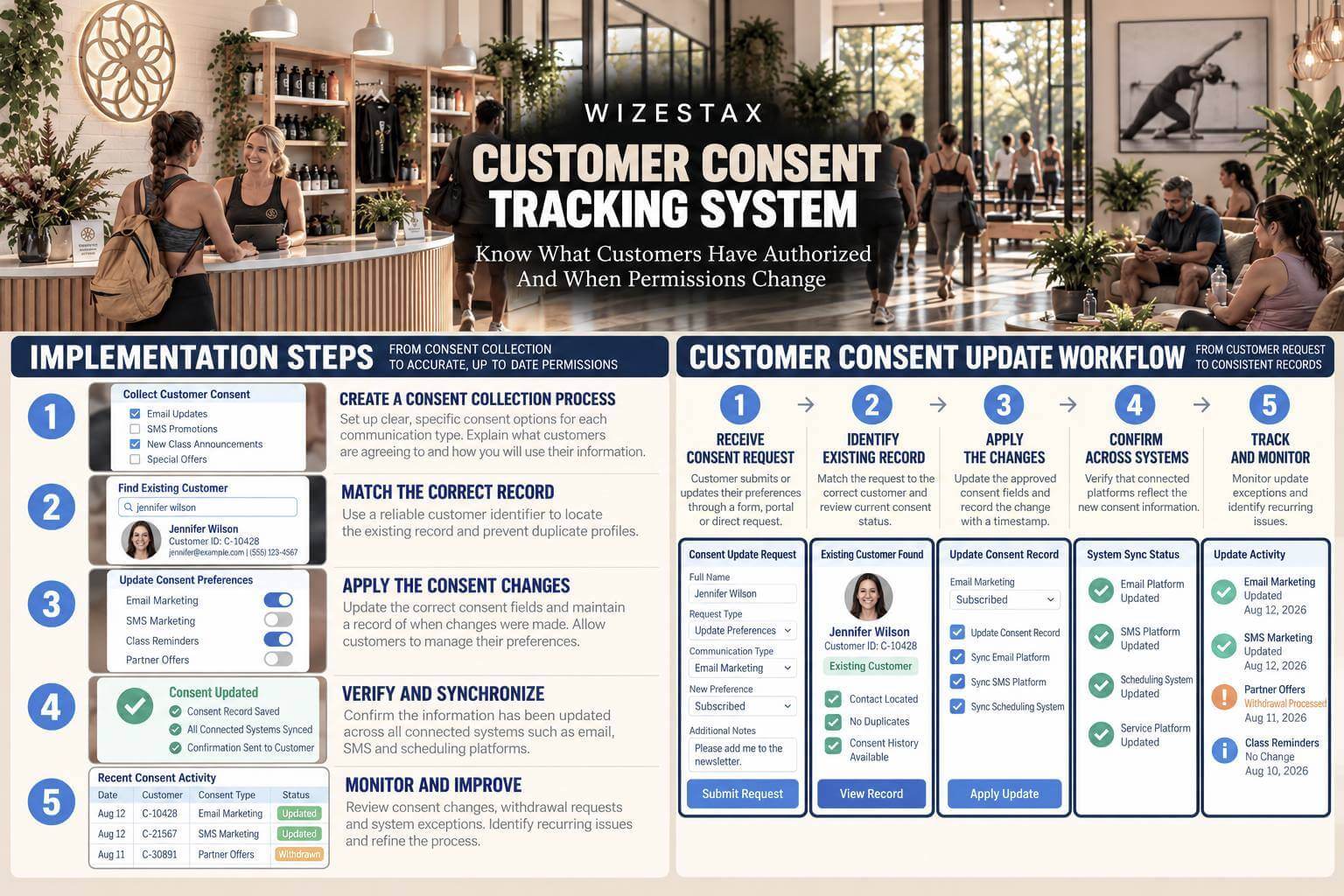
Step By Step Implementation Guide
The following setup demonstrates one implementation path using Brevo.
It is not a WIZESTAX recommendation or preferred Stax.
Brevo is used because its signup forms, double opt in process and subscription management provide a clear example of recording and honoring marketing permissions.
Step 1: Identify Consent Dependent Activities
Review the ways the business communicates with customers.
Identify which activities require consent under the applicable laws and circumstances.
Examples may include:
Promotional Email
Marketing Newsletters
SMS Promotions
Optional Product Updates
Partner Marketing
Selected Customer Campaigns
Do not automatically classify transactional or necessary service messages as promotional communications.
Step 2: Define Permission Categories
Establish separate permission categories where customers are offered distinct choices.
| Category | Purpose |
|---|---|
| Newsletter | General updates |
| Promotions | Marketing offers |
| Product News | Product announcements |
| Events | Event invitations |
| Partner Offers | Third party promotions |
The categories should reflect actual business activities.
Do not combine unrelated permissions into one broad agreement when separate choices are required.
Step 3: Create A Consent Collection Form
Open Brevo and navigate to Marketing, then Forms.
Create a signup form for the intended communication program.
Include the contact information required for the subscription.
Add appropriate GDPR fields where relevant and clearly describe the communication purpose.
Review the wording and ensure the customer’s choice is recorded appropriately.
Step 4: Configure Double Opt In
Configure the form’s confirmation settings.
Select double opt in when appropriate for the subscription process.
Create a confirmation email that allows subscribers to verify their request.
Ensure the business retains sufficient information about the consent wording and confirmation process.
Step 5: Establish Subscription Records
Review the contact attributes and subscription information maintained in Brevo.
| Field | Purpose |
|---|---|
| Contact ID | Identifies subscriber |
| Consent Purpose | Defines permission |
| Signup Source | Identifies collection |
| Consent Timestamp | Records event |
| Subscription Status | Shows current state |
| Withdrawal Date | Records removal |
Confirm which information Brevo records automatically and whether additional attributes or documentation are required.
Step 6: Configure Preference Management
Where appropriate, create consent groups for different communication topics.
Allow subscribers to update their preferences through supported subscription management features.
Ensure the business understands the difference between individual consent group changes and a global unsubscribe.
Test both processes before using them in live campaigns.
Step 7: Test Consent Collection
Create test contacts and submit several subscription scenarios.
| Test | Expected Result |
|---|---|
| Valid signup | Consent recorded |
| Unconfirmed signup | Confirmation pending |
| Topic preference change | Selected group updated |
| Unsubscribe | Marketing stopped |
| Unknown permission | Review required |
| Duplicate contact | Status investigated |
Confirm that contacts without the necessary authorization are excluded from relevant campaigns.
Step 8: Review Existing Contacts
Examine imported and previously collected contacts.
Identify which records contain sufficient permission evidence for their intended marketing activities.
Separate records with uncertain authorization from contacts whose permissions can be established.
Do not send promotional reconfirmation messages to contacts who have already withdrawn permission or otherwise lack the required authorization.
Step 9: Verify Connected Systems
Identify external platforms that send marketing communications.
Determine how subscription changes and withdrawals reach those systems.
A customer unsubscribing in one platform does not guarantee that every separate communication system has received the change.
Test synchronization where integrations are available.
Step 10: Monitor Consent Exceptions
Review consent collection failures, disputed subscriptions, incomplete records and withdrawal processing.
Investigate recurring problems with forms, imports and connected communication systems.
Maintain a documented process for resolving exceptions and preserving appropriate evidence.
Customer Consent Administration Cost Exposure Snapshot
| Monthly Reviews | Review Hours | Labor Cost |
|---|---|---|
| 50 | 5 | $125 |
| 100 | 10 | $250 |
| 200 | 20 | $500 |
Illustrative scenarios assuming six minutes of administrative review per consent exception and labor valued at $25 per hour. These figures represent potential review costs, not regulatory penalties or guaranteed savings. Actual costs depend on exception complexity, business procedures and applicable requirements.
WIZESTAX Diagnostic Scorecard
| Category | Assessment |
|---|---|
| Economic Problem | Consent errors create recovery and compliance exposure |
| Signal Quality Required | High |
| Automation Potential | High |
| Human Judgment Required | High |
| Data Dependency | High |
| Scalability | High |
| Primary Value | Verifiable customer permission status |
| Primary Risk | Treating incomplete records as authorization |
Common Mistakes
| Mistake | Result |
|---|---|
| Treating every signup as consent | Permission may be invalid |
| Combining unrelated permissions | Customer choices become unclear |
| Ignoring withdrawal requests | Unauthorized activity may continue |
| Failing to preserve consent evidence | Permission becomes difficult to verify |
| Importing outdated contact lists | Previous withdrawals may be lost |
| Confusing cookie consent with email consent | Incorrect permissions are applied |
| Assuming tools guarantee compliance | Legal obligations remain unresolved |
| Ignoring connected systems | Conflicting permissions persist |
Get New WIZESTAX Blueprints Every Monday
Subscribe to receive new WIZESTAX Blueprints covering Customer Retention, Marketing, Sales, Finance and Operations directly to your inbox.