
Quote Acceptance Friction Detection System
Identify Where Qualified Quotes Stall Before They Become Accepted Work
A quote can reach an interested customer and still fail to become a sale. The customer may open it but never respond. They may repeatedly return to the pricing section without accepting. A second decision maker may become involved. Optional services may create uncertainty. The customer may reach the signature stage but stop before completing it. In other cases, the quote itself may simply make the next step difficult to understand.
When these situations are mixed together under a single status such as “quote sent,” the business cannot easily tell what is preventing the customer from moving forward.
The Quote Acceptance Friction Detection System creates visibility between quote delivery and final acceptance. Instead of treating every unaccepted quote the same way, the business monitors meaningful buyer activity and identifies where qualified opportunities appear to stall.
This Blueprint does not assume that every delay represents a problem. Customers need different amounts of time to make decisions. Its purpose is to make recurring acceptance friction visible so staff can investigate what may be slowing otherwise viable opportunities.
Which Stax Fits Your Business
| Business Need | Stax | Software | Cost |
|---|---|---|---|
| Connected quote creation, tracking, pricing and signatures | Starter Stax | PandaDoc | Varies by plan and users |
| Structured proposal management with engagement visibility | Growth Stax | Proposify | Varies by plan and users |
| Detailed buyer interaction and acceptance stage analysis | Pro Stax | Qwilr | Varies by plan and users |
Pricing and capabilities change over time and should be confirmed directly with each software provider before purchase.
Software Linx
Starter
Growth
Pro
Blueprint Overview
| Metric | Value |
|---|---|
| Category | Sales |
| Business Problem | Qualified quotes stall without a clear explanation |
| Primary Objective | Identify friction between quote delivery and acceptance |
| Core Signals | Opens, repeat views, pricing interaction, acceptance activity, signatures and inactivity |
| Setup Time | Approximately 60 to 120 minutes |
| Difficulty | Intermediate |
| Maintenance | Periodic review |
| Best For | Service businesses, agencies, contractors, consultants and quote based sales teams |
| Primary Output | Quote friction status and staff review |
The Hidden Revenue Leak
| Without This Blueprint | With This Blueprint |
|---|---|
| Every outstanding quote looks similar | Quote activity reveals different customer behavior |
| Staff cannot tell whether a quote was reviewed | Opens and engagement become visible |
| Pricing hesitation remains hidden | Pricing interaction can provide additional context |
| Signature delays appear as general inactivity | Acceptance activity can be monitored separately |
| Follow up depends heavily on guesswork | Staff can review actual quote activity before responding |
| Recurring friction is difficult to recognize | Patterns across quotes can be reviewed over time |
Quote engagement is evidence of activity, not proof of customer intent. A customer repeatedly viewing pricing may have questions, may be comparing alternatives, or may simply be reviewing the document carefully.
Business Impact Snapshot
| Area | Potential Impact |
|---|---|
| Sales Visibility | Staff gain more information about outstanding quotes |
| Follow Up | Customer contact can reflect what has actually happened since delivery |
| Quote Design | Recurring areas of hesitation can become easier to investigate |
| Sales Process | Acceptance obstacles become a measurable stage |
| Management | Quote performance can be reviewed beyond sent and accepted |
| Revenue | Viable opportunities may receive attention before they become inactive |
Real World Example
A commercial cleaning company sends a $6,800 annual service proposal to a prospective customer.
The prospect opens the proposal the same afternoon and returns to it twice over the following three days.
The quote remains unaccepted.
Under a simple quote system, the salesperson sees only that the proposal was sent and has not been signed.
With quote activity tracking, the business can see that the customer has engaged with the proposal but has not completed acceptance.
That does not reveal why the customer has stopped.
It does tell the salesperson that the situation is different from a proposal that has never been opened.
The salesperson reviews the opportunity, checks whether any questions remain unresolved and decides whether a direct follow up is appropriate.
The value of the system is not predicting whether the prospect will buy. It is separating different forms of quote inactivity so the business can investigate the right problem.
WIZESTAX Stax Options
Starter Stax
PandaDoc
Best For
Businesses that want quoting, document tracking, pricing and electronic signatures inside one connected document workflow.
| Function | Software |
|---|---|
| Quote Creation | PandaDoc |
| Pricing | Quote Builder And Pricing Tables |
| Engagement | Document Analytics |
| Status Monitoring | Document Tracking |
| Acceptance | Electronic Signatures |
| Internal Process | Notifications And Workflows |
Advantages
| Benefit |
|---|
| Quotes and proposals can be created and tracked within the same system |
| Document status changes are visible after sending |
| Pricing tables keep quote information structured |
| Electronic signatures reduce the number of systems involved in acceptance |
| CRM integrations can connect document activity with sales records |
PandaDoc currently supports real time document tracking, quote and pricing functionality, electronic signatures and proposal analytics. Its Business plan includes custom quotes, CRM integrations and approval workflows. (PandaDoc)
Limitations
| Limitation |
|---|
| Detailed functionality depends on plan |
| Engagement does not explain customer motivation |
| More advanced workflow capabilities may exceed the needs of occasional quote senders |
| Poorly designed quotes can still create friction |
| Tracking cannot determine why a customer ultimately declines |
Growth Stax
Proposify
Best For
Sales teams that want structured proposal creation combined with quote tracking, interactive pricing and electronic acceptance.
| Function | Software |
|---|---|
| Proposal Creation | Proposify |
| Pricing | Interactive Quoting |
| Engagement | Document Tracking |
| Notifications | Proposal Notifications |
| Acceptance | Electronic Signatures |
| Analysis | Tracking And Analytics |
Advantages
| Benefit |
|---|
| Proposal engagement can be monitored after delivery |
| Interactive quoting allows buyers to work with available options |
| Electronic signatures keep acceptance within the proposal process |
| Reusable content supports consistent proposal structure |
| Tracking provides additional information for follow up |
Proposify currently provides document tracking and notifications, interactive quoting, electronic signatures and proposal analytics. Its proposal system can also connect with CRM and payment tools. (Proposify)
Limitations
| Limitation |
|---|
| Customer activity still requires human interpretation |
| Proposal analytics cannot reveal every reason behind hesitation |
| More structured proposal management may be unnecessary for very low quote volume |
| Staff can overreact to ordinary viewing behavior |
| Better tracking does not correct weak pricing or poor sales qualification |
Pro Stax
Qwilr
Best For
Businesses that want deeper visibility into how customers interact with quotes and where activity appears to slow during the buying process.
| Function | Software |
|---|---|
| Quote Presentation | Qwilr Pages |
| Pricing | Interactive Quote Blocks |
| Engagement | Buyer Interaction Analytics |
| Acceptance | Accept Blocks |
| Signing | Electronic Signatures |
| Monitoring | Engagement And Acceptance Tracking |
Advantages
| Benefit |
|---|
| Buyer engagement can be tracked throughout the proposal |
| Individual proposal sections and interactions can provide additional context |
| Acceptance and signing activity can be monitored |
| Interactive quote options can reduce some back and forth |
| Proposal behavior can be analyzed over time |
Qwilr is particularly relevant to this Blueprint because its current analytics explicitly track proposal engagement, acceptance activity and situations where signing stalls. It also provides interactive quote blocks, acceptance controls and electronic signatures. (Qwilr)
Limitations
| Limitation |
|---|
| Detailed engagement data can be overinterpreted |
| Higher level automation increases system complexity |
| Customers may interact with proposals in unpredictable ways |
| Analytics identify behavior rather than the customer’s reasoning |
| Software cannot repair an offer that is fundamentally unattractive |
How The Three Stax Differ
| Stax | Primary Approach |
|---|---|
| PandaDoc | Connected quote, document and acceptance monitoring |
| Proposify | Structured proposal management and engagement tracking |
| Qwilr | Detailed buyer interaction and acceptance stage analysis |
These are different implementation architectures rather than rankings.
The appropriate architecture depends on quote volume, the complexity of the sales process, how much buyer behavior the business needs to observe and whether the existing CRM should remain the primary sales record.
Copy And Paste Quote Friction Alert
“Quote activity warning for {{customer_name}}. Quote {{quote_number}} remains unaccepted after recent customer activity. Review document engagement, pricing interaction, outstanding questions and acceptance status before deciding whether follow up is appropriate.”
Copy And Paste Customer Follow Up
“Hi {{first_name}}, I wanted to check in regarding the quote we sent over. If anything needs clarification or if you would like us to walk through any part of the scope or pricing with you, please let me know. I would be happy to help.”
Copy And Paste AI Prompt
You are assisting a small business with quote acceptance analysis.
Review the quote activity provided and identify where the opportunity appears to have stalled.
Consider delivery time, first open, repeat views, pricing interaction, requested changes, unanswered questions, acceptance activity, signatures and time since the most recent customer activity.
Do not assume that repeated views indicate price objections.
Do not assume that an unopened quote means the customer is uninterested.
Separate observable customer activity from possible explanations.
Identify which stage deserves staff attention and explain which signals caused the quote to be flagged.
Do not invent customer behavior or intent.
Do not automatically recommend discounts.
If the available information does not explain the delay, state that direct customer clarification may be necessary.
Step By Step Implementation Guide
The following setup demonstrates one implementation path using Qwilr.
It is not a WIZESTAX recommendation or preferred Stax it is used to show a possible set up.
Qwilr is used here because its engagement analytics provide a clear example of how buyer activity throughout a proposal can be converted into a quote friction monitoring process. Qwilr currently tracks proposal opens, engagement, acceptance activity, signing progress and interactions with individual sections. (Qwilr)
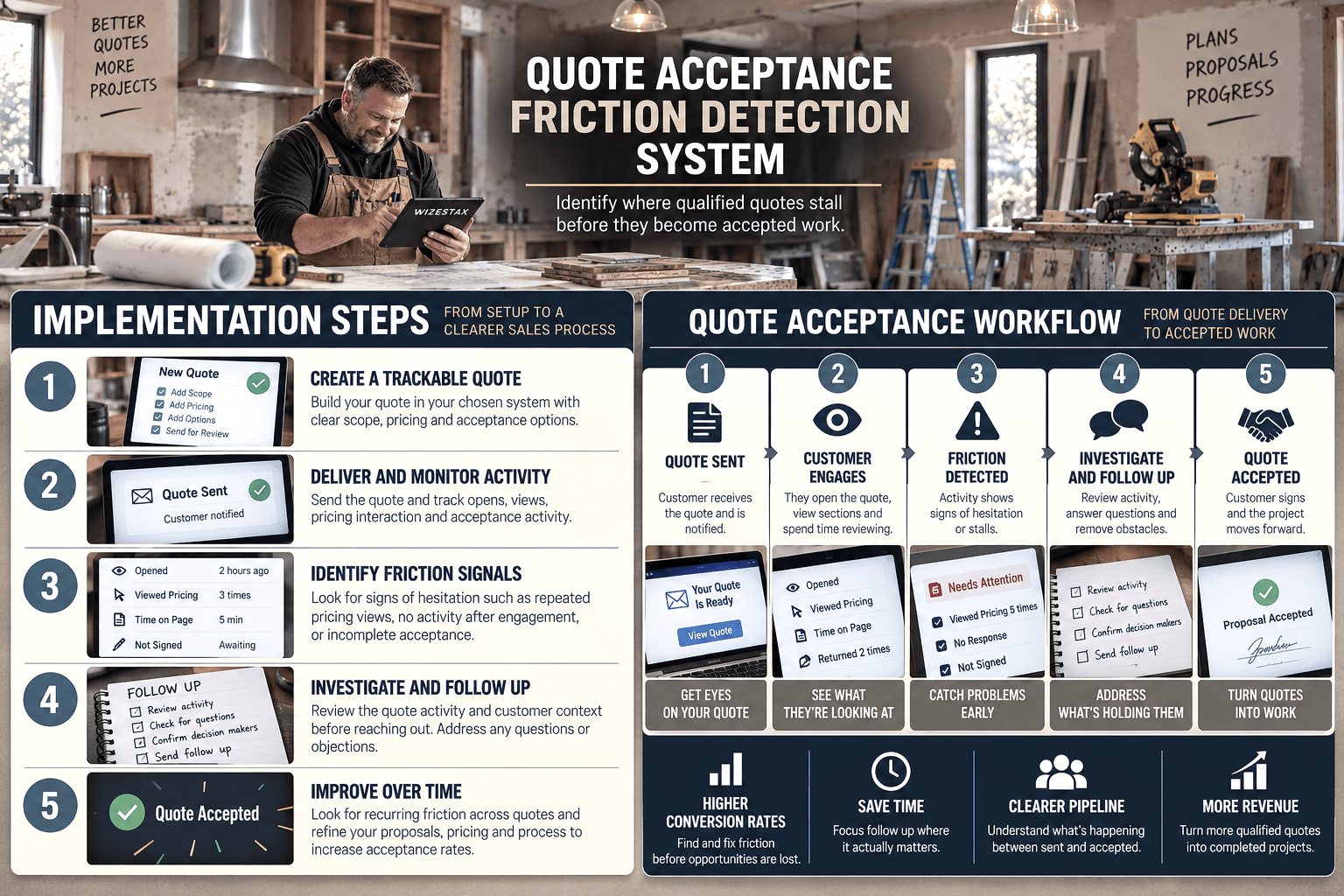
Step 1: Define The Quote Stages
Create a consistent set of stages for quotes after they are delivered.
A practical structure could include:
Sent
Opened
Engaged
Acceptance Started
Accepted
Inactive
Declined
The purpose is not to predict the outcome. It is to stop treating every outstanding quote as the same condition.
Step 2: Establish Meaningful Friction Signals
Decide which behaviors deserve staff review.
Examples could include a quote that remains unopened beyond the normal delivery window, repeated engagement without acceptance, incomplete signing, repeated customer questions about the same section or unusual inactivity after meaningful engagement.
Thresholds should reflect the business’s normal sales cycle.
A residential repair estimate may require a very different review window from a commercial services proposal.
Step 3: Build A Trackable Quote
Create the proposal in Qwilr.
Add the relevant scope, pricing and terms.
Configure the quote block.
Add the appropriate acceptance or electronic signature process.
Keep the path from reviewing the offer to accepting it as clear as possible.
Qwilr supports interactive quote blocks, acceptance controls, payments and electronic signatures within its proposal system. (Qwilr)
Step 4: Monitor Buyer Activity
After sending the quote, monitor actual customer behavior.
Look for whether the proposal was opened, which content received attention, whether the buyer returned, whether acceptance began and whether required signatures were completed.
Qwilr’s analytics can track proposal engagement and activity within individual sections rather than limiting the business to a simple sent status. (Qwilr)
Step 5: Review Friction Before Responding
When a quote reaches a defined friction condition, create an internal review.
Check the customer’s activity.
Review previous conversations.
Confirm that the scope and pricing are accurate.
Look for unanswered questions.
Determine whether additional decision makers are involved.
Then decide whether follow up is appropriate.
Do not automatically change the price or send a discount simply because acceptance has slowed.
Revenue At Risk Snapshot
| Outstanding Quotes Flagged Monthly | Average Quote Value | Revenue Represented |
|---|---|---|
| 5 | $2,000 | $10,000 |
| 10 | $2,000 | $20,000 |
| 25 | $2,000 | $50,000 |
Illustrative scenario using an average quote value of $2,000. Revenue represented is not revenue recovered or guaranteed sales.
WIZESTAX Diagnostic Scorecard
| Category | Assessment |
|---|---|
| Economic Problem | Qualified quotes can lose momentum before acceptance |
| Signal Quality Required | Moderate To High |
| Automation Potential | Moderate To High |
| Human Judgment Required | High |
| Data Dependency | Moderate |
| Scalability | High |
| Primary Value | Visibility into acceptance friction |
| Primary Risk | Mistaking customer activity for customer intent |
Common Mistakes
| Mistake | Result |
|---|---|
| Treating every outstanding quote as identical | Staff cannot distinguish different forms of friction |
| Assuming repeat views mean a price objection | Customer intent is inferred without evidence |
| Following up after every document open | Customers can receive excessive contact |
| Automatically discounting stalled quotes | Margin can be surrendered without understanding the problem |
| Tracking activity without defining review thresholds | Staff receive noise instead of meaningful signals |
| Ignoring the acceptance process itself | Signing and approval friction remains hidden |
| Measuring only accepted versus declined | Valuable behavior between those outcomes disappears |