

Service Promise Tracking System
Identify Customer Commitments at Risk of Being Missed Before They Become Broken Promises
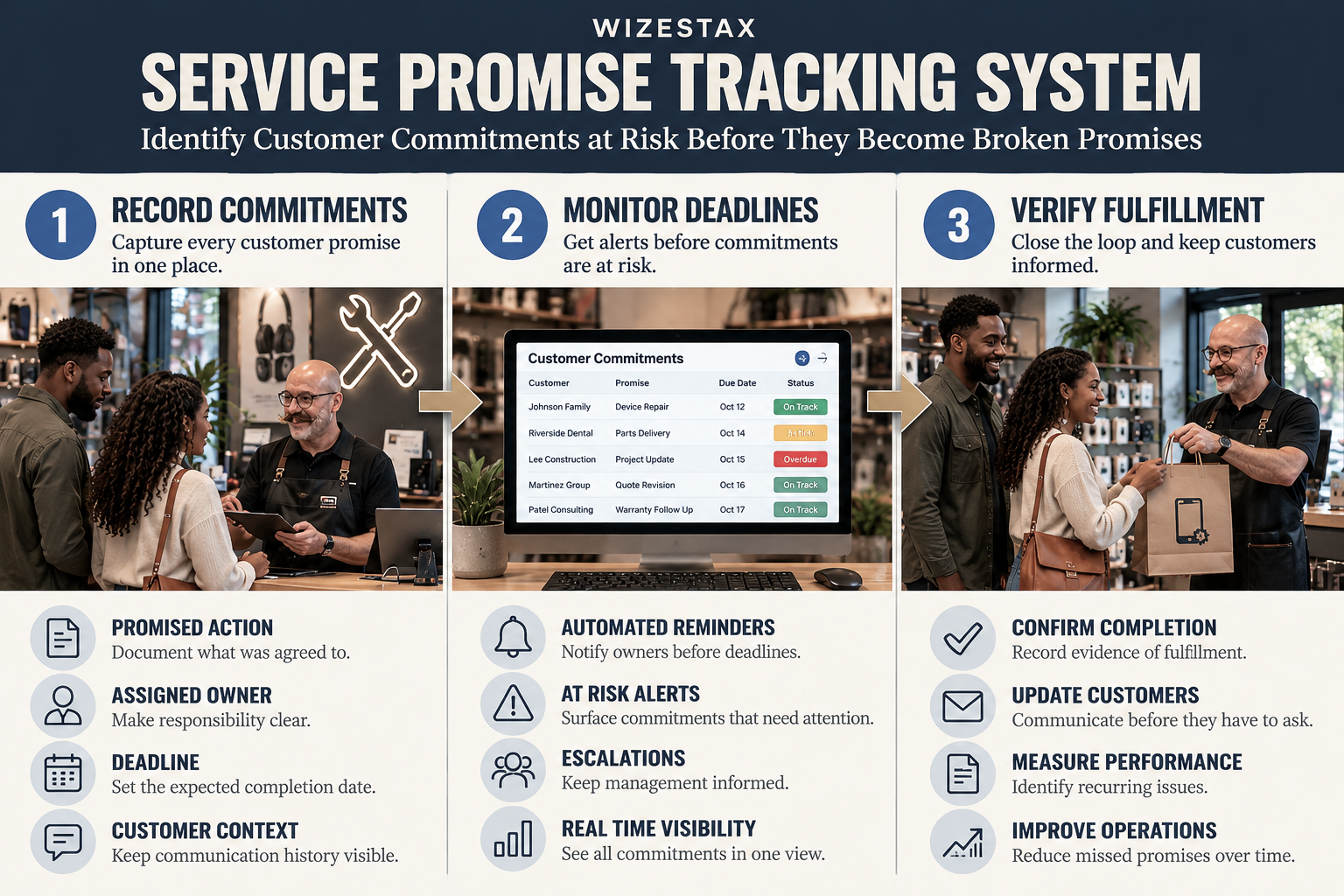
Customer service teams make commitments throughout the day. An employee promises to return a call, a service coordinator confirms a repair date and a manager agrees to send documentation before the end of the week. Each commitment creates an expectation that extends beyond the original conversation.
Most businesses already have systems for recording customer requests, but those systems do not always distinguish between a request being answered and a specific promise being fulfilled.
The Service Promise Tracking System monitors commitments made to customers and identifies when promised actions are approaching their deadlines without sufficient evidence of completion.
The purpose is not to treat every delayed action as a service failure. Supplier delays, customer dependencies and unexpected operational conditions can change fulfillment timelines. The system provides an early signal so employees can investigate, communicate and take corrective action before a missed commitment becomes an avoidable customer problem.
Software Linx
Starter: monday.com
Growth: Jobber
Pro: Supportbench
Blueprint Overview
| Metric | Value |
|---|---|
| Category | Customer Service And Operations |
| Business Problem | Customer commitments are made without reliable fulfillment tracking |
| Primary Objective | Identify promises at risk of being missed before their original deadlines |
| Core Signals | Promised action, owner, deadline, status, dependencies and completion evidence |
| Setup Time | Approximately 2 to 4 hours |
| Difficulty | Intermediate |
| Maintenance | Daily exception review and weekly performance analysis |
| Best For | Businesses making recurring customer commitments with specific deadlines |
| Primary Output | Commitment risk alerts and fulfillment reporting |
The Hidden Revenue Leak
| Without This Blueprint | With This Blueprint |
|---|---|
| Promises remain buried in conversations | Commitments have individual records |
| Employees rely on memory | Deadlines remain visible |
| Responsibility becomes unclear | Each commitment has an owner |
| Delays emerge after complaints | At risk promises trigger investigation |
| Customers repeatedly request updates | Earlier communication becomes possible |
| Completion is assumed | Fulfillment evidence is recorded |
A customer can receive a fast initial response and still experience poor service when the business fails to complete an agreed action.
This creates a problem that ordinary response time reporting may not detect. A support ticket can receive an immediate reply while a promised replacement, callback or document remains outstanding.
The risk becomes greater when fulfillment depends on multiple employees. A representative may promise an update that requires information from another department. A service coordinator may commit to a repair date before confirming that the required materials are available.
If the original promise is not recorded separately, employees may continue working without recognizing that a customer deadline is approaching.
The financial consequences can include repeated administrative work, service recovery costs, customer cancellations and reduced repeat business.
Not every missed commitment results in lost revenue. The purpose of tracking is to identify where the business is creating preventable customer dissatisfaction and unnecessary recovery work.
Business Impact Snapshot
| Area | Potential Impact |
|---|---|
| Customer Retention | Fewer preventable broken promises |
| Administrative Labor | Less time investigating forgotten commitments |
| Accountability | Clear responsibility for fulfillment |
| Customer Communication | Earlier updates about potential delays |
| Operations | Better visibility into outstanding obligations |
| Management | Measurable commitment performance |
Real World Example
A regional equipment service company receives a request from a customer whose commercial machine requires a replacement component.
The service coordinator promises that the component will arrive within four business days.
The customer receives confirmation, and the service request remains open while the company waits for delivery.
Two days later, the supplier informs the company that the replacement component will be delayed.
Without commitment tracking, the original delivery promise may remain buried in the service notes. The coordinator may not recognize the conflict until the customer contacts the business after the promised date.
With a Service Promise Tracking System, the commitment has its own deadline, assigned employee and current status.
The supplier delay changes the expected fulfillment timeline. The original customer commitment remains visible and can be flagged for investigation.
The coordinator can then explore alternatives, communicate the delay and establish a revised expectation.
The system cannot prevent every delay. It helps prevent an operational change from becoming an unexplained broken promise.
WIZESTAX Stax Options
Starter Stax
monday.com
Best For
Small businesses that need flexible tracking of customer commitments across departments without implementing a dedicated customer support platform.
| Function | Software |
|---|---|
| Commitment Records | Custom Boards |
| Employee Ownership | People Column |
| Deadline Tracking | Date Column |
| Fulfillment Progress | Status Column |
| Deadline Visibility | Deadline Mode |
| Internal Alerts | Date Based Automations |
monday.com allows businesses to create individual records for customer commitments, assign responsible employees and monitor deadlines through customizable boards.
Its Deadline Mode connects date and status columns so employees can identify approaching or overdue work. Date based automations can send notifications when specified deadlines arrive or when incomplete work becomes overdue.
For a Service Promise Tracking System, a business can create one record for each promised action rather than relying on a general customer conversation to represent every outstanding obligation.
The employee responsible for fulfillment can update the commitment status, document dependencies and record evidence when the action is completed.
Advantages
| Benefit |
|---|
| Flexible tracking across departments |
| Clear employee ownership |
| Customizable commitment statuses |
| Automated deadline reminders |
| Suitable for different promise categories |
Limitations
| Limitation |
|---|
| Employees must consistently record promises |
| Customer communications may require separate tools |
| Automation limits depend on subscription |
| Completion evidence requires an internal process |
| Complex service agreements may require additional configuration |
Growth Stax
Jobber
Best For
Field service businesses that make customer commitments involving scheduled visits, repairs, maintenance work and job completion.
| Function | Software |
|---|---|
| Customer Records | Client Manager |
| Incoming Requests | Requests |
| Scheduled Work | Jobs And Visits |
| Employee Responsibility | Team Assignments |
| Customer Reminders | Automated Visit Reminders |
| Work Progress | Job Tracking |
Jobber connects customer information with scheduled work, employee assignments and service communications.
For businesses where customer promises involve physical service delivery, this provides a more direct connection between the commitment and the operational activity required to fulfill it.
Scheduled visits and assigned jobs make it easier to identify upcoming service obligations. Automated visit reminders help customers prepare for appointments, while job tracking provides visibility into the progress of scheduled work.
Jobber also supports automated communication around selected stages of the service process.
These capabilities are most relevant to commitments that can be represented through requests, jobs and scheduled visits. A separate process may still be needed for informal promises that fall outside the normal job workflow.
Advantages
| Benefit |
|---|
| Connects promises with scheduled work |
| Clear visibility into assigned visits |
| Customer appointment reminders |
| Centralized service records |
| Job progress supports fulfillment review |
Limitations
| Limitation |
|---|
| Primarily designed for field service |
| Less suitable for unrelated administrative promises |
| Not every verbal commitment is automatically recorded |
| Communication features vary by plan |
| Some fulfillment checks require manual review |
Pro Stax
Supportbench
Best For
B2B service organizations managing customer specific service obligations, contractual response targets and complex escalation requirements.
| Function | Software |
|---|---|
| Customer Support | Case Management |
| Service Obligations | Dynamic SLAs |
| Account Requirements | Account Specific Policies |
| Responsibility | Case Routing |
| Escalation | Workflow Automation |
| Service Analysis | SLA Reporting |
Supportbench provides service management capabilities designed around complex B2B customer relationships.
Its dynamic SLA system can apply different service requirements according to customer accounts, contract terms, products, case types and severity levels.
This makes it relevant when a business must manage formal commitments that vary between customers.
Workflow automation can route cases, trigger alerts and escalate service obligations when defined conditions are met.
For customer promises that extend beyond standard response or resolution targets, the business still needs to ensure that the specific promised action and deadline are represented within its case workflow.
Advantages
| Benefit |
|---|
| Supports account specific obligations |
| Dynamic SLA monitoring |
| Structured escalation workflows |
| Visibility into complex service cases |
| Detailed service performance reporting |
Limitations
| Limitation |
|---|
| More complexity than smaller teams may need |
| Requires careful SLA configuration |
| Not every individual promise matches an SLA |
| Custom commitments may need additional fields |
| Pricing and implementation require evaluation |
How The Three Stax Differ
Each platform addresses customer commitments through a different operating system.
monday.com
Tracks individual customer promises, assigned employees and deadlines across departments. This approach is suited to businesses that need a flexible record of commitments involving several types of work.
Jobber
Connects customer commitments to scheduled service visits, employee assignments and job completion. This approach is suited to businesses where fulfilling a promise depends on completing field service work.
Supportbench
Monitors customer specific service obligations, contractual requirements and escalation workflows. This approach is suited to organizations managing more complex service relationships and formal performance commitments.
These are different implementation architectures rather than rankings. The appropriate system depends on how promises are created, what fulfillment requires and whether the business manages informal commitments or formal service agreements.
Copy And Paste Commitment Risk Alert
Customer commitment review for {{customer_name}}.
The promised action {{promised_action}} has an original deadline of {{original_deadline}}.
Current status: {{current_status}}.
Assigned employee: {{assigned_employee}}.
Review fulfillment progress, investigate outstanding dependencies and determine whether the original commitment can still be completed on time.
If the deadline is at risk, document the required action and communicate with the customer before the original commitment expires.
Copy And Paste Customer Update
Hello {{customer_name}},
We are following up regarding {{promised_action}}.
The current status is {{current_status}}.
Our next expected update is {{next_update_date}}.
We will contact you if the expected timeline changes.
Thank you for your patience.
Copy And Paste AI Prompt
You are assisting a small business with customer commitment monitoring.
Review the customer commitment records provided.
Identify promises that remain incomplete, are approaching their original deadlines or have already become overdue.
Compare each promised action with its recorded deadline, assigned employee and current fulfillment status.
Identify commitments where the responsible employee, deadline or completion evidence is missing.
Separate ordinary customer response targets from specific promises made to customers.
Review external dependencies that may prevent fulfillment.
Do not assume that closing a customer service ticket proves every associated commitment was completed.
Do not assume that a revised deadline erases a missed original commitment.
Do not invent missing promises, deadlines or completion records.
Present the findings in a table containing the customer, promised action, original deadline, current status, responsible employee, risk level and required follow up.
If the information is insufficient to determine fulfillment risk, identify what additional information is required.
Step By Step Implementation Guide
The following setup demonstrates one implementation path using monday.com.
It is not a WIZESTAX recommendation or preferred Stax.
monday.com is used here because its customizable boards, deadline tracking and notification automations provide a clear example of monitoring individual customer commitments.
Step 1: Define A Customer Commitment
Identify the types of promises that require tracking.
Examples may include:
Customer Callbacks
Replacement Deliveries
Service Completion
Document Preparation
Customer Updates
Issue Resolution
A commitment should represent a specific action the business has agreed to complete.
Step 2: Create The Commitment Board
Create a dedicated board in monday.com for customer promises.
Each item should represent one commitment.
If a customer has several promises with different deadlines, record them separately.
This allows each obligation to have its own owner, deadline and fulfillment status.
Step 3: Establish The Required Fields
Configure the board to capture the information needed for monitoring.
| Field | Purpose |
|---|---|
| Customer | Identifies the customer |
| Promised Action | Defines the obligation |
| Original Deadline | Records the promised date |
| Assigned Employee | Establishes ownership |
| Current Status | Shows fulfillment progress |
| Dependency | Records potential blockers |
| Completion Evidence | Verifies the action |
| Last Update | Shows recent activity |
Preserve the original deadline even when a revised completion date is agreed upon.
Step 4: Assign Responsibility
Assign each commitment to an employee responsible for monitoring fulfillment.
The assigned employee may depend on another department, supplier or manager to complete the promised action.
Ownership should remain clear even when responsibility for individual tasks changes.
Step 5: Establish Fulfillment Statuses
Create statuses that distinguish between normal progress and commitments requiring attention.
Examples include:
Pending
In Progress
At Risk
Overdue
Fulfilled
Avoid marking a commitment fulfilled simply because an employee has sent an update or closed the original customer conversation.
Step 6: Configure Deadline Monitoring
Connect the commitment deadline with its status using monday.com’s Deadline Mode.
Configure date based notifications for approaching deadlines.
Where appropriate, establish overdue reminders for commitments that remain incomplete after their original deadlines.
Automation availability and usage limits depend on the subscription.
Step 7: Monitor Dependencies
Review commitments that depend on external conditions.
These may include supplier deliveries, approval requests, employee availability or customer supplied information.
A dependency does not automatically mean the commitment will be missed.
It becomes a risk when the remaining time or available information suggests that the promised action may not be completed as agreed.
Step 8: Verify Completion
Define what evidence demonstrates fulfillment.
Examples may include:
Completed Callback Record
Delivery Confirmation
Approved Document Sent
Completed Service Record
Confirmed Issue Resolution
Record the evidence before changing the commitment to fulfilled.
Step 9: Review At Risk Commitments
Review approaching and overdue commitments daily.
Determine whether each flagged promise requires investigation, additional resources or customer communication.
When the original deadline cannot reasonably be met, communicate the change rather than waiting for the customer to discover it.
Step 10: Monitor Fulfillment Performance
Review the number of commitments created and completed during each reporting period.
Track how many were fulfilled by their original deadlines and how many required additional recovery work.
Identify recurring causes of missed promises.
The purpose is to improve how commitments are made and fulfilled rather than simply increase the number of reminders employees receive.
Customer Commitment Cost Exposure Snapshot
| Monthly Promises | Recovery Hours | Labor Cost |
|---|---|---|
| 100 | 4 | $100 |
| 200 | 8 | $200 |
| 300 | 12 | $300 |
Illustrative scenarios assuming a 12% missed commitment rate, 20 minutes of additional administrative work per missed commitment and labor valued at $25 per hour. Actual results depend on commitment complexity, recovery requirements and labor costs. These figures do not represent guaranteed savings.
WIZESTAX Diagnostic Scorecard
| Category | Assessment |
|---|---|
| Economic Problem | Missed promises create avoidable recovery work and customer dissatisfaction |
| Signal Quality Required | High |
| Automation Potential | High |
| Human Judgment Required | Moderate To High |
| Data Dependency | Moderate |
| Scalability | High |
| Primary Value | Earlier visibility into commitments at risk |
| Primary Risk | Treating reminders or closed tickets as proof of fulfillment |
Common Mistakes
| Mistake | Result |
|---|---|
| Recording promises only in conversation notes | Commitments remain difficult to monitor |
| Failing to assign an owner | Responsibility becomes unclear |
| Replacing the original deadline | Missed promises become harder to measure |
| Tracking only response times | Fulfillment obligations remain invisible |
| Closing commitments without verification | Incomplete promises appear fulfilled |
| Ignoring external dependencies | Potential delays are identified too late |
| Sending alerts without follow up | Warnings do not produce corrective action |
| Treating every delay as employee failure | Operational causes remain unexplored |
Get New WIZESTAX Blueprints Every Monday
Subscribe to receive new WIZESTAX Blueprints covering Customer Retention, Marketing, Sales, Finance and Operations directly to your inbox.