
Vendor Contract Renewal System
Track Vendor Agreements, Identify Upcoming Renewal Deadlines, And Prevent Unreviewed Contract Costs Vendor contracts can create financial obligations long after the original purchasing decision has been made.
A business may sign an annual agreement for equipment maintenance, software, cleaning services or commercial supplies. The service operates normally, invoices are paid and employees become accustomed to the recurring expense.
Months later, the contract approaches its renewal date. If the agreement contains an automatic renewal clause, the business may need to provide written notice before a specific deadline to avoid another contractual term.
The renewal may occur before anyone reviews the supplier’s performance, updated pricing or continuing business requirements. The Vendor Contract Renewal System monitors vendor agreements from initial execution through renewal review, notice deadlines, approval and final disposition.
It identifies contracts approaching important dates, agreements with incomplete renewal information, upcoming price changes and vendor relationships that have not received a documented review.
The purpose is not to assume every renewal is unnecessary or that all automatic renewal provisions are enforceable. The system establishes a reliable process for reviewing contractual commitments before important decision deadlines pass.
Software Linx
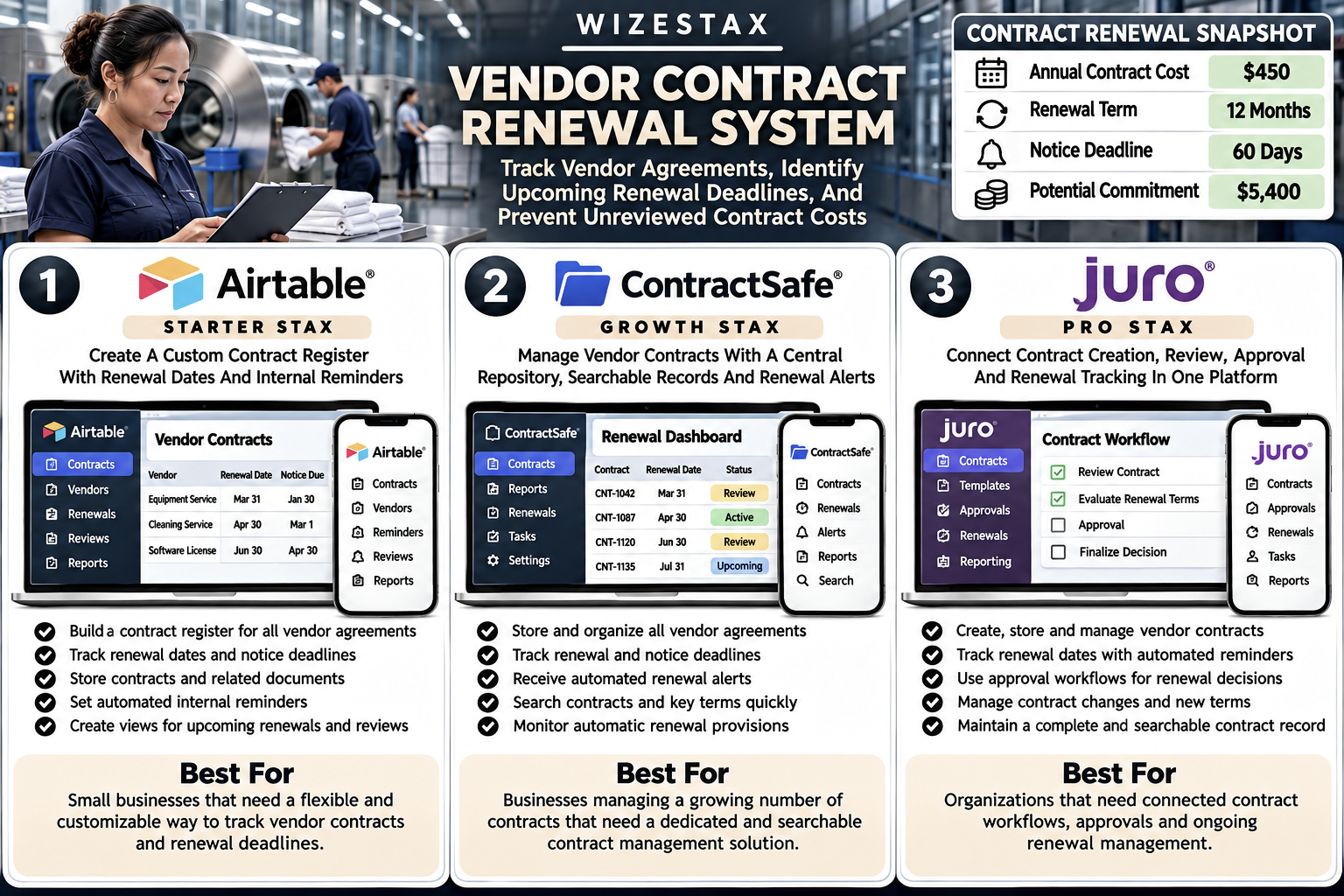
Starter: Airtable
Growth: ContractSafe
Pro: Juro
Blueprint Overview
| Metric | Value |
|---|---|
| Category | Vendor Management And Contract Administration |
| Business Problem | Vendor agreements renew or expire without sufficient review |
| Primary Objective | Monitor contract deadlines and document renewal decisions |
| Core Signals | Renewal date, notice deadline, contract value, renewal terms, assigned owner |
| Setup Time | Approximately 3 to 6 hours for a basic contract register |
| Difficulty | Intermediate |
| Maintenance | Weekly deadline review and monthly contract reconciliation |
| Best For | Businesses managing recurring vendor agreements |
| Primary Output | Renewal alerts, contract review tasks and documented decisions |
Setup time is illustrative and excludes extensive contract migration, legal review or complex integrations.
The Hidden Revenue Leak
| Without This Blueprint | With This Blueprint |
|---|---|
| Renewal dates remain buried in contracts | Important dates are recorded |
| Notice deadlines are overlooked | Advance alerts support timely review |
| Agreements renew without evaluation | Renewal decisions receive assigned reviews |
| Supplier price changes go unnoticed | Pricing terms are examined |
| Contract ownership is unclear | Each agreement has a responsible employee |
| Unused services continue billing | Continued business need is assessed |
| Contract versions become fragmented | Current agreements and amendments are linked |
| Renewal decisions are undocumented | Decisions and supporting records are preserved |
A vendor agreement may contain several dates that serve different purposes.
The contract may have an effective date, an initial expiration date, an automatic renewal date and a separate deadline for giving notice of nonrenewal.
These dates should not be treated as interchangeable.
For example, an agreement may renew on December 31 but require written notice at least 60 days beforehand.
If the business first reviews the agreement in December, the contractual notice window may already have closed.
The company could then face another year of payments, depending on the agreement and applicable law.
The financial exposure becomes more difficult to manage when different departments independently purchase services.
An operations manager may oversee equipment maintenance while the accounting department pays the invoices. A marketing employee may manage software subscriptions, and the owner may retain responsibility for facility contracts.
Without a central register, no single employee may have a complete picture of upcoming commitments.
The system separates the date a contract renews from the date the business must make or communicate its decision.
It also distinguishes a contract approaching renewal from a contract that has actually been renewed, amended, terminated or allowed to expire.
Not every automatic renewal creates a financial loss. Many agreements provide valuable services at acceptable prices.
The purpose is to prevent renewal decisions from occurring through administrative inattention rather than informed evaluation.
Business Impact Snapshot
| Area | Potential Impact |
|---|---|
| Contract Costs | Earlier identification of unnecessary commitments |
| Purchasing | More time to compare supplier terms |
| Cash Flow | Greater visibility into future obligations |
| Administration | Less time locating agreements and deadlines |
| Compliance | More consistent documentation of required notices |
| Accountability | Clear responsibility for contract reviews |
| Management | Better visibility into recurring vendor spending |
Real World Example
A regional commercial cleaning company uses several outside vendors for equipment maintenance, business software and facility services.
One vendor provides specialized equipment servicing under a contract costing $450 per month.
The agreement has an annual term and an automatic renewal provision.
The company must provide written notice 60 days before the renewal date if it does not intend to continue the agreement.
During the year, the business replaces several pieces of equipment and no longer requires the same maintenance coverage.
However, the agreement remains active in the accounting system.
The business does not review the contract before the notice deadline.
Assuming the renewal is valid and creates another full year of payments, the company may become responsible for an additional $5,400.
Without a contract monitoring process, the business may not recognize the commitment until the next billing cycle.
With a Vendor Contract Renewal System, the agreement has a separate contract record containing the annual value, renewal date, notice deadline and assigned employee.
An internal alert is scheduled well before the notice deadline.
The operations manager reviews the equipment requirements, verifies the agreement and determines whether the service remains necessary.
If the company decides not to renew, the responsible employee follows the contract’s notice procedure and preserves evidence of delivery.
The contract remains under review until the vendor’s response and final contractual status are documented.
The system cannot guarantee that a cancellation request will be accepted or that an agreement can be terminated without cost.
It helps ensure that the business has time to evaluate its options and complete the applicable administrative process.
WIZESTAX Stax Options
Starter Stax
Airtable
Software: Airtable
Best For
Small businesses that need a customizable contract register and internal renewal reminders without implementing a dedicated contract management platform.
| Function | Software |
|---|---|
| Contract Records | Airtable Tables |
| Vendor Relationships | Linked Records |
| Contract Documents | Attachment Fields |
| Renewal Dates | Date Fields |
| Notice Deadlines | Date Fields |
| Contract Ownership | Collaborator Fields |
| Review Status | Single Select Fields |
| Internal Reminders | Airtable Automations |
| Contract Value Analysis | Formulas And Rollups |
Airtable allows businesses to create a central register containing vendor agreements, contract dates, financial commitments and review responsibilities.
Each agreement can be associated with a vendor record and assigned to the employee responsible for monitoring it.
Attachment fields can store signed contracts, amendments and supporting documents.
Date fields allow businesses to record renewal dates and contractual notice deadlines separately.
Filtered views can identify agreements approaching their review windows.
Airtable Automations can send notifications when records meet configured conditions, subject to the account’s available features and usage limits.
Businesses can also create formulas to estimate annual contract commitments and summarize recurring vendor spending.
This approach is flexible, but it does not automatically interpret contractual language or determine whether an automatic renewal provision is enforceable.
Employees must review the agreement and enter accurate dates and terms.
Advantages
| Benefit |
|---|
| Customizable contract register |
| Centralized vendor information |
| Configurable renewal reminders |
| Clear contract ownership |
| Flexible cost reporting |
Limitations
| Limitation |
|---|
| Requires initial database configuration |
| Contract terms generally require manual verification |
| Automated reminders depend on correct date fields |
| Legal notice procedures remain separate |
| Financial reconciliation may require accounting integration |
Growth Stax
ContractSafe
Software: ContractSafe
Best For
Businesses managing a growing number of vendor agreements that need a dedicated contract repository, searchable documents and structured renewal alerts.
| Function | Software |
|---|---|
| Contract Storage | Centralized Repository |
| Document Search | Contract Search |
| Renewal Dates | Contract Date Tracking |
| Notice Deadlines | Custom Date Fields |
| Renewal Reminders | Automated Email Alerts |
| Automatic Renewals | Autorenew Tracking |
| Contract Information | AI Assisted Data Extraction |
| Related Agreements | Amendment And Attachment Tracking |
ContractSafe provides a dedicated environment for storing and organizing business contracts.
Businesses can upload agreements and maintain information about important dates, contract status and related documents.
Its date tracking capabilities support renewal, expiration and notice deadline monitoring.
The platform also provides configurable email reminders for contract milestones.
ContractSafe offers AI assisted extraction of contract information, including important dates, which users can review and confirm.
This can reduce the administrative work involved in identifying dates across a large collection of agreements.
For contracts with recurring renewal cycles, the platform provides features designed to advance relevant dates and reminders.
However, extracted information still requires verification against the signed agreement.
A date reminder does not establish whether a contract should be renewed or whether a termination notice satisfies the contract’s requirements.
Businesses must maintain clear internal approval procedures and preserve evidence of important communications.
Advantages
| Benefit |
|---|
| Dedicated contract repository |
| Searchable agreements |
| Renewal and notice deadline alerts |
| AI assisted contract date extraction |
| Recurring renewal monitoring |
Limitations
| Limitation |
|---|
| Requires document migration and validation |
| Extracted contract terms require human review |
| Renewal decisions remain the business’s responsibility |
| Legal notices may require external communication |
| Subscription costs require individual evaluation |
Pro Stax
Juro
Software: Juro
Best For
Organizations that need connected contract creation, review, approval, execution and ongoing renewal monitoring.
| Function | Software |
|---|---|
| Contract Repository | Contract Storage And Search |
| Contract Creation | Document Templates |
| Internal Review | Contract Collaboration |
| Approval Workflows | Configured Approvals |
| Electronic Signing | Contract Execution |
| Renewal Dates | Calendar Smartfields |
| Deadline Notifications | Automated Reminders |
| Contract Monitoring | Repository Views And Reporting |
Juro combines contract management with workflows for creating, reviewing and executing agreements.
Businesses can maintain contract information in a searchable repository and use structured fields to track important dates.
Calendar smartfields allow teams to record renewal and expiration dates.
Reminder settings can notify designated internal users before important contract milestones.
Multiple reminders can be configured around the same date, allowing teams to establish review stages before a renewal deadline.
For example, a company may schedule internal reviews 90, 60 and 30 days before an important contractual milestone.
The business can also connect contract review and approval activities with the broader agreement management process.
This can be useful when vendor renewals require approval from purchasing, finance or legal personnel.
However, a reminder does not automatically complete a contract negotiation or deliver a legally effective termination notice.
Businesses must verify the current agreement, the relevant notice requirements and the authority of the employee approving the decision.
The platform’s broader contract lifecycle capabilities may also exceed the requirements of businesses that only need basic renewal reminders.
Advantages
| Benefit |
|---|
| Connected contract lifecycle workflows |
| Structured contract information |
| Configurable renewal reminders |
| Internal collaboration and approvals |
| Centralized contract records |
Limitations
| Limitation |
|---|
| More extensive implementation requirements |
| Reminder recipients require appropriate access |
| Contract data must be maintained accurately |
| Legal interpretation remains a human responsibility |
| Pricing and functionality require individual evaluation |
How The Three Stax Differ
Each platform addresses vendor renewal monitoring through a different operational structure.
Airtable
Creates a customizable contract register containing renewal dates, notice deadlines, contract values and assigned employees. This approach suits businesses that need a flexible administrative tracking system.
ContractSafe
Provides a dedicated contract repository with searchable agreements, date extraction and renewal alerts. This approach suits businesses that need to organize and monitor a larger collection of existing contracts.
Juro
Connects contract creation, review, approval, execution and renewal monitoring. This approach suits organizations that need renewal administration within a broader contract lifecycle process.
These are different implementation architectures rather than rankings.
The appropriate system depends on whether the business primarily needs a contract register, a dedicated document repository or connected contract lifecycle workflows.
Vendor Selection Boundary
Starter, Growth and Pro describe illustrative implementation approaches rather than product rankings or endorsements.
Businesses should verify current features, pricing, user access requirements, integrations and implementation needs directly with each vendor.
Copy And Paste Vendor Contract Renewal Alert
Vendor contract review for {{vendor_name}}.
Contract reference: {{contract_number}}
Service category: {{service_category}}
Contract owner: {{assigned_employee}}
Current annual value: {{annual_contract_value}}
Renewal date: {{renewal_date}}
Notice deadline: {{notice_deadline}}
Automatic renewal provision: {{automatic_renewal_status}}
Current review status: {{review_status}}
Days remaining before notice deadline: {{days_remaining}}
Outstanding requirement: {{outstanding_action}}
Review the signed agreement, applicable amendments and current vendor performance.
Confirm the contractual notice requirements and the date by which a decision must be communicated.
Determine whether the service remains necessary and whether the existing pricing and terms are acceptable.
Document the renewal decision and assign responsibility for any required vendor communication.
Do not mark the contract resolved until the decision, applicable notice and final contract status have been recorded.
Copy And Paste Vendor Renewal Review Email
Hello {{vendor_contact}},
We are reviewing our current agreement for {{service_description}}.
Our records indicate that the agreement is scheduled for renewal on {{renewal_date}}.
Before completing our internal review, we would appreciate confirmation of the current renewal terms, pricing and any proposed changes to the existing agreement.
Please also confirm whether there are updated service conditions or contractual amendments that we should consider.
We are reviewing our ongoing operational requirements and will communicate our decision through the appropriate contractual process.
Thank you for your assistance.
This email is intended to request information and should not be treated as a formal termination or nonrenewal notice.
Copy And Paste AI Prompt
You are assisting a business with vendor contract renewal monitoring.
Review the vendor agreements, contract register and supporting records provided.
Identify contracts approaching their renewal dates.
Identify agreements containing automatic renewal provisions.
Extract the stated notice periods and notice deadlines where the contract language clearly supports them.
Identify contracts with missing or inconsistent renewal information.
Flag agreements where the internal review date occurs after the contractual notice deadline.
Identify upcoming pricing changes and recurring financial commitments.
Identify contracts without an assigned owner.
Identify agreements that have not received a documented renewal decision.
Separate the contract expiration date, renewal date, notice deadline and internal review date.
Do not assume these dates are interchangeable.
Do not invent renewal provisions, notice requirements, contractual rights or termination fees.
Do not assume every automatic renewal provision is legally enforceable.
Do not classify an agreement as terminated merely because a cancellation request was sent.
Identify situations where contractual language is ambiguous or legal review may be necessary.
Present the findings in a table containing the vendor, contract reference, annual value, renewal date, notice deadline, automatic renewal status, assigned owner, current review status and required follow up.
Where information is insufficient, identify the documents or contractual details needed to determine the correct next action.
Step By Step Implementation Guide
The following setup demonstrates one implementation path using Airtable.
It is not a WIZESTAX recommendation or preferred Stax.
Airtable is used because its customizable records, date fields and automation capabilities provide a clear example of monitoring vendor agreements independently from invoice processing.
Step 1: Define Which Contracts Require Tracking
Identify vendor agreements that create ongoing operational or financial obligations.
Examples may include:
Software Subscriptions
Equipment Maintenance Agreements
Commercial Cleaning Contracts
Facility Service Agreements
Supplier Purchasing Agreements
Equipment Leasing Contracts
Marketing Service Agreements
Professional Service Contracts
Prioritize agreements containing recurring charges, automatic renewal provisions or contractual notice requirements.
Step 2: Create The Vendor Contracts Table
Create a table named Vendor Contracts.
Each record should represent one agreement.
Include a unique contract identifier, vendor name, contract owner and current contract status.
Preserve the original agreement and connect any amendments or renewal documents to the same record.
A vendor may have several separate agreements that require individual tracking.
Step 3: Establish The Required Fields
| Field | Purpose |
|---|---|
| Contract Number | Identifies the agreement |
| Vendor Name | Identifies the supplier |
| Service Category | Describes the service |
| Contract Owner | Assigns responsibility |
| Effective Date | Records when the agreement begins |
| Expiration Date | Records the stated end date |
| Renewal Date | Tracks the next renewal event |
| Notice Period | Records advance notice requirements |
| Notice Deadline | Tracks the final notice date |
| Automatic Renewal | Identifies renewal provisions |
| Contract Value | Records financial commitment |
| Billing Frequency | Supports cost calculations |
| Review Date | Schedules internal evaluation |
| Contract Status | Shows current disposition |
| Supporting Documents | Stores agreements and amendments |
Do not calculate a notice deadline until the applicable contract terms have been verified.
Step 4: Upload The Agreements
Attach the signed vendor contract to the corresponding record.
Include amendments, renewal letters and relevant pricing schedules.
Where multiple versions exist, identify the currently operative agreement.
Do not delete earlier versions that may be necessary to understand the contractual history.
Step 5: Identify Renewal Provisions
Review each agreement for renewal language.
Determine whether the contract:
Expires Without Renewal
Requires Express Renewal Approval
Renews Automatically
Continues On A Rolling Basis
Contains A Negotiated Extension Option
Record the applicable structure.
Do not assume every vendor contract renews automatically.
Step 6: Establish Notice Deadlines
Identify whether the agreement requires advance notice for termination or nonrenewal.
For example, a contract may renew on December 31 and require notice at least 60 days beforehand.
Record the contractual deadline and any requirements concerning delivery method, recipient or form of notice.
Different provisions may govern termination for convenience, nonrenewal and termination for breach.
Track the relevant deadline for the intended action.
Step 7: Assign Contract Ownership
Designate an employee responsible for each agreement.
The contract owner should coordinate the internal review and confirm that required actions are completed.
The employee may need input from accounting, operations, purchasing or management.
Contract ownership should remain clear even when the original employee who negotiated the agreement is no longer with the company.
Step 8: Configure Renewal Reminders
Create internal review dates before the contractual notice deadline.
An illustrative schedule might include:
90 Days Before The Notice Deadline: Initial Review
60 Days Before The Notice Deadline: Pricing And Service Evaluation
30 Days Before The Notice Deadline: Final Decision Check
These intervals should be adjusted to the actual agreement.
Configure Airtable notifications using the appropriate date fields and supported automation triggers.
Test the reminder workflow with a sample record before relying on it.
Step 9: Review Vendor Performance
Evaluate whether the vendor continues to meet the business’s requirements.
Consider service reliability, pricing, response times, usage and contractual obligations.
Document any recurring problems or changes in operational needs.
The purpose is to support an informed decision rather than automatically classify the vendor as satisfactory or unsatisfactory.
Step 10: Document The Renewal Decision
Create statuses that reflect the contract review process.
| Status | Meaning |
|---|---|
| Active | Agreement currently in effect |
| Review Scheduled | Internal review date established |
| Under Review | Contract being evaluated |
| Renewal Approved | Authorized to continue |
| Negotiation Pending | Terms under discussion |
| Nonrenewal Approved | Decision made not to renew |
| Notice Sent | Required communication submitted |
| Renewal Confirmed | Continuing agreement verified |
| Expired | Agreement reached its end without continuation |
| Closed | Final disposition documented |
A decision not to renew should not automatically change the contract status to terminated.
Step 11: Verify Vendor Communication
When notice is required, follow the contract’s specified procedure.
Record the date, recipient, communication method and supporting evidence.
Preserve delivery confirmation or acknowledgment where available.
If the vendor disputes the notice or contractual status, refer the issue to the appropriate decision maker or legal adviser.
Do not assume that an ordinary email satisfies every contract’s notice requirements.
Step 12: Monitor Contract Renewal Performance
Review upcoming renewals and unresolved agreements at the end of each reporting period.
Track the number of contracts approaching notice deadlines.
Identify agreements with missing renewal information.
Compare renewed, renegotiated and discontinued agreements.
Measure the value of recurring commitments that have received documented review.
Investigate contracts that renewed without an assigned owner or recorded decision.
The purpose is to improve contractual visibility, reduce avoidable administrative oversights and support more deliberate vendor spending decisions.
Vendor Contract Renewal Cost Exposure Snapshot
| Monthly Contract Cost | Potential Additional Term | Illustrative Commitment |
|---|---|---|
| $150 | 12 Months | $1,800 |
| $300 | 12 Months | $3,600 |
| $450 | 12 Months | $5,400 |
| $800 | 12 Months | $9,600 |
Illustrative scenarios assume that an agreement renews for another 12 months at the stated monthly cost.
Actual obligations depend on the contract’s renewal provisions, applicable law, pricing changes, cancellation rights and any available remedies.
These figures represent potential contractual commitments rather than guaranteed avoidable costs or software savings.
WIZESTAX Diagnostic Scorecard
| Category | Assessment |
|---|---|
| Economic Problem | Unreviewed vendor renewals can create avoidable commitments |
| Signal Quality Required | High |
| Automation Potential | Moderate To High |
| Human Judgment Required | High |
| Data Dependency | High |
| Scalability | High |
| Primary Value | Visibility into renewal deadlines and recurring obligations |
| Primary Risk | Treating reminder completion as legally effective nonrenewal |
Common Mistakes
| Mistake | Result |
|---|---|
| Tracking expiration dates but not notice deadlines | Review occurs too late |
| Assuming every contract renews automatically | Incorrect renewal classifications |
| Failing to preserve signed agreements | Contract terms become difficult to verify |
| Ignoring amendments | Outdated dates or prices are used |
| Failing to assign contract ownership | Renewal responsibility remains unclear |
| Scheduling alerts too close to deadlines | Insufficient time for evaluation |
| Assuming a reminder completes a cancellation | Contract may remain active |
| Sending notices to the wrong recipient | Notice requirements may not be satisfied |
| Treating nonrenewal approval as termination | Contract status becomes inaccurate |
| Ignoring changes in vendor pricing | Future commitments are underestimated |
| Overwriting historical contract records | Previous obligations become difficult to investigate |
| Failing to reconcile vendor billing | Charges may continue without review |
Get New WIZESTAX Blueprints Every Monday
Subscribe to receive new WIZESTAX Blueprints covering Customer Retention, Marketing, Sales, Finance and Operations directly to your inbox.