Abandoned Booking Recovery System
Recover High Intent Customers Who Leave Before Completing a Booking
A customer can choose a service, select a date or time and begin entering their information without ever completing the reservation. That unfinished booking can disappear quietly. The calendar never receives an appointment, staff may never know someone tried to book and the customer may not return to finish the process.
An Abandoned Booking Recovery System detects incomplete booking attempts where enough customer information has been captured, waits for a defined period and creates a path for the customer to continue or restart the reservation.
Which Stax Fits Your Business
| Business Need | Stax | Software | Cost |
|---|---|---|---|
| Dedicated recovery for service appointment bookings | Starter Stax | Booknetic | Paid add on or eligible plan |
| Recovery with captured booking details and scheduled SMS | Growth Stax | MoeGo | Growth plan and above |
| Automated recovery within a larger service business platform | Pro Stax | Zenoti | Varies by plan |
Pricing, availability and capabilities can change. Confirm current terms directly with each provider before implementation.
Software Linx
Starter: Booknetic
Growth: MoeGo
Pro: Zenoti
Blueprint Overview
| Metric | Value |
|---|---|
| Category | Marketing |
| Business Problem | Customers begin booking but leave before creating a confirmed reservation |
| Primary Objective | Detect recoverable incomplete bookings and provide customers with a route back |
| Core Signals | Booking started, customer identified, booking step reached, booking incomplete, booking later completed |
| Setup Time | Approximately 45 to 90 minutes |
| Difficulty | Intermediate |
| Maintenance | Weekly review with periodic controlled testing |
| Best For | Appointment and reservation businesses with online booking |
| Primary Output | Abandoned booking recovery workflow |
The Hidden Revenue Leak
| Without This Blueprint | With This Blueprint |
|---|---|
| Incomplete bookings disappear silently | Eligible abandoned attempts become visible |
| Staff only see completed reservations | Booking intent can be captured earlier |
| Interested customers must start over | Recovery can provide a route back |
| Follow up depends on staff noticing | Eligible recovery can be automated |
| Booking friction can remain hidden | Abandonment stages can reveal where customers leave |
| Recovery results remain unknown | Recovered bookings can be tracked |
MoeGo, for example, preserves information entered before a customer leaves online booking and lets businesses review the abandoned step, contact the customer and convert the attempt into a scheduled appointment. MoeGo
Business Impact Snapshot
| Area | Potential Impact |
|---|---|
| Revenue | Existing booking intent receives another opportunity to convert |
| Calendar Utilization | More incomplete booking attempts can potentially become scheduled appointments |
| Customer Experience | Customers can receive assistance after leaving the booking process |
| Operations | Staff gain visibility into demand that previously disappeared |
| Marketing | Recovery focuses on customers who already demonstrated booking intent |
| Measurement | Businesses can compare abandoned attempts with recovered bookings |
Real World Example
A grooming business receives 180 completed online bookings during a month.
Another 30 visitors begin booking and provide enough information to be identified, but leave before confirming an appointment.
Without recovery, those 30 attempts never appear on the calendar.
With an Abandoned Booking Recovery System, the incomplete attempts are captured separately. After a defined delay, eligible customers receive a simple message offering a route back to booking.
Some will not return. Others may have intentionally stopped. A portion may complete the reservation.
The system does not treat all 30 attempts as lost revenue. It preserves visibility into customer intent that otherwise would have disappeared.
WIZESTAX Stax Options
Starter Stax
Booknetic
Best For
Businesses using WordPress that want booking recovery integrated directly into their appointment system.
| Function | Software |
|---|---|
| Online Booking | Booknetic |
| Abandonment Detection | Booking Recovery |
| Recovery Trigger | Incomplete Booking Session |
| Follow Up | Booknetic Workflows |
| Timing | Configurable Delay |
| Measurement | Recovery Conversion Tracking |
Booknetic’s Booking Recovery add on detects incomplete booking sessions, allows businesses to configure the follow up delay and uses its Workflow system to send recovery messages. When the customer later completes the booking, Booknetic can record the recovered conversion. Booknetic
Advantages
| Benefit |
|---|
| Designed specifically around incomplete booking recovery |
| Recovery operates inside the booking environment |
| Follow up timing can be configured |
| Workflow engine handles recovery communication |
| Recovered conversions can be tracked |
Limitations
| Limitation |
|---|
| Requires Booknetic |
| Booking Recovery is an additional paid capability |
| Recovery depends on enough information being captured during the booking process |
| Workflow configuration still requires testing |
| A detected abandonment does not prove the customer intended to complete the booking |
Growth Stax
MoeGo
Best For
Pet service businesses that want detailed visibility into abandoned booking attempts and automated recovery messaging.
| Function | Software |
|---|---|
| Online Booking | MoeGo |
| Abandonment Record | Abandoned Bookings |
| Recovery Communication | Scheduled Recovery Message |
| Segmentation | Customer Type And Abandoned Step |
| Manual Recovery | Call, Text And Schedule |
| Recovery Status | Contacted And Recovered |
MoeGo can retain information from incomplete online bookings, including the point where the customer stopped. Businesses can filter abandoned attempts, contact the customer and schedule the appointment from captured information. Its scheduled recovery feature can also send one automated recovery text based on selected recipients, abandonment steps and timing. MoeGo
Advantages
| Benefit |
|---|
| Shows where the booking was abandoned |
| Supports both automated and staff assisted recovery |
| Captured information can reduce the need to restart |
| Recovery audiences and timing can be configured |
| Staff scheduled recoveries can be recorded |
Limitations
| Limitation |
|---|
| Designed specifically for pet service businesses |
| Automated recovery is available on qualifying plans |
| Scheduled recovery messages use SMS credits |
| Communication eligibility depends on customer information and applicable consent rules |
| Not every later self booking is necessarily attributed as a staff recovery |
MoeGo explicitly notes that scheduled recovery texts are marketing SMS and businesses should confirm applicable consent, opt out, content, timing and regional requirements before enabling them. MoeGo Help Center
Pro Stax
Zenoti
Best For
Larger appointment based businesses that want abandoned booking recovery within a broader customer engagement platform.
| Function | Software |
|---|---|
| Booking Environment | Zenoti |
| Recovery Layer | SmartBot |
| Detection | Incomplete Booking Interaction |
| Follow Up | Automated Message |
| Return Path | SmartBot Or Webstore |
| Timing | Automated After Inactivity |
Zenoti’s abandoned booking alert can automatically contact customers who do not finish booking. Its documentation says SmartBot sends a recovery message after a period of inactivity and provides a way to restart the conversation or return to the Webstore. Zenoti Help
Advantages
| Benefit |
|---|
| Recovery is automated after booking inactivity |
| Customer can return through the conversation or Webstore |
| Minimal manual intervention is required |
| Fits into a broader booking and customer engagement environment |
| Useful for businesses operating more complex service operations |
Limitations
| Limitation |
|---|
| Requires the broader Zenoti environment and applicable SmartBot capabilities |
| Greater platform scope may exceed the needs of a small business |
| Recovery timing is tied to supported booking interactions |
| Messaging eligibility still requires appropriate customer information |
| Automation cannot determine why the customer abandoned the booking |
How The Three Stax Differ
| Stax | Primary Approach |
|---|---|
| Booknetic | Detect incomplete booking sessions and trigger workflow based recovery |
| MoeGo | Preserve abandoned booking details and combine automated recovery with staff follow up |
| Zenoti | Automatically reconnect incomplete booking interactions through SmartBot |
These are different implementation architectures rather than rankings.
The appropriate architecture depends on the existing booking platform, business type, customer identification point and amount of automation required.
Copy And Paste Booking Recovery Message
It looks like your booking was not completed.
If you would still like to schedule, you can continue here:
{{booking_link}}
If you decided not to book, no action is needed.
Copy And Paste Recovery Review
Review abandoned booking activity for {{period}}. Compare incomplete booking attempts, identifiable customers, recovery messages, completed bookings and recorded recoveries. Identify where customers most often leave the booking process and investigate meaningful changes before adjusting the workflow.
Copy And Paste AI Prompt
You are assisting a service business with abandoned booking recovery.
Review the available booking activity, abandonment records, customer information and completed reservations.
Identify customers who began the booking process but did not complete a confirmed reservation.
Separate incomplete bookings from cancellations, no shows and completed appointments.
Exclude customers who subsequently completed the booking where the available data supports that conclusion.
Review where customers left the booking process and whether a recovery message was sent.
Do not assume every abandoned booking represents a lost customer.
Do not assume abandonment proves there is a problem with the booking experience.
Do not invent missing customer information or booking activity.
If the available information cannot determine whether an abandoned booking was recovered, identify the additional information required.
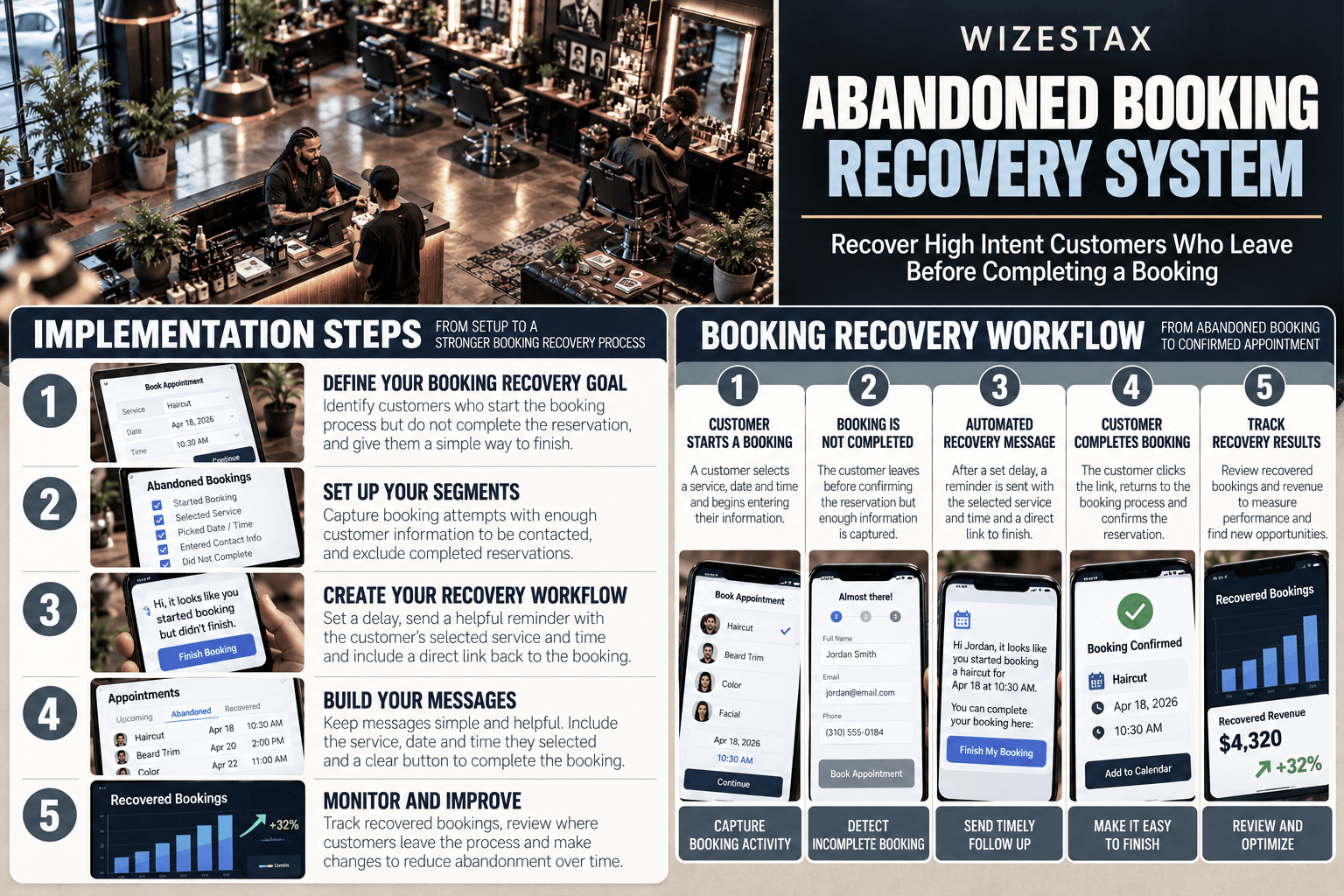
Step By Step Implementation Guide
The following setup demonstrates one implementation path using Booknetic.
It is not a WIZESTAX recommendation or preferred Stax.
Booknetic is used here because its current Booking Recovery capability directly detects incomplete booking sessions, supports configurable follow up timing and tracks recovered conversions. Booknetic
Step 1: Define A Completed Booking
Establish exactly what the system considers successful.
For most businesses, the booking should reach its final confirmation state before being classified as complete.
Anything earlier should not automatically be treated as a confirmed appointment.
Step 2: Identify The Recoverable Point
Determine when enough customer information becomes available to support recovery.
A visitor who opens the booking page and immediately leaves is different from someone who selects a service, chooses a time and provides contact information.
Recovery requires a reliable way to reconnect with the customer.
Step 3: Enable Booking Recovery
Install and activate the Booking Recovery capability.
Confirm that incomplete booking sessions are being detected and recorded.
Step 4: Configure The Abandonment Delay
Choose how long the system should wait before treating an unfinished session as abandoned.
Booknetic allows the recovery delay to be configured rather than requiring every business to use the same timing. Booknetic
The delay should give customers enough time to finish naturally before recovery begins.
Step 5: Create The Recovery Workflow
Build the basic sequence:
Booking Started → Booking Not Completed → Delay → Recovery Message
The recovery message should help the customer return without implying that an appointment already exists.
Step 6: Build The Message
Keep the communication simple.
Explain that the booking was not completed and provide a direct route back.
Avoid unnecessary urgency or an automatic discount.
Step 7: Establish The Completion Condition
Confirm how the platform recognizes a customer who returns and completes the booking.
Once the reservation is successfully created, that customer should no longer require abandoned booking recovery.
Step 8: Test The Entire Process
Use a controlled test customer.
Begin a booking.
Select a service and appointment information.
Provide the required contact information.
Leave before confirmation.
Confirm the abandoned session appears.
Verify the recovery message.
Return and complete the booking.
Confirm that the completed appointment is recorded correctly.
Step 9: Review Where Customers Leave
Do not look only at total abandoned bookings.
Where the platform provides the information, review which stage customers reach before leaving.
Repeated abandonment around service selection, availability, customer information or payment can provide different diagnostic clues.
It still does not establish why customers left.
Step 10: Monitor Recovery Results
Review:
Abandoned Booking Attempts
Identifiable Abandoned Customers
Recovery Messages Sent
Completed Bookings After Recovery
Recorded Recovered Bookings
Track the numbers over time without assuming every later booking was caused solely by the recovery message.
Booking Value At Risk Snapshot
| Monthly Recoverable Abandoned Bookings | Average Booking Value | Booking Value Entering Recovery |
|---|---|---|
| 10 | $100 | $1,000 |
| 30 | $100 | $3,000 |
| 60 | $100 | $6,000 |
Illustrative scenario only. Booking value entering recovery is not confirmed lost revenue or expected recovered revenue. Some customers would not have completed their reservation, while others may return independently.
WIZESTAX Diagnostic Scorecard
| Category | Assessment |
|---|---|
| Economic Problem | Customer booking intent disappears before a reservation reaches the calendar |
| Signal Quality Required | High |
| Automation Potential | High |
| Human Judgment Required | Moderate |
| Data Dependency | High |
| Scalability | High |
| Primary Value | Visibility and systematic follow up for incomplete bookings |
| Primary Risk | Treating every unfinished booking as recoverable revenue |
Common Mistakes
| Mistake | Result |
|---|---|
| Confusing abandoned bookings with no shows | Different customer problems become mixed together |
| Contacting customers before enough time has passed | Normal booking behavior can trigger unnecessary messages |
| Recovering customers without confirming identity | Messages can reach the wrong person |
| Continuing recovery after the booking is completed | Customers receive irrelevant communication |
| Automatically offering discounts | Revenue can be sacrificed without evidence that price caused abandonment |
| Ignoring the abandonment stage | Valuable diagnostic context is lost |
| Treating every incomplete booking as lost revenue | Economic impact becomes overstated |
| Ignoring communication consent requirements | Recovery creates unnecessary compliance risk |
Get New WIZESTAX Blueprints Every Monday
Subscribe to receive new WIZESTAX Blueprints covering Customer Retention, Marketing, Sales, Finance and Operations directly to your inbox.