0 Second Missed Call Capture
Keep Unanswered Calls From Quietly Becoming Lost Opportunities
For many local service businesses, the phone is still one of the most valuable ways a new customer first makes contact. A homeowner may be calling about a leaking pipe, damaged roof, fallen tree, electrical problem, HVAC issue, estimate request, repair, or another service they want handled quickly. The problem is that the person running the business is often the same person doing the work. They may be driving, working with another customer, standing on a jobsite, operating equipment, or simply unable to answer at that moment. The call rings. No one answers. The caller may leave a voicemail. They may call again later. Or they may immediately contact another business.
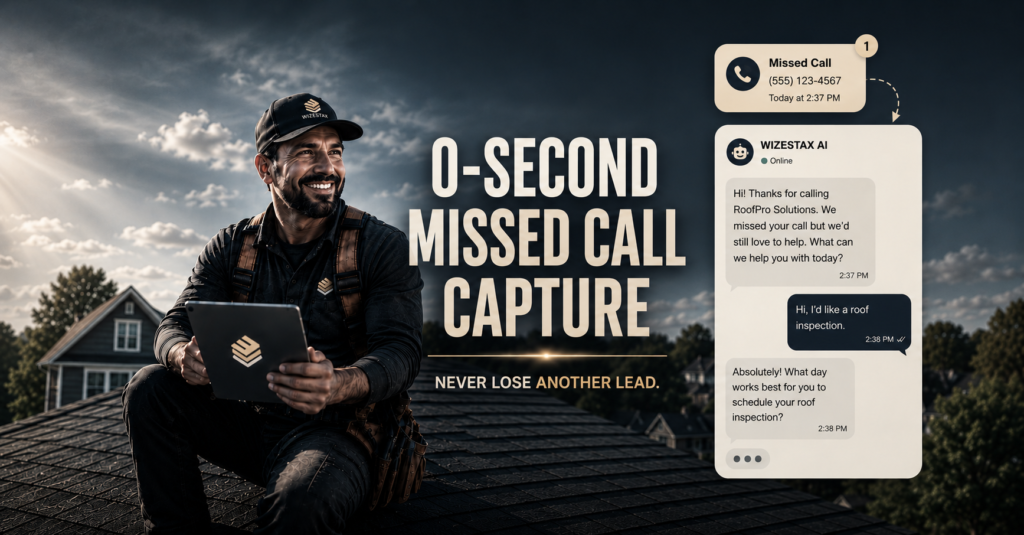
The 0 Second Missed Call Capture System creates an automatic first layer of communication when an inbound call is missed.
Instead of relying entirely on voicemail, the caller receives an immediate text acknowledging the missed call and providing a simple next step. The purpose is not to pretend the call was answered. It is to make sure the caller knows the business received their attempt to make contact.
Which Stax Fits Your Business
| Business Need | Stax | Software | Cost |
|---|---|---|---|
| Built in missed call text response with minimal setup | Starter Stax | Quo | Varies By Plan |
| Missed call response connected to lead records and workflow automation | Growth Stax | Quo + Make + HubSpot CRM | Varies By Usage |
| Phone, booking and field service operations connected inside a larger service platform | Pro Stax | ServiceTitan | Custom Pricing |
Pricing and capabilities change over time and should be confirmed directly with each software provider before purchase.
Software Linx
Starter Stax
Growth Stax
Pro Stax
Blueprint Overview
| Metric | Value |
|---|---|
| Category | Lead Generation |
| Business Problem | Potential customers call but nobody is available to answer |
| Primary Objective | Create immediate written contact after a missed inbound call |
| Core Signal | Valid inbound business call is missed |
| Setup Time | Approximately 15 To 90 Minutes |
| Difficulty | Beginner To Intermediate |
| Maintenance | Periodic message and routing review |
| Best For | Businesses where inbound phone calls frequently represent new customer demand |
| Primary Output | Missed caller receives an immediate next step |
The Hidden Revenue Leak
| Without This Blueprint | With This Blueprint |
|---|---|
| Missed caller reaches voicemail only | Caller receives immediate acknowledgment |
| Caller does not know when anyone will respond | Business can set expectations immediately |
| Staff manually review every missed call | Basic first contact can happen automatically |
| New inquiries can disappear unnoticed | Missed calls remain visible |
| Call information remains disconnected | Lead information can enter a structured process |
| Response depends entirely on staff availability | Initial communication can begin while staff are busy |
The economic problem is not simply having missed calls.
Every business misses calls occasionally.
The leak occurs when a legitimate potential customer tries to initiate a sales conversation and the business provides no useful response while that customer’s need is still active.
The system protects the moment between:
Inbound Call Attempt
and
Actual Human Or Automated Conversation
That makes this Blueprint narrower than a general lead response system.
The customer has specifically chosen the phone as their first contact method and the business has failed to answer that call.
Business Impact Snapshot
| Area | Potential Impact |
|---|---|
| Initial Response | Missed callers can receive acknowledgment immediately |
| Lead Visibility | Missed inbound opportunities become easier to track |
| Staff Work | Routine first responses require less manual effort |
| Customer Experience | Caller knows the business received the contact attempt |
| Lead Routing | Responses can move into a defined sales process |
| Scalability | More missed calls can be handled without equivalent manual texting |
The automation should not assume every missed caller is a sales opportunity.
Inbound calls may include existing customers, vendors, spam, employees, wrong numbers, billing inquiries, emergency situations, or other conversations.
The system therefore needs a simple path for identifying what the caller actually needs.
Real World Example
A plumber is underneath a kitchen sink when the business phone rings.
The plumber cannot safely stop working and answer.
The caller is a homeowner who discovered water leaking from a pipe.
The call is missed.
Within moments, the homeowner receives a text:
“Hi, thanks for calling {{business_name}}. We could not answer your call, but we received it. What can we help you with today?”
The homeowner replies that they have a leaking kitchen pipe.
The conversation is now visible even though the original phone call was not answered.
Depending on the business setup, the customer can provide a few basic details, receive a booking link, or wait for a staff member to continue the conversation.
The value of the system is not that it automatically closes the sale.
It prevents the missed call from automatically becoming silence.
WIZESTAX Stax Options
Starter Stax
Quo
Best For
Solo operators and small teams that want a straightforward missed call text response without constructing a larger automation system.
| Function | Software |
|---|---|
| Business Phone | Quo |
| Missed Call Detection | Quo |
| Automatic SMS Response | Quo |
| Customer Conversation | Quo |
| Business Hours Logic | Quo |
Quo, formerly OpenPhone, supports automatic SMS responses triggered by missed calls, new voicemails and incoming messages. Businesses can configure different responses during and outside business hours. (Quo)
Advantages
| Benefit |
|---|
| Simple architecture |
| Missed call response is built into the phone system |
| Different messages can be used during and after business hours |
| Calls and texts remain in the same communication environment |
| Minimal automation infrastructure is required |
Limitations
| Limitation |
|---|
| Native response logic is intentionally simple |
| Broader lead qualification may require additional tools |
| CRM workflows may require an integration |
| Message frequency controls affect repeated calls from the same number |
| Human follow through is still required for many conversations |
Growth Stax
Quo + Make + HubSpot CRM
Best For
Businesses that want missed call capture to create a structured lead process instead of stopping after the first automatic text.
| Function | Software |
|---|---|
| Business Phone | Quo |
| Missed Call Response | Quo |
| Automation | Make |
| CRM | HubSpot |
| Lead Record | HubSpot |
| Routing Logic | Make |
| Ongoing Conversation | Quo And Staff |
Quo supports integrations and automated messaging workflows beyond its native instant responses, while Make can be used to connect communication events with other business applications. (Quo)
Advantages
| Benefit |
|---|
| Existing phone communication remains central |
| Missed calls can become structured CRM records |
| Routing logic can be customized |
| Lead information can remain visible after the initial text |
| Human follow up can be organized around CRM activity |
Limitations
| Limitation |
|---|
| Several systems must remain connected |
| Setup requires more workflow design |
| Duplicate records need to be controlled |
| Poor routing logic can create unnecessary automation |
| Staff still need a clear ownership process |
Pro Stax
ServiceTitan
Best For
Established trade and field service businesses where phone calls, customer records, job booking, dispatching and service operations need to remain closely connected.
| Function | Software |
|---|---|
| Customer Records | ServiceTitan |
| Inbound Call Management | ServiceTitan |
| Job Booking | ServiceTitan |
| Scheduling | ServiceTitan |
| Dispatch | ServiceTitan |
| Contact Center Operations | ServiceTitan |
ServiceTitan connects inbound phone activity with customer and job records. Its current phone integrations range from call tracking to Phones Pro and Contact Center Pro. (ServiceTitan Help)
ServiceTitan also supports booking jobs directly from incoming calls, and its Contact Center Pro environment is designed around call handling and job booking for service businesses. (ServiceTitan Help)
Advantages
| Benefit |
|---|
| Phone activity can remain connected to field service operations |
| Customer and job information can remain together |
| Call handling can connect directly to booking |
| Suitable for larger service teams |
| Strong fit where the phone is part of a broader operational system |
Limitations
| Limitation |
|---|
| Significantly broader than simple missed call capture |
| Pricing is generally suited to established service businesses |
| Implementation is more complex |
| Some advanced contact center capabilities remain product specific |
| Contact Center Pro is currently described by ServiceTitan as early access |
How The Three Stax Differ
| Stax | Primary Approach |
|---|---|
| Quo | Native missed call text response |
| Quo + Make + HubSpot | Missed call capture connected to a CRM workflow |
| ServiceTitan | Phone activity connected to broader field service operations |
These are different architectures rather than rankings.
Quo fits businesses that mainly need to solve the immediate silence after a missed call.
Quo, Make and HubSpot fit businesses that want the missed call to become part of a structured lead management process.
ServiceTitan fits service companies where phone conversations need to remain connected to customer records, bookings, jobs, dispatch and larger operational workflows.
The right architecture depends on call volume, staff size, current phone system, sales process, CRM requirements and how much operational activity begins with a phone call.
Copy And Paste Missed Call SMS
“Hi {{first_name}}, thanks for calling {{business_name}}. We could not answer your call, but we received it. What can we help you with today?”
Copy And Paste After Hours SMS
“Hi, thanks for calling {{business_name}}. Our team is currently unavailable, but we received your call. Tell us what you need help with and someone can follow up as soon as possible during business hours.”
Copy And Paste AI Prompt
You are assisting a business with people who called but did not reach a staff member.
Your purpose is to understand why the person called and help move legitimate customer inquiries toward the correct next step.
Use only approved business information supplied to you.
Keep responses short, helpful, professional and conversational.
First determine the reason for the call.
For legitimate service inquiries, collect only the information necessary to understand the request.
Useful information may include:
Customer name
Service requested
Service location or service area
Brief description of the problem
Preferred next step
Do not ask for information that is not necessary at this stage.
Do not invent pricing.
Do not invent appointment availability.
Do not invent services, policies, response times, guarantees, discounts or service areas.
Do not promise that a technician or employee will arrive at a particular time unless accurate scheduling information has been supplied by the connected system.
If the caller has an emergency, safety issue, complaint, billing dispute, unusual request, or situation requiring professional judgment, route the conversation to the approved human process.
If the caller is an existing customer, vendor, employee, wrong number, spam contact, or another non sales caller, classify the conversation appropriately instead of treating everyone as a new lead.
Respect communication opt outs.
The goal is to make sure the missed caller receives a useful response without pretending a human answered the original call.
Step By Step Implementation Guide
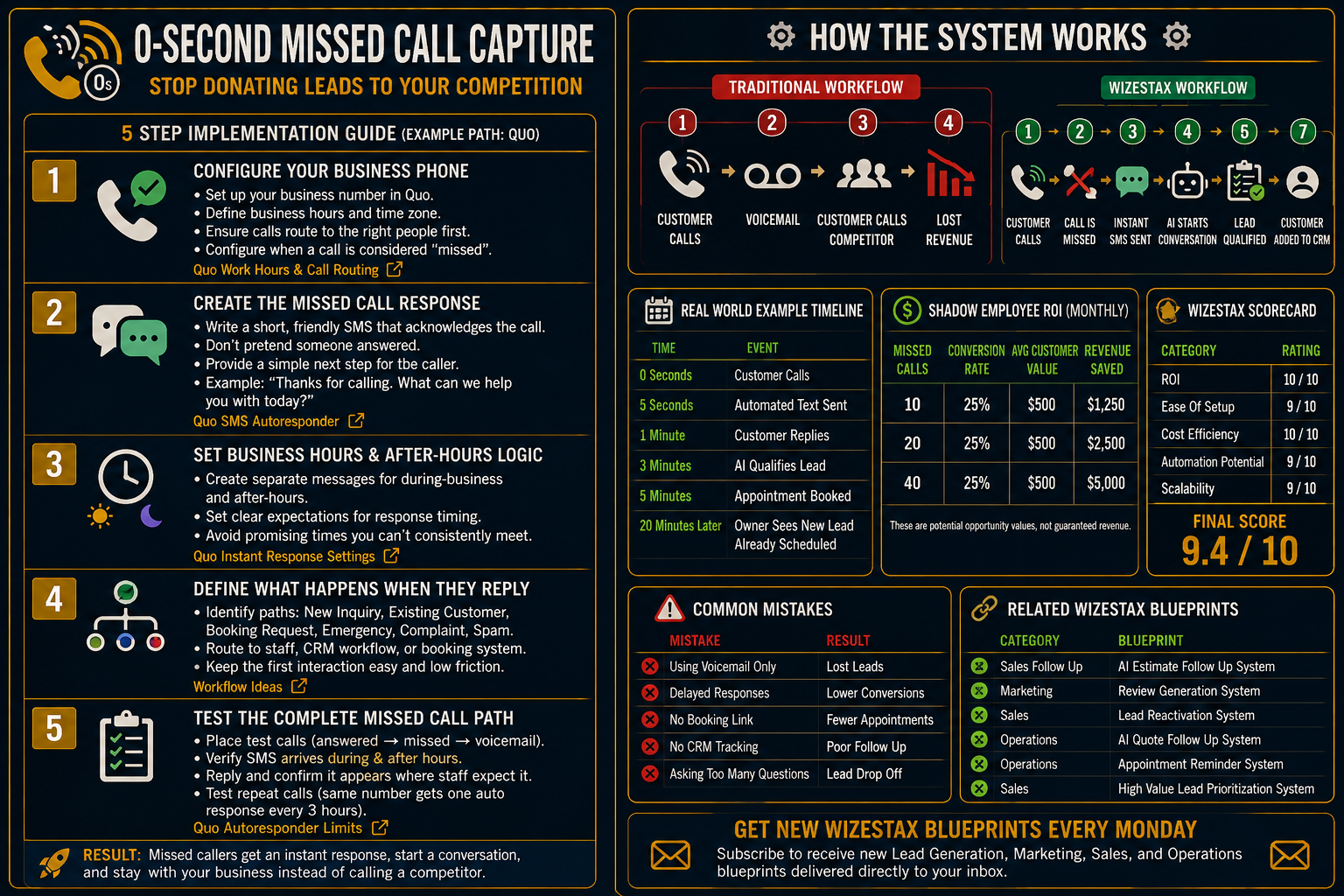
The following setup demonstrates one implementation path using Quo.
It is not a WIZESTAX recommendation or preferred Stax.
Quo is used here because the missed call trigger and automatic SMS response can operate directly inside the business phone system without requiring the business to build the initial capture process in a separate CRM.
Step 1: Configure The Business Phone Number
Open the business number that should receive customer calls.
Confirm:
Business Number
Make sure the correct customer facing number is being configured.
Business Hours
Set the hours when the business normally expects someone to answer.
Time Zone
Verify that business hours operate in the correct local time.
Call Routing
Make sure incoming calls reach the appropriate person or team before they are classified as missed.
Quo allows businesses to configure work hours and use different automatic responses depending on whether a missed call occurs during or outside those hours. (Quo)
Step 2: Create The Missed Call Response
Inside the phone number settings, locate the automatic response settings.
Quo currently supports separate missed call response conditions including calls with and without voicemail during and outside business hours. (Quo)
Create a short response that:
Acknowledges the call
Identifies the business
Avoids pretending someone answered
Provides a simple next step
Encourages the caller to explain what they need
For example:
“Thanks for calling {{business_name}}. We could not answer your call, but we received it. What can we help you with?”
Avoid beginning the conversation with a long questionnaire.
The first objective is simply to reopen communication.
Step 3: Separate Business Hours And After Hours Logic
The same message may not make sense at every time of day.
During normal hours, the business might tell the caller that someone will review their message.
After hours, the response should accurately explain that the team is unavailable and describe the approved next step.
Quo allows separate automatic responses for missed calls during and outside configured business hours. (Quo)
Do not promise a response time unless the business can consistently meet it.
Step 4: Define What Happens When The Caller Replies
The text response is only the first layer.
Create a clear process for incoming replies.
Possible paths include:
New Service Inquiry
Collect basic information or route to sales.
Existing Customer
Route to the appropriate customer service process.
Booking Request
Provide the approved booking process when appropriate.
Emergency Or Safety Issue
Escalate according to the business’s actual policy.
Complaint Or Billing Question
Route to a staff member.
Spam Or Wrong Number
Close or classify appropriately.
If the business needs deeper automation, this is where Make, a CRM, AI classification, or another workflow layer can be added.
The missed call system itself should not become an oversized intake form.
Step 5: Test The Complete Missed Call Path
Call the business number from a test phone.
Allow the call to go unanswered.
Confirm the automatic text arrives.
Repeat the test with a voicemail.
Test during business hours.
Test the after hours response.
Reply to the automatic text.
Confirm the reply appears where staff expect it.
Test a repeat call.
Quo states that automatic responses are limited so the same number does not receive repeated auto responses more than once within a three hour period. (Quo)
Confirm that staff understand who owns the conversation once the customer replies.
The system is ready when a missed inbound call reliably creates an immediate and visible communication path.
Missed Call Opportunity Snapshot
A useful way to evaluate this Blueprint is to measure the potential customer value represented by legitimate missed sales calls.
Consider an illustrative service business where the average new customer is worth $500.
| Legitimate Missed Sales Calls | Average Potential Customer Value | Opportunity Value Represented |
|---|---|---|
| 10 | $500 | $5,000 |
| 20 | $500 | $10,000 |
| 40 | $500 | $20,000 |
These figures represent potential opportunity value associated with missed calls. They do not represent revenue saved, recovered or created by the automation.
Some missed callers would have contacted the business again.
Some would never have purchased.
Some may not be legitimate sales leads.
Some may respond to the automatic text but never book.
The system does not turn every missed call into revenue.
The more useful measurements are:
Total Inbound Calls
How much phone activity entered the business.
Missed Calls
How many calls were not answered.
Eligible Missed Calls
How many missed calls entered the capture process.
Automatic Responses Delivered
How consistently the system acknowledged eligible calls.
Caller Replies
How many missed callers continued the conversation by text.
Qualified Opportunities
How many conversations represented legitimate potential business.
Human Handovers
How many required staff involvement.
Bookings Or Sales Progression
How many moved into the next stage of the business’s sales process.
WIZESTAX Diagnostic Scorecard
| Category | Assessment |
|---|---|
| Economic Problem | Legitimate inbound demand can disappear when nobody answers the phone |
| Trigger Accuracy Required | High |
| Automation Potential | High |
| Human Judgment Required | Moderate |
| Customer Effort | Very Low |
| Timing Dependency | Very High |
| Scalability | High |
| Primary Value | Reopening communication immediately after a missed call |
| Primary Risk | Treating every missed caller as the same type of lead |
Common Mistakes
| Mistake | Result |
|---|---|
| Sending the caller directly to voicemail with no other response | Customer receives no immediate next step |
| Writing a long automatic message | Caller may ignore the response |
| Asking too many questions immediately | The first interaction becomes unnecessary work |
| Treating every caller as a new lead | Existing customers and other contacts enter the wrong workflow |
| Promising unrealistic response times | Automatic communication creates false expectations |
| Allowing AI to invent pricing or availability | Customer receives unreliable information |
| Failing to assign replies to someone | Initial capture occurs but the conversation still dies |
| Sending repeated automatic texts | Useful outreach becomes intrusive |
| Trying to complete full customer intake immediately | Missed Call Capture overlaps another operational process |
| Measuring messages instead of sales progression | Automation activity is mistaken for business impact |
Related WIZESTAX Categories
| Category | Related Business Problem |
|---|---|
| Sales | New Lead Response |
| Sales | Lead Follow Up |
| Sales | Website Lead Qualification |
| Operations | Customer Intake |
| Operations | Appointment Reminder |
| Sales | High Value Lead Prioritization |
These remain separate problems. 0 Second Missed Call Capture begins when somebody calls the business and nobody answers. Its job is to eliminate the silence immediately following that missed call. New Lead Response manages the first response to a newly captured lead across the broader sales process. Lead Follow Up begins after an initial conversation has already occurred but the opportunity remains unresolved. Website Lead Qualification determines whether a website inquiry meets the business’s approved fit criteria. Customer Intake collects the operational information needed after a customer advances toward an actual service or appointment. Appointment Reminder operates after an appointment has already been scheduled. High Value Lead Prioritization determines which legitimate opportunities deserve greater attention after they have entered the sales system. Each Blueprint therefore protects a different economic or operational leak.
Get New WIZESTAX Blueprints Every Monday
Subscribe to receive new WIZESTAX Blueprints covering Lead Generation, Marketing, Sales, Finance and Operations directly to your inbox.