AI FAQ and Customer Support System
Answer Routine Customer Questions Without Pulling Staff Away From Real Work
Customer questions are a normal part of doing business. People want to know when the business is open, whether their location is serviced, how scheduling works, what they should bring, which services are available, or what a particular policy means. Individually, these questions may take only a few minutes to answer. Across dozens or hundreds of customers, they can consume substantial staff time. The larger problem appears when routine questions interrupt employees who are already serving customers, performing work, handling sales, or managing operations. The AI FAQ and Customer Support System creates a controlled first layer of support. It answers routine questions using approved business information, helps customers find relevant resources, and sends questions requiring judgment to a real person. This Blueprint is not designed to replace customer service employees. Its purpose is to separate repeatable information requests from situations where human attention actually creates value.
Which Stax Fits Your Business
| Business Need | Stax | Software | Cost |
|---|---|---|---|
| Website focused support with AI answers and human takeover | Starter Stax | Tidio | Varies By Plan And Usage |
| Support centered around a structured knowledge base and customer conversations | Growth Stax | Freshdesk | Varies By Plan And Users |
| Larger support operation requiring advanced AI, routing and support management | Pro Stax | Intercom | Varies By Plan And Usage |
Pricing and capabilities change over time and should be confirmed directly with each software provider before purchase.
Software Linx
Starter
Growth
Pro
Blueprint Overview
| Metric | Value |
|---|---|
| Category | Customer Service |
| Business Problem | Staff repeatedly answer routine customer questions |
| Primary Objective | Resolve approved routine questions without unnecessary staff involvement |
| Core Input | Customer question and approved business knowledge |
| Setup Time | Approximately 45 To 120 Minutes |
| Difficulty | Beginner To Intermediate |
| Maintenance | Regular knowledge review |
| Best For | Businesses receiving repetitive customer questions |
| Primary Output | Approved answer or appropriate human escalation |
The Hidden Revenue Leak
| Without This Blueprint | With This Blueprint |
|---|---|
| Staff repeatedly answer the same questions | Routine questions can receive consistent answers |
| Employees are interrupted throughout the day | Simple support can be separated from staff work |
| Customers wait for basic information | Approved answers can remain accessible outside staffed hours |
| Answers vary between employees | A controlled knowledge source can improve consistency |
| Difficult and simple questions enter the same queue | Exceptions can be routed to people |
| Support workload grows with customer volume | Routine information can scale more efficiently |
The economic problem is not simply the number of customer messages.
The larger leak is skilled employee time repeatedly being consumed by questions that do not require skilled employee judgment.
Every interruption has an opportunity cost.
A receptionist answering the same scheduling question is not handling another customer. A technician stopping work to answer a service area question is not completing the job. An owner replying to routine messages at night is spending time on information that could potentially have been available automatically.
The objective is therefore not maximum automation.
It is better allocation of human attention.
Business Impact Snapshot
| Area | Potential Impact |
|---|---|
| Staff Interruptions | Routine questions can require less employee involvement |
| Customer Access | Approved information can remain available outside normal response hours |
| Consistency | Customers receive answers from the same approved information |
| Support Capacity | Employees can focus on questions requiring judgment |
| Customer Experience | Simple questions can receive faster answers |
| Management | Repeated questions can reveal gaps in customer information |
The quality of the system depends heavily on the quality of the knowledge supplied to it.
Automation cannot compensate for missing, contradictory, or outdated business information.
Real World Example
A veterinary clinic closes its front desk at 6:00 PM.
At 8:45 PM, a customer visits the website and asks whether the clinic provides a particular routine service.
The support assistant checks the clinic’s approved information and provides the documented answer.
The customer then asks what they should bring to the appointment.
That information also exists in the approved knowledge base, so the assistant responds without staff involvement.
The customer then describes symptoms and asks whether the animal needs immediate medical attention.
That question requires professional judgment.
The automated support path stops and directs the customer according to the clinic’s approved escalation instructions.
The system did not attempt to replace the veterinary team.
It handled the information requests that did not require them and protected the boundary where human expertise became necessary.
WIZESTAX Stax Options
Starter Stax
Tidio
Best For
Smaller businesses that want website chat, routine AI assisted answers, and a relatively straightforward path between automated support and human conversations.
| Function | Software |
|---|---|
| Website Chat | Tidio |
| AI Support | Tidio Lyro |
| Customer Conversations | Tidio |
| Knowledge Sources | Tidio |
| Human Handoff | Tidio |
| Support Inbox | Tidio |
Advantages
| Benefit |
|---|
| Website support remains relatively centralized |
| Designed for customer conversations |
| AI can address repetitive questions |
| Human conversations can remain available |
| Less infrastructure than building a custom support architecture |
Limitations
| Limitation |
|---|
| Usage and AI limits depend on plan |
| Knowledge quality still requires business maintenance |
| More complex support operations may outgrow the platform |
| Businesses must configure escalation carefully |
Growth Stax
Freshdesk
Best For
Businesses that need routine customer support connected to a more structured help desk environment containing tickets, knowledge resources, support agents, and escalation processes.
| Function | Software |
|---|---|
| Help Desk | Freshdesk |
| Knowledge Base | Freshdesk |
| Customer Support | Freshdesk |
| Ticket Management | Freshdesk |
| AI Support | Freddy AI |
| Agent Routing | Freshdesk |
Advantages
| Benefit |
|---|
| Support questions can become structured tickets |
| Knowledge resources remain connected to support operations |
| Better suited to teams managing ongoing customer requests |
| Human escalation fits naturally into the help desk process |
| Support activity becomes easier to organize and measure |
Limitations
| Limitation |
|---|
| More setup than a simple website chatbot |
| AI capabilities can depend on plan and add ons |
| Knowledge articles require maintenance |
| Can be excessive for businesses receiving very little support volume |
Pro Stax
Intercom
Best For
Organizations handling larger customer conversation volumes that need AI support, a structured knowledge environment, human routing, inbox management, and broader customer service operations.
| Function | Software |
|---|---|
| Customer Support | Intercom |
| AI Support | Fin |
| Knowledge | Intercom |
| Customer Conversations | Intercom |
| Human Routing | Intercom |
| Support Management | Intercom |
Advantages
| Benefit |
|---|
| AI and human support can operate inside the same environment |
| Designed for larger customer conversation volumes |
| Knowledge can support automated answers |
| Strong routing and support management capabilities |
| Suitable for dedicated customer service teams |
Limitations
| Limitation |
|---|
| More infrastructure than many small businesses require |
| Cost can increase with usage and required capabilities |
| Successful AI support depends on accurate knowledge |
| Implementation requires careful support process design |
How The Three Stax Differ
| Stax | Primary Approach |
|---|---|
| Tidio | Website centered conversational support |
| Freshdesk | Help desk centered customer support |
| Intercom | Advanced conversational support and AI service infrastructure |
These are different implementation architectures rather than rankings.
Tidio fits businesses primarily trying to answer repetitive questions through website conversations.
Freshdesk fits businesses where customer questions should become part of a structured support operation with tickets, knowledge resources, and employees.
Intercom fits organizations where automated and human conversations need to operate across a more advanced support environment.
The appropriate architecture depends on support volume, communication channels, staff structure, existing software, and how complicated the questions become after routine information has been exhausted.
Copy And Paste FAQ Starter List
Build the knowledge base around questions customers actually ask.
Business Information
What are your business hours?
What areas do you serve?
How can I contact someone directly?
Services
What services do you offer?
What is included with each service?
Are there services you do not provide?
Scheduling
How do I schedule an appointment?
How do I reschedule?
What should I expect before my appointment?
Policies
What is your cancellation policy?
What payment methods do you accept?
Are there important policies customers should know before booking?
Only add answers using actual business information.
If the business cannot confidently approve an answer, the AI should not be expected to create one.
Copy And Paste AI Prompt
You are a customer support assistant for a service business.
Your purpose is to answer routine customer questions using only approved business information supplied to you.
You may assist with documented information such as business hours, service areas, available services, scheduling instructions, approved policies, preparation instructions and basic service information.
Keep responses short, helpful and conversational.
Never invent prices, availability, policies, services, guarantees, discounts, appointment times or other business information.
Do not infer an answer when the approved information does not clearly support it.
If the approved information does not contain the answer, tell the customer that a team member needs to assist.
Immediately escalate complaints, billing disputes, refund requests, emergencies, safety concerns, sensitive personal situations and unusual requests.
Do not provide professional medical, legal, financial or other regulated advice unless the business has supplied an explicitly approved response appropriate for that situation.
When uncertain, route the conversation to a person rather than guessing.
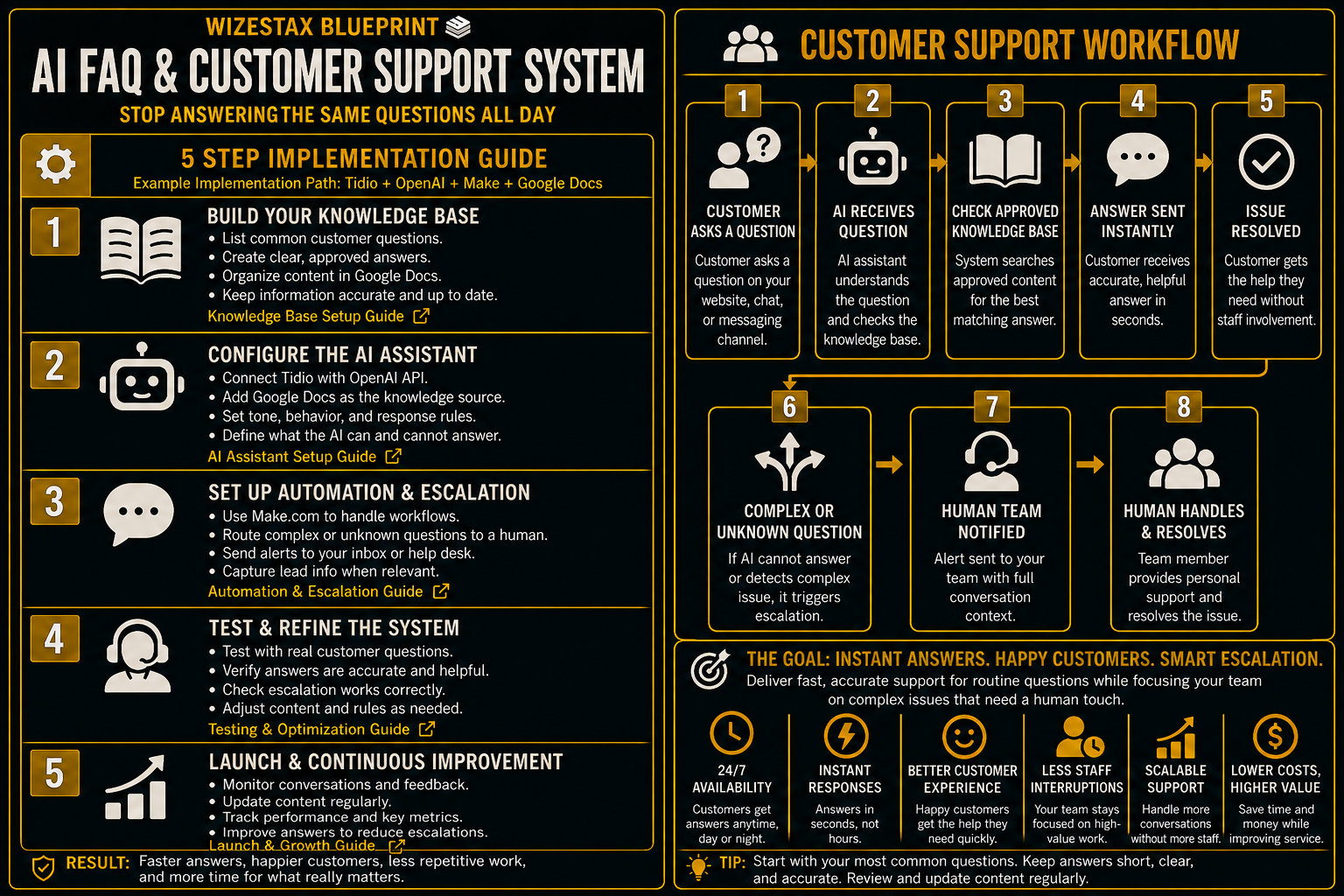
Step By Step Implementation Guide
The following setup demonstrates one implementation path using Tidio and Lyro AI.
It is not a WIZESTAX recommendation or preferred Stax.
Tidio is used here because website chat, AI responses, approved knowledge sources, conversation testing, and human support can operate within the same customer support environment.
Step 1: Identify Questions Suitable For Automation
Review actual customer conversations before building the assistant.
Separate questions into three groups.
Approved Routine Questions
Questions with stable, factual answers such as business hours, service areas, basic services and scheduling instructions.
Questions Requiring Current Information
Questions where the answer may depend on availability, current pricing, inventory, staffing or another changing condition.
Human Only Questions
Complaints, disputes, emergencies, unusual requests and situations requiring judgment.
The AI should begin with the first group.
Do not automate a question simply because customers ask it frequently.
Automate it because the business can provide a reliable approved answer.
Step 2: Build The Approved Knowledge
Create the information Lyro is allowed to use when answering customers.
Start with the highest volume routine questions.
Use clear, direct business language.
Remove outdated policies and conflicting answers.
Include enough context for the assistant to distinguish similar questions.
For example, do not simply document:
“Open 9 To 5.”
Specify which days, relevant time zone, holiday exceptions if appropriate, and any separate service hours customers need to understand.
Step 3: Configure The Customer Support Experience
Install or configure the Tidio chat experience on the appropriate website pages.
Decide where automated support should appear and what customers should see when beginning a conversation.
Make it clear that customers can receive help without creating the impression that automation has authority it does not actually have.
Provide an appropriate route to human assistance when necessary.
Step 4: Define Human Handoff Rules
Determine exactly when automated support should stop.
Examples include:
Answer Not Found
The approved knowledge does not contain a reliable answer.
Customer Requests A Person
The customer explicitly wants staff assistance.
Complaint Or Dispute
A person should manage the situation.
Sensitive Request
The issue involves information or judgment that should not be automated.
Repeated Failure
The assistant has not successfully resolved the customer’s question.
Human escalation is not a failure of the system.
It is part of the system.
The purpose of AI support is to resolve the questions it can safely handle while identifying the questions that deserve human attention.
Step 5: Test The Complete Support Path
Create a test set containing both easy and difficult customer questions.
Ask routine questions using different wording.
Ask questions whose answers are intentionally absent from the knowledge base.
Ask a question containing incorrect assumptions.
Test a complaint.
Test a request for a human.
Confirm that routine questions receive accurate answers.
Confirm that unsupported questions do not produce invented information.
Confirm that human escalation reaches the appropriate employee or support process.
Only expand the assistant’s responsibilities after the existing question set performs reliably.
Staff Capacity Snapshot
The economic value of this system is primarily the employee time repeatedly consumed by routine customer questions.
Consider an illustrative business where each routine question requires approximately five minutes of employee attention.
At an illustrative labor value of $30 per hour:
| Weekly Routine Questions | Time Per Question | Approximate Monthly Staff Time | Illustrative Labor Capacity |
|---|---|---|---|
| 25 | 5 Minutes | 8.3 Hours | $249 |
| 50 | 5 Minutes | 16.7 Hours | $501 |
| 100 | 5 Minutes | 33.3 Hours | $999 |
Illustrative scenario only. Actual support volume, handling time, labor costs and automation rates will vary.
This should not automatically be interpreted as direct cash savings.
If the business continues paying the same employees, the economic benefit appears primarily as staff capacity returned to other work.
That capacity can be used for customers, sales, operations, administrative work, or support situations where a person actually makes a difference.
WIZESTAX Diagnostic Scorecard
| Category | Assessment |
|---|---|
| Economic Problem | Skilled staff time is repeatedly consumed by routine information requests |
| Knowledge Accuracy Required | Very High |
| Automation Potential | High |
| Human Judgment Required | Low For Routine Questions, High For Exceptions |
| Customer Effort | Low |
| Data Dependency | Moderate |
| Scalability | High |
| Primary Value | Returning staff attention to work requiring human judgment |
| Primary Risk | AI providing confident answers from incomplete or outdated information |
Common Mistakes
| Mistake | Result |
|---|---|
| Giving AI too little approved information | Answers become incomplete |
| Allowing AI to guess | Customers receive incorrect information |
| Using outdated knowledge | Old policies continue reaching customers |
| Automating sensitive issues | Situations requiring judgment receive inappropriate responses |
| Hiding human assistance | Customers can become trapped in automation |
| Writing excessively long answers | Simple support becomes harder to use |
| Automating before studying actual questions | The system solves questions customers rarely ask |
| Measuring conversations instead of resolutions | Activity appears successful without showing support quality |
Related WIZESTAX Categories
| Category | Related Business Problem |
|---|---|
| Customer Service | Support Request Routing |
| Customer Service | Complaint Escalation |
| Lead Generation | Website Lead Qualification |
| Operations | Customer Intake |
| Sales | New Lead Response |
| Customer Retention | Customer Churn Warning |
These remain separate problems. The AI FAQ and Customer Support System owns repetitive customer questions that can be answered from approved business information. Website Lead Qualification determines whether a prospect appears appropriate for the business. New Lead Response protects the period immediately after a new sales inquiry arrives. Customer Intake collects information the business needs to prepare for a specific customer, appointment, or job. Complaint Escalation identifies situations requiring higher level human intervention. Customer Churn Warning identifies existing customers showing signals that they may be at risk of leaving. Each Blueprint therefore protects a different economic or operational leak.
Get New WIZESTAX Blueprints Every Monday
Subscribe to receive new WIZESTAX Blueprints covering Customer Retention, Marketing, Sales, Finance and Operations directly to your inbox.