

AI Estimate Follow Up System
Keep Open Estimates From Quietly Becoming Lost Jobs
Sending an estimate does not finish the sales process. A customer may be comparing providers, waiting for another decision maker, reviewing the cost, dealing with another priority, or simply forgetting to respond. An estimate can remain open for days or weeks without anyone knowing whether the customer is still considering the work. The AI Estimate Follow Up System creates a structured process around those unanswered estimates. It monitors estimate status, waits for an appropriate period, sends professional follow up communication, and stops outreach when the customer accepts, declines, or requires personal attention.
This Blueprint does not assume that additional follow up will make every customer accept an estimate. Its purpose is to prevent viable sales opportunities from disappearing simply because an open quote received no further attention.
Which Stax Fits Your Business
| Business Need | Stax | Software | Cost |
|---|---|---|---|
| Service business wanting estimates and follow up inside one operational platform | Starter Stax | Jobber | Varies By Plan |
| Sales team needing flexible deal and estimate follow up workflows | Growth Stax | Pipedrive | Varies By Plan And Users |
| Larger field service operation managing substantial estimate volume | Pro Stax | ServiceTitan | Custom Pricing |
Pricing and capabilities change over time and should be confirmed directly with each software provider before purchase.
Software Linx
Starter
Growth
Pro
Blueprint Overview
| Metric | Value |
|---|---|
| Category | Sales |
| Business Problem | Open estimates receive inconsistent attention and quietly become lost opportunities |
| Primary Objective | Maintain a structured process around unanswered estimates |
| Core Signal | Estimate remains open without acceptance or rejection |
| Setup Time | Approximately 30 To 90 Minutes |
| Difficulty | Beginner To Intermediate |
| Maintenance | Periodic timing and message review |
| Best For | Businesses that regularly send estimates, proposals or quotes |
| Primary Output | Open estimate tracked until a meaningful outcome occurs |
The Hidden Revenue Leak
| Without This Blueprint | With This Blueprint |
|---|---|
| Estimates sit unanswered | Open estimates remain visible |
| Staff must remember which quotes need attention | Follow up follows defined rules |
| Timing changes between employees | Follow up timing becomes more consistent |
| Accepted or declined estimates may still receive messages | Estimate status can control outreach |
| Sales opportunities quietly become stale | Aging estimates remain measurable |
| Nobody knows why customers stopped responding | Responses can provide useful sales information |
The economic problem is not simply that employees forget to send reminders.
The larger leak is revenue represented by legitimate sales opportunities that remain unresolved until they quietly become lost business.
The estimate already required time to prepare. In many businesses it may also represent advertising expense, sales labor, travel, inspection time, or administrative work.
A useful system protects that investment by making sure the estimate reaches a meaningful outcome instead of disappearing into an inbox.
Business Impact Snapshot
| Area | Potential Impact |
|---|---|
| Sales Visibility | Open estimates remain easier to identify |
| Staff Work | Routine follow up can require less manual effort |
| Consistency | Similar opportunities can follow defined timing rules |
| Customer Experience | Customers receive a clear opportunity to ask questions or respond |
| Pipeline Management | Accepted, declined and unresolved estimates become easier to distinguish |
| Management | Estimate outcomes can become measurable rather than anecdotal |
The goal is not maximum message volume.
The goal is to keep legitimate opportunities visible long enough for the business to understand what happened to them.
Real World Example
A residential painting company visits a homeowner and prepares a $4,200 estimate.
The estimate is sent on Monday.
The customer opens it but does not respond.
Nothing about that silence reveals whether the customer rejected the price, is comparing another company, needs to speak with a spouse, has questions, or simply became distracted.
After the company’s defined waiting period, the system sends a short follow up message.
The customer replies that they want the project completed but need the work scheduled after an upcoming vacation.
A salesperson takes over the conversation.
The customer later approves the estimate and scheduling begins.
The system did not convince the customer to purchase.
It prevented silence from being mistaken for a final sales outcome.
WIZESTAX Stax Options
Starter Stax
Jobber
Best For
Service businesses that already manage customers, quotes, jobs, and scheduling through a field service platform and want quote follow up connected to the same operational record.
| Function | Software |
|---|---|
| Customer Records | Jobber |
| Quotes | Jobber |
| Quote Status | Jobber |
| Customer Communication | Jobber |
| Quote Follow Up | Jobber |
| Job Conversion | Jobber |
Advantages
| Benefit |
|---|
| Quotes remain connected to customer records |
| Designed around service business workflows |
| Accepted quotes can move toward operational work |
| Less infrastructure than connecting several separate applications |
| Quote activity remains close to scheduling and job management |
Limitations
| Limitation |
|---|
| Automation capabilities depend on the selected plan |
| Less flexible than a dedicated automation architecture |
| Primarily suited to service businesses |
| Complex sales processes may require additional tools |
Growth Stax
Pipedrive
Best For
Businesses where estimates are part of a broader sales pipeline and employees need clear ownership, activities, stages, and automation around unresolved opportunities.
| Function | Software |
|---|---|
| CRM | Pipedrive |
| Opportunity Tracking | Pipedrive Deals |
| Pipeline Management | Pipedrive |
| Follow Up Activities | Pipedrive Activities |
| Automation | Pipedrive Automations |
| Sales Ownership | Pipedrive |
Advantages
| Benefit |
|---|
| Sales focused pipeline architecture |
| Open opportunities remain visible |
| Activities can create clear employee responsibilities |
| Flexible sales stages |
| Suitable for businesses with dedicated sales processes |
Limitations
| Limitation |
|---|
| Not primarily a field service platform |
| Estimates may originate in another business system |
| Automation availability depends on plan |
| Additional integration may be necessary when quoting occurs elsewhere |
Pro Stax
ServiceTitan
Best For
Established field service organizations handling larger volumes of estimates across technicians, salespeople, customers, and locations.
| Function | Software |
|---|---|
| Customer Management | ServiceTitan |
| Estimate Management | ServiceTitan |
| Field Operations | ServiceTitan |
| Sales Tracking | ServiceTitan |
| Customer Communication | ServiceTitan |
| Reporting | ServiceTitan |
Advantages
| Benefit |
|---|
| Estimate activity connects to broader field operations |
| Suitable for larger service organizations |
| Detailed sales and operational reporting |
| Customer and service history remain connected |
| Can support structured unsold estimate processes |
Limitations
| Limitation |
|---|
| More infrastructure than many small businesses require |
| Higher implementation complexity |
| Pricing requires direct consultation |
| Advanced capabilities may require additional products or configuration |
How The Three Stax Differ
| Stax | Primary Approach |
|---|---|
| Jobber | Estimate follow up inside a small business field service workflow |
| Pipedrive | Estimate opportunity managed as part of a sales pipeline |
| ServiceTitan | Estimate recovery inside a larger field service operation |
These are different implementation architectures rather than rankings.
Jobber fits service businesses where the estimate should remain closely connected to the customer and resulting job.
Pipedrive fits businesses where the larger concern is sales pipeline visibility and ownership of unresolved opportunities.
ServiceTitan fits larger field service operations where estimates are part of a more extensive sales and operational infrastructure.
The appropriate architecture depends on where estimates are created, who owns the sale, how complex the sales process is, and what must happen after an estimate is accepted.
Copy And Paste Follow Up Message
“Hi {{first_name}}, just checking in on the estimate we sent for your project. If you have any questions or need any additional information before making a decision, just reply here and we will be happy to help.”
Copy And Paste Final Follow Up Message
“Hi {{first_name}}, I wanted to follow up once more regarding your estimate. If you are still considering the project, we would be happy to answer any questions. If your plans have changed, that is completely fine too. Just let us know.”
Copy And Paste AI Prompt
You are assisting a service business with customers who have received an estimate but have not yet accepted or declined it.
Your purpose is to help the business understand whether the customer is still considering the work and make it easy for the customer to ask questions.
Keep communication short, professional and conversational.
Do not pressure the customer into accepting the estimate.
Do not assume that silence means rejection.
When a customer responds, identify whether they are still considering the work, have a question, have a concern, want to proceed, or no longer need the service.
Answer only questions supported by information supplied by the business.
Do not invent prices, discounts, availability, financing terms, project details or company policies.
Do not modify the estimate.
Route pricing negotiations, scope changes, unusual requests, complaints and situations requiring judgment to a staff member.
Stop unnecessary follow up when the estimate has been accepted, declined, expired, replaced, or otherwise resolved.
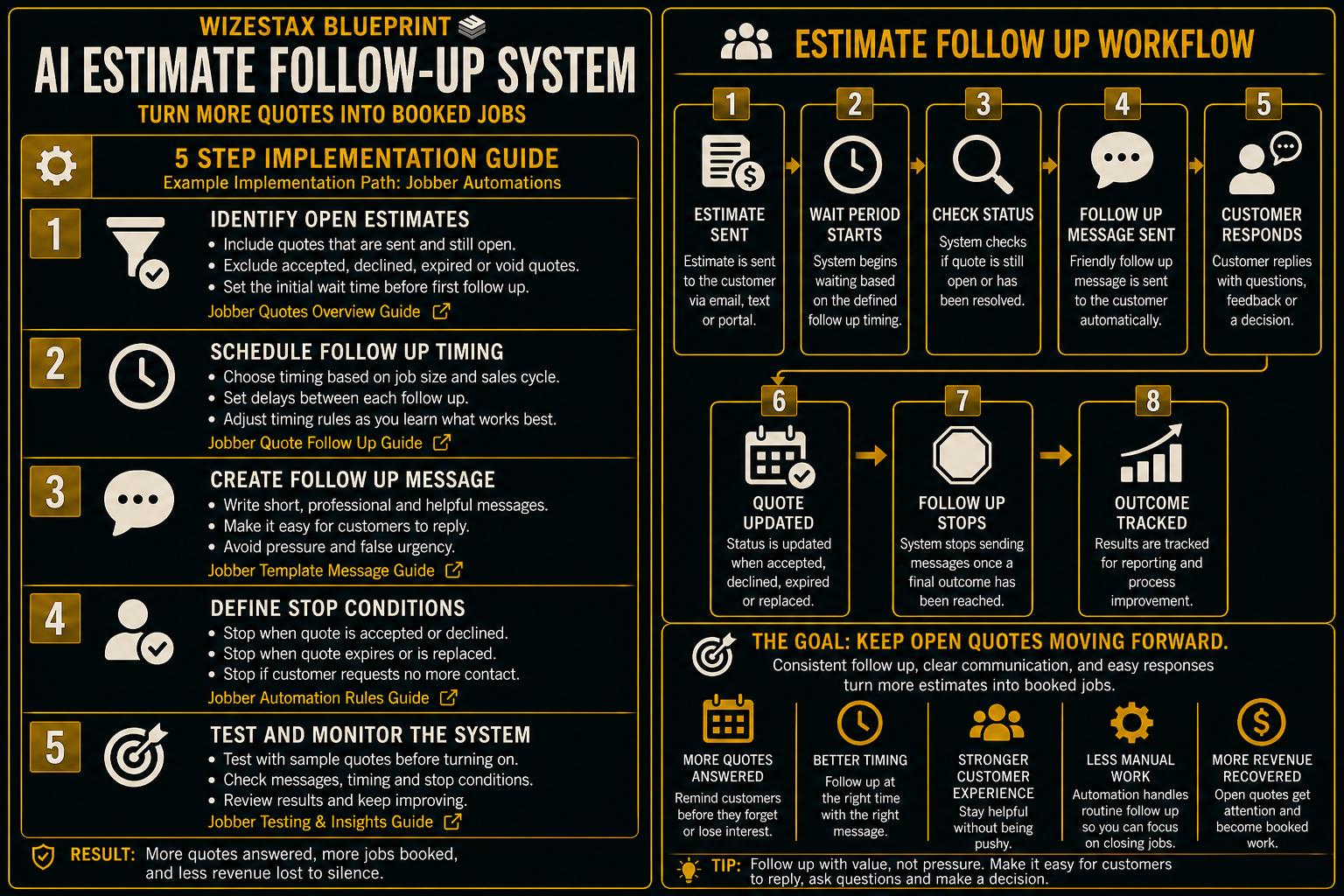
Step By Step Implementation Guide
The following setup demonstrates one implementation path using Jobber.
It is not a WIZESTAX recommendation or preferred Stax.
Jobber is used here because quotes can remain connected to the customer and subsequent job process, providing a practical example of estimate follow up inside a service business workflow.
Step 1: Define Which Quotes Need Follow Up
Before automating anything, define which estimates should enter the process.
A useful rule should distinguish between:
Sent Quotes
The customer has actually received the estimate.
Open Quotes
The estimate has not yet been accepted or rejected.
Resolved Quotes
The customer has already made a decision.
Exceptions
Quotes that staff do not want automatically followed up.
Avoid using time alone as the trigger.
The system should confirm that the estimate is still genuinely unresolved before contacting the customer.
Step 2: Configure Quote Follow Up
Open the appropriate quote or automation settings in Jobber.
Configure the follow up process available for the business’s account and plan.
Choose timing that gives the customer a reasonable opportunity to review the estimate before receiving another message.
The appropriate timing depends on the type and value of the work.
A small repair estimate may require a different sales cycle from a major remodeling project.
Step 3: Write The Follow Up Message
Create a short message that reminds the customer about the estimate without assuming why they have not responded.
The message should make three actions easy:
Ask A Question
The customer may need clarification.
Continue Considering
The customer may simply need more time.
Respond With A Decision
The customer may be ready to proceed or decline.
Avoid creating artificial urgency unless the business has a genuine reason such as an actual estimate expiration date.
Step 4: Define The Stop Conditions
Determine exactly when automated follow up should end.
Stop conditions can include:
Estimate Accepted
The sales objective has been reached.
Estimate Declined
The customer has provided a decision.
Estimate Replaced
A revised quote has taken its place.
Customer Requests No Further Contact
Outreach should stop.
Staff Takes Over
A person is actively managing the conversation.
This step prevents a useful sales system from becoming repetitive customer messaging.
Step 5: Test The Complete Estimate Path
Create several test estimates.
Test an estimate that remains open.
Test an accepted estimate.
Test a declined estimate.
Test a revised estimate.
Test a customer who replies with a question.
Confirm that only unresolved estimates receive the appropriate follow up.
Confirm that accepted and declined quotes stop receiving unnecessary messages.
Verify that staff can see when a customer responds and can take over when necessary.
The system is ready when an open estimate can move through the follow up process without losing track of its current status.
Open Estimate Value Snapshot
The primary economic value of this system is the sales opportunity represented by estimates that remain unresolved.
Consider a business with an average open estimate value of $750.
| Monthly Open Estimates | Average Estimate Value | Open Estimate Value Represented |
|---|---|---|
| 10 | $750 | $7,500 |
| 20 | $750 | $15,000 |
| 40 | $750 | $30,000 |
These figures represent the value of open estimates, not additional revenue created by follow up.
Not every estimate would have been accepted without automation, and follow up cannot guarantee additional sales.
The useful measurements are:
Open Estimates
How many sent estimates remain unresolved.
Follow Up Attempts
How many appropriate reminders were sent.
Customer Responses
How many customers returned to the conversation.
Accepted Estimates
How many estimates eventually became approved work.
Declined Estimates
How many opportunities reached a clear negative outcome.
Unresolved Estimates
How many opportunities remain open after the follow up process.
The system creates visibility and consistency around revenue already sitting in the sales pipeline.
WIZESTAX Diagnostic Scorecard
| Category | Assessment |
|---|---|
| Economic Problem | Legitimate sales opportunities can quietly disappear while estimates remain unanswered |
| Status Accuracy Required | High |
| Automation Potential | High |
| Human Judgment Required | Moderate |
| Customer Effort | Low |
| Data Dependency | Moderate |
| Scalability | High |
| Primary Value | Keeping open estimates visible until a meaningful outcome occurs |
| Primary Risk | Excessive or inappropriate follow up damaging the sales relationship |
Common Mistakes
| Mistake | Result |
|---|---|
| Following up immediately after sending the estimate | Customers are not given reasonable decision time |
| Sending too many reminders | Helpful follow up becomes pressure |
| Continuing after acceptance | Customers receive irrelevant communication |
| Continuing after rejection | Customer preferences are ignored |
| Ignoring estimate status | Resolved opportunities continue through automation |
| Treating every estimate identically | Different sales cycles receive inappropriate timing |
| Inventing urgency | Customer trust can be damaged |
| Measuring messages instead of estimate outcomes | Activity appears productive without showing sales results |
Related WIZESTAX Categories
| Category | Related Business Problem |
|---|---|
| Sales | Sales Follow Up Timing |
| Sales | Quote Acceptance Friction Detection |
| Sales | Sales Opportunity Aging |
| Lead Generation | New Lead Response |
| Operations | Customer Intake |
| Customer Retention | Customer Reactivation |
These remain separate problems. The AI Estimate Follow Up System owns the period after an estimate has been delivered but before the customer has provided a meaningful decision. New Lead Response protects the initial inquiry before an estimate exists. Customer Intake collects operational information needed to understand or prepare for work. Quote Acceptance Friction Detection investigates why customers encounter difficulty moving from estimate to approval. Sales Opportunity Aging identifies opportunities that remain unresolved beyond the expected sales cycle. Customer Reactivation addresses previous customers whose relationship has already become inactive. Each Blueprint therefore protects a different economic or operational leak.
Get New WIZESTAX Blueprints Every Monday
Subscribe to receive new WIZESTAX Blueprints covering Customer Retention, Marketing, Sales, Finance and Operations directly to your inbox.