
Price Increase Communication System
Communicate Price Changes Clearly Before They Become Customer Problems
Raising prices is sometimes necessary as labor costs change, and supplier prices rise. Software expenses increase, insurance becomes more expensive. Services improve. Businesses add staff, equipment, capabilities, support, or operating capacity.
The pricing decision itself is only part of the problem. Existing customers also need to understand what is changing, when it changes, whether the change applies to them, and what they should do if they have questions. When that communication is inconsistent, customers can discover the increase on an invoice, during a renewal, at their next appointment, or while speaking with an employee who was not prepared to explain it. That turns a pricing decision into a customer relationship problem.
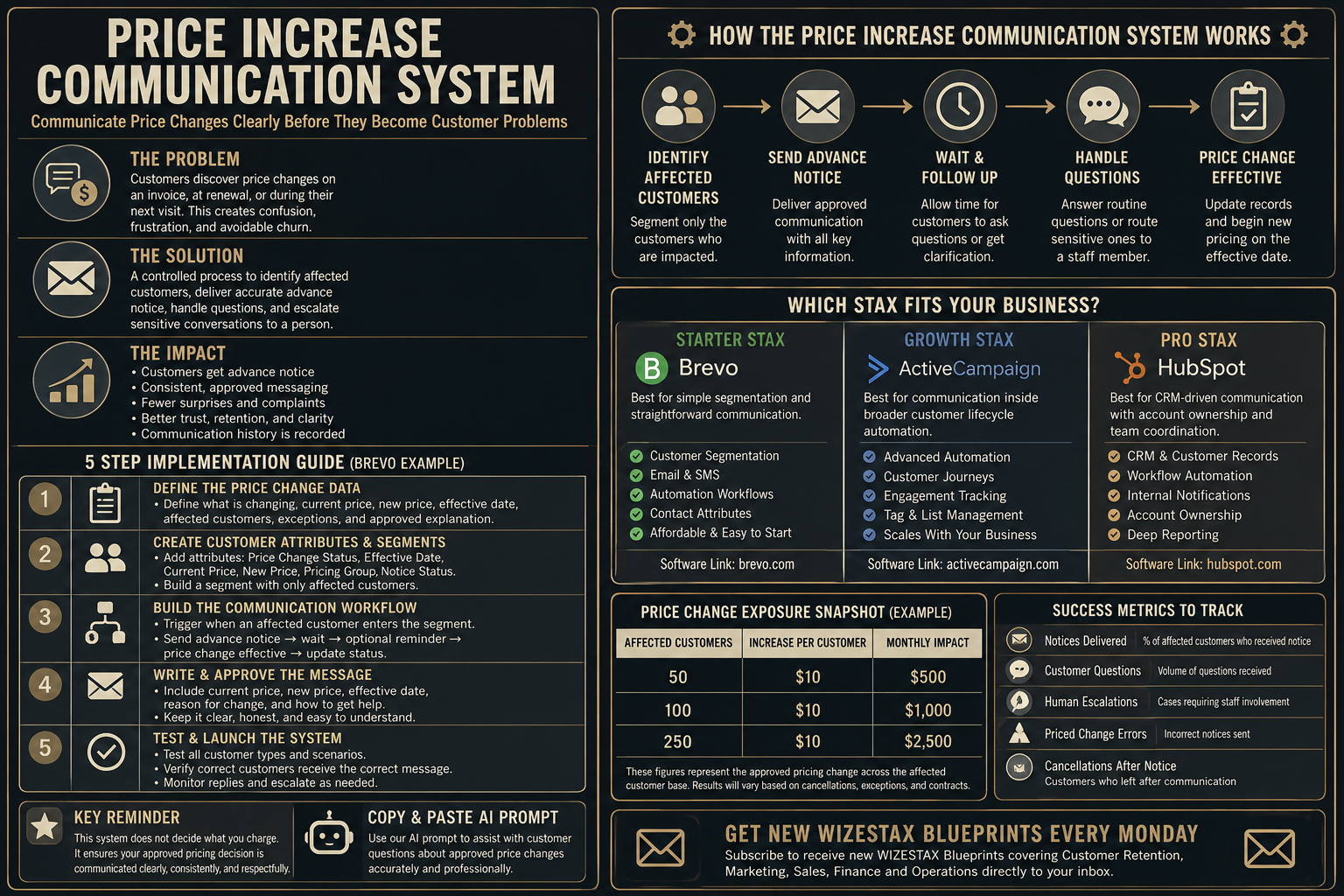
The Price Increase Communication System creates a controlled process for identifying affected customers, delivering accurate advance notice, recording communication, handling routine questions, and escalating sensitive conversations to a person.
The goal is not to convince every customer that a higher price is good. The goal is to make sure an important financial change is communicated clearly, consistently, and respectfully.
Which Stax Fits Your Business
| Business Need | Stax | Software | Cost |
|---|---|---|---|
| Straightforward customer segmentation and automated communication | Starter Stax | Brevo | Varies By Plan |
| Price communication connected to customer lifecycle automation | Growth Stax | ActiveCampaign | Varies By Contacts And Plan |
| Customer specific communication connected to deeper CRM records | Pro Stax | HubSpot | Varies By Hub And Plan |
Pricing and capabilities change over time and should be confirmed directly with each software provider before purchase.
Software Linx
Starter Stax
Growth Stax
Pro Stax
Blueprint Overview
| Metric | Value |
|---|---|
| Category | Customer Retention |
| Business Problem | Customers experience price changes without consistent advance communication |
| Primary Objective | Communicate approved price changes accurately before they take effect |
| Core Signal | Customer is affected by an approved future price change |
| Setup Time | Approximately 60 To 120 Minutes |
| Difficulty | Beginner To Intermediate |
| Maintenance | Required whenever pricing, eligibility, timing, or customer records change |
| Best For | Businesses changing prices for existing customers |
| Primary Output | Correct customer receives the correct price notice at the correct time |
The Hidden Revenue Leak
| Without This Blueprint | With This Blueprint |
|---|---|
| Customers discover changes unexpectedly | Customers receive advance communication |
| Employees explain changes differently | Approved messaging stays consistent |
| Customer groups are handled manually | Affected customers can be segmented |
| Important dates are easy to miss | Communication follows defined timing |
| Questions arrive without context | Staff receive a structured escalation path |
| Notice history is difficult to verify | Communication activity can be recorded |
The economic problem is not the price increase itself.
The leak is avoidable customer friction created when an approved price change is communicated inaccurately, inconsistently, or too late.
A commercially justified increase can still create unnecessary confusion if a customer does not understand the new price or effective date.
Advance notice is particularly important because customers may need time to adjust budgets or evaluate the change. Clear communication should identify what is changing, when it becomes effective, who is affected, and what the customer can do next. (Revenue Management Labs)
This Blueprint begins after the business has made and approved the pricing decision.
It does not determine what the business should charge.
Business Impact Snapshot
| Area | Potential Impact |
|---|---|
| Customer Awareness | Affected customers learn about the change before it takes effect |
| Message Consistency | Customers receive approved information |
| Staff Work | Routine notification can require less manual outreach |
| Customer Questions | Routine questions can follow a defined path |
| Escalation | Sensitive conversations can reach the appropriate employee |
| Record Keeping | Communication activity becomes easier to track |
| Scalability | Larger customer groups can be notified systematically |
Price increases can affect trust and retention, which makes communication part of the implementation rather than an afterthought. Direct notice, reasonable advance warning, clear reasoning, and a way to ask questions are recurring recommendations in current guidance. (U.S. Chamber of Commerce)
Real World Example
A residential cleaning company decides to increase the price of a recurring service from $140 to $150 beginning October 1.
The business has 180 recurring customers.
Some customers receive weekly service.
Others receive service every two weeks.
Several customers have individual agreements that remain at their current price until a later date.
Without a structured process, an employee exports the customer list and begins sending emails manually.
One customer receives the wrong price.
Several customers with protected pricing receive the announcement accidentally.
Another customer never receives anything and discovers the increase after seeing the next charge.
With the communication system, the business first identifies exactly which customer records are affected.
Those customers receive the approved notice containing the current price, new price, effective date, and contact path for questions.
Customers whose agreements are not changing remain outside the workflow.
A customer who replies with a contract question is routed to a person.
The automation did not decide the price.
It made sure the approved pricing decision reached the correct customers in a controlled way.
WIZESTAX Stax Options
Starter Stax
Brevo
Best For
Small businesses that need customer segmentation, email communication, basic automation, and contact tracking without a larger CRM implementation.
| Function | Software |
|---|---|
| Customer Records | Brevo |
| Segmentation | Brevo |
| Brevo | |
| SMS Where Appropriate | Brevo |
| Automation | Brevo |
| Contact Attributes | Brevo |
Brevo allows businesses to build segments from contact information and use those segments inside automations. Contact attributes can also trigger automation based on defined customer criteria. (Brevo Help)
Advantages
| Benefit |
|---|
| Communication and customer segmentation remain together |
| Custom attributes can identify affected customers |
| Automation can send email or SMS |
| Suitable for relatively straightforward customer lists |
| Lower implementation complexity than a larger CRM architecture |
Limitations
| Limitation |
|---|
| Pricing data must be accurate before automation begins |
| Complex contracts may require external records |
| Sensitive objections still require human handling |
| Segmentation errors can send incorrect notices |
| Broader account management may require additional software |
Growth Stax
ActiveCampaign
Best For
Businesses already using customer lifecycle automation that need price communication to interact with segmentation, account activity, tags, and ongoing customer messaging.
| Function | Software |
|---|---|
| Customer Records | ActiveCampaign |
| Segmentation | ActiveCampaign |
| Email Automation | ActiveCampaign |
| Customer Journey Logic | ActiveCampaign |
| Follow Up | ActiveCampaign |
| Engagement Tracking | ActiveCampaign |
Advantages
| Benefit |
|---|
| Strong customer automation environment |
| Communication can interact with existing lifecycle workflows |
| Customer groups can receive different approved paths |
| Useful when pricing communication is one part of broader retention activity |
| Follow up can be organized around customer behavior |
Limitations
| Limitation |
|---|
| Requires careful segmentation |
| Complex automation can become difficult to maintain |
| Pricing source data may still live elsewhere |
| Not every customer objection should enter automated follow up |
| Existing customer automation must be checked for conflicting messages |
Pro Stax
HubSpot
Best For
Businesses where price changes depend on detailed CRM information, account ownership, customer relationships, sales records, contracts, or coordinated staff follow up.
| Function | Software |
|---|---|
| CRM | HubSpot |
| Customer Properties | HubSpot |
| Segmentation | HubSpot |
| Workflow Automation | HubSpot |
| HubSpot | |
| Internal Notifications | HubSpot |
| Account Ownership | HubSpot |
HubSpot workflows can use record information to automate actions and can send internal notifications or automated communication depending on the HubSpot products and subscription involved. (HubSpot Knowledge Base)
Advantages
| Benefit |
|---|
| Customer communication remains connected to CRM records |
| Useful for account specific pricing situations |
| Internal owners can be incorporated into the process |
| Complex customer groups can be managed with record properties |
| Strong fit for businesses with larger sales or service teams |
Limitations
| Limitation |
|---|
| Advanced automation depends on subscription level |
| More system than a simple customer list may require |
| Accurate CRM data is essential |
| Complex pricing arrangements still require human review |
| Implementation requires stronger data governance |
How The Three Stax Differ
| Stax | Primary Approach |
|---|---|
| Brevo | Straightforward customer segmentation and communication |
| ActiveCampaign | Price communication inside broader customer lifecycle automation |
| HubSpot | CRM driven communication with deeper account and staff coordination |
These are different architectures rather than rankings.
Brevo fits businesses that primarily need to identify affected customers and communicate with them consistently.
ActiveCampaign fits businesses where customer communication already operates through more developed lifecycle automation.
HubSpot fits businesses where pricing changes depend on detailed CRM information or require coordination between account owners, sales teams, service teams, and customers.
The correct architecture depends on customer count, pricing complexity, existing systems, contract structure, communication channels, and the amount of human involvement required.
Copy And Paste Price Increase Notice
Subject: An Update To Your Pricing
“Hi {{first_name}},
We are writing to let you know about an upcoming change to your pricing with {{business_name}}.
Beginning {{effective_date}}, your price for {{service_or_product}} will change from {{current_price}} to {{new_price}}.
{{approved_reason_for_change}}
We wanted to provide advance notice so you have time to prepare for the change.
If you have any questions about how this applies to your account, please {{approved_contact_method}}.
Thank you for continuing to work with us.
{{business_name}}”
Copy And Paste Short Notice
“Hi {{first_name}}, we wanted to give you advance notice that the price of {{service}} will change from {{current_price}} to {{new_price}} beginning {{effective_date}}. If you have questions about your account, please {{approved_contact_method}}.”
Copy And Paste AI Prompt
You are assisting a business with customer questions about an approved price change.
Use only pricing, dates, customer information, policies, options, and explanations explicitly supplied by the business.
Your purpose is to explain the approved change clearly and route situations requiring judgment to a staff member.
Keep responses concise, respectful, factual, and professional.
Never invent a price.
Never invent an effective date.
Never invent the reason for an increase.
Never invent discounts.
Never invent grandfathered pricing.
Never invent contract terms.
Never invent exceptions.
Never promise that an increase can be reversed.
Never negotiate pricing unless the business has explicitly provided approved negotiation rules.
Do not tell a customer that everyone is receiving the same increase unless that information has been verified.
If the customer disputes their current price, new price, contract, billing terms, eligibility, effective date, or previous agreement, route the conversation to a staff member.
If the customer expresses dissatisfaction or indicates they may leave because of the change, record the concern and route it according to the approved customer retention process.
If the customer asks a routine question that can be answered entirely from approved information, provide the answer clearly.
The goal is accurate communication, not persuasion.
Step By Step Implementation Guide
The following setup demonstrates one implementation path using Brevo.
It is not a WIZESTAX recommendation or preferred Stax.
Brevo is used here because customer attributes, segments, email communication, automation rules, and contact updates can operate within the same environment.
Step 1: Define The Price Change Data
Before creating any customer communication, define the approved pricing change.
At minimum, establish:
Affected Product Or Service
What exactly is changing?
Current Price
What does the affected customer currently pay?
New Price
What will the customer pay after the change?
Effective Date
When does the new price begin?
Affected Customers
Which customers actually receive the increase?
Exceptions
Which customers should not receive the standard notice?
Approved Explanation
What explanation may employees and automation provide?
Escalation Owner
Who handles disputes or unusual circumstances?
Do not begin automation while these details are still uncertain.
Step 2: Create Customer Attributes And Segments
Create the customer information needed to distinguish affected records.
Useful attributes might include:
Price Change Status
Affected
Not Affected
Human Review Required
Effective Date
The approved date for the customer’s change.
Current Price
The verified existing amount.
New Price
The approved future amount.
Pricing Group
The pricing structure applicable to the customer.
Notice Status
Not Sent
Sent
Question Received
Human Review
Resolved
Brevo stores customer information in contact attributes and allows those attributes to be used for segmentation and automation. (Brevo Help)
Brevo Contact Attributes Guide
Step 3: Build The Affected Customer Segment
Create a segment containing only customers who should receive the communication.
For example:
Price Change Status = Affected
AND
Effective Date = October 1
AND
Communication Eligible = Yes
AND
Email Status = Valid
Exclude customers requiring individual review.
Brevo segments can be used to filter contacts and launch automations when contacts meet specified conditions. (Brevo Help)
Review the resulting customer list manually before activating the workflow.
A segmentation mistake can be more damaging than sending the notice manually.
Step 4: Build The Communication Workflow
Create an automation triggered when an approved customer enters the price change segment.
A simple workflow might contain:
Affected Customer Identified
↓
Advance Notice Sent
↓
Wait
↓
Optional Reminder
↓
Price Change Effective
↓
Notice Status Updated
Brevo automations support actions including sending email, sending SMS, updating contact information, creating tasks, and updating deal information. Rules can also control delays and conditional paths. (Brevo Help)
Brevo Automation Actions Guide
Do not automatically assume every price increase requires multiple reminders.
The communication sequence should reflect the significance of the change, customer relationship, contract requirements, and amount of advance notice needed.
Step 5: Test The Complete Price Change Path
Create several test customer records.
Test a normal affected customer.
Test an unaffected customer.
Test a customer with a different effective date.
Test a customer requiring human review.
Test a customer without a valid email address.
Test a customer who should be excluded.
Confirm that the message displays the correct:
Customer name
Current price
New price
Product or service
Effective date
Approved explanation
Contact method
Then verify that excluded customers receive nothing.
Finally, test what happens when a customer replies with a question or dispute.
The system is ready when the correct customer receives the correct approved pricing information at the correct time.
Price Change Exposure Snapshot
The economic importance of this system can be evaluated by looking at the recurring customer revenue affected by the pricing change.
Consider an illustrative business increasing a recurring service by $10 per customer.
| Affected Customers | Monthly Increase Per Customer | Monthly Pricing Change |
|---|---|---|
| 50 | $10 | $500 |
| 100 | $10 | $1,000 |
| 250 | $10 | $2,500 |
These figures represent the approved pricing change across the affected customer base.
They do not represent additional profit guaranteed by the communication system.
Customers may cancel.
Some customers may be exempt.
Service frequency may change.
Contracts may affect implementation.
The communication system does not create the pricing increase.
It manages how that decision reaches customers.
Useful measurements include:
Affected Customers
How many customers should receive the change.
Notices Delivered
How many received the approved communication.
Delivery Failures
How many notices could not be delivered.
Customer Questions
How many customers requested clarification.
Human Escalations
How many situations required staff involvement.
Pricing Exceptions
How many customers required treatment outside the standard process.
Cancellations Following Notice
How many affected customers ended the relationship after communication.
Communication Errors
How many customers received incorrect information.
WIZESTAX Diagnostic Scorecard
| Category | Assessment |
|---|---|
| Economic Problem | Approved price changes create avoidable customer friction when communication is inconsistent or late |
| Customer Data Accuracy Required | Very High |
| Automation Potential | High |
| Human Judgment Required | Moderate To High |
| Customer Effort | Low |
| Timing Dependency | Very High |
| Policy And Contract Sensitivity | High |
| Scalability | High |
| Primary Value | Consistent communication of approved pricing changes |
| Primary Risk | Sending incorrect pricing information to the wrong customer |
Common Mistakes
| Mistake | Result |
|---|---|
| Announcing the change too late | Customers feel surprised |
| Hiding the actual new price | Customers still do not understand the change |
| Omitting the effective date | Customers cannot plan |
| Sending identical notices to customers with different agreements | Incorrect information reaches customers |
| Allowing AI to invent explanations | Business communicates unsupported reasons |
| Automatically offering discounts | Pricing policy becomes inconsistent |
| Failing to prepare employees | Customers receive conflicting explanations |
| Treating complaints as routine automation | Sensitive conversations receive inadequate attention |
| Ignoring contract requirements | Communication may conflict with existing agreements |
| Failing to test segmentation | Unaffected customers may receive the notice |
| Measuring sends instead of customer outcomes | Communication activity is mistaken for successful implementation |
Related WIZESTAX Categories
| Category | Related Business Problem |
|---|---|
| Customer Retention | Customer Churn Warning |
| Finance | Underpriced Service Detection |
| Finance | Customer Profitability |
| Customer Retention | Customer Complaint Pattern Detection |
| Customer Retention | Customer Spend Decline Warning |
| Operations | Customer Expectation Handoff |
These remain separate problems. The Price Increase Communication System begins after a business has already approved a price change and needs to communicate it to affected customers. Underpriced Service Detection determines whether a service may be priced too low. It does not communicate a price change. Customer Churn Warning identifies customers showing signs that they may leave. A customer reacting negatively to a price increase may eventually produce churn signals, but that belongs to the separate retention process. Customer Complaint Pattern Detection looks for recurring complaint patterns across customer interactions. Customer Spend Decline Warning identifies customers whose spending behavior is falling. Customer Expectation Handoff protects information as responsibility moves between employees or teams. Each Blueprint therefore protects a different economic or operational leak.
Get New WIZESTAX Blueprints Every Monday
Subscribe to receive new WIZESTAX Blueprints covering Customer Retention, Marketing, Sales, Finance and Operations directly to your inbox.