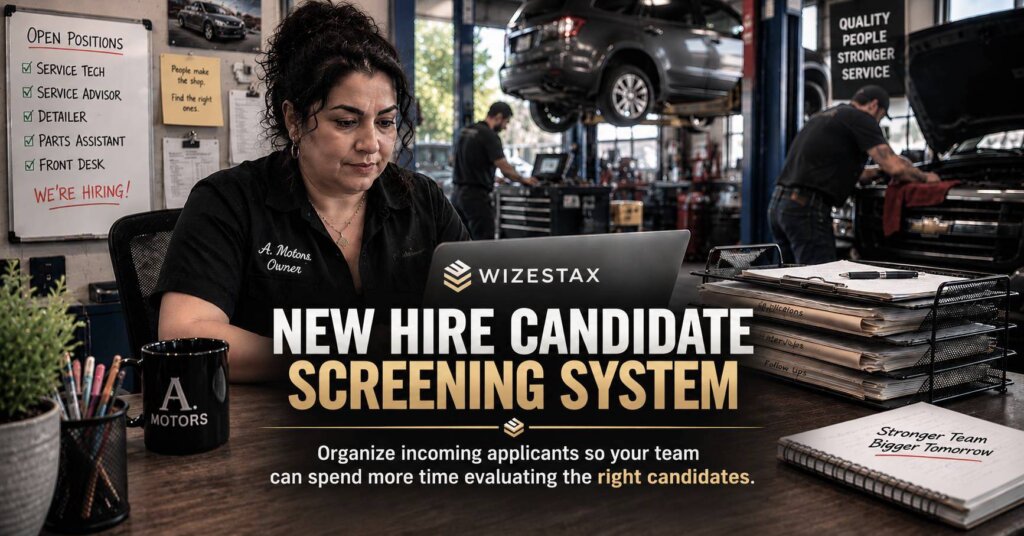
New Hire Candidate Screening System
Reduce Manual Applicant Review Without Turning Hiring Decisions Over To An Algorithm
A successful job posting can create a new operational problem almost immediately. Applications begin arriving faster than the hiring team can review them. Some candidates clearly lack a required license or qualification. Others appear potentially suitable but become buried among dozens or hundreds of applications. Managers begin scanning resumes quickly, screening standards become inconsistent, and valuable hiring time gets consumed before interviews have even started.
The New Hire Candidate Screening System creates structure at the beginning of that process. Instead of asking software to decide who should be hired, the system collects job relevant information consistently, organizes candidates around predefined requirements, identifies applications requiring attention, and gives a human reviewer a more manageable candidate pool.
That distinction matters. Employment screening can affect access to employment and is subject to anti discrimination laws. The EEOC notes that employment tests and selection procedures can create legal problems when they intentionally discriminate or disproportionately exclude protected groups without appropriate legal justification. The ADA also places restrictions on disability related inquiries and medical examinations before a conditional job offer. (EEOC)
For that reason, this Blueprint keeps human judgment at the center of the hiring decision.
Which Stax Fits Your Business
| Business Need | Stax | Software | Primary Approach |
|---|---|---|---|
| Small business filling occasional positions | Starter Stax | Breezy HR | Structured applications and candidate questionnaires |
| Growing business managing regular recruiting | Growth Stax | Workable | Applicant tracking, structured evaluation and recruiting automation |
| Larger hiring operation requiring stronger process governance | Pro Stax | Greenhouse | Application rules, structured scorecards and controlled hiring workflows |
These are different screening architectures rather than rankings.
Software Linx
Starter Stax
Growth Stax
Pro Stax
Breezy provides resume parsing on its free Bootstrap plan, while its paid Startup plan adds candidate questionnaires and automations. Workable combines custom application forms, resume parsing, applicant tracking, standardized evaluation tools, interview scorecards and automated actions. Greenhouse provides structured scorecards and application rules that can tag, advance, or, on qualifying plans, reject applicants based on answers to predefined application questions. (Breezy HR)
Blueprint Overview
| Metric | Value |
|---|---|
| Category | Workforce Operations |
| Business Problem | Hiring teams spend excessive time manually sorting applicants before meaningful evaluation begins |
| Primary Objective | Organize applicants around predefined job relevant requirements before human review |
| Core Signals | Application responses, required qualifications, licenses, availability and role specific criteria |
| Difficulty | Intermediate |
| Maintenance | Review whenever job requirements change |
| Best For | Businesses receiving more applications than managers can efficiently review |
| Primary Output | Structured candidate review queue |
| Human Decision | Required |
The Hidden Hiring Leak
The problem is not simply receiving too many resumes.
It is spending expensive human attention determining basic information that could have been collected consistently when the candidate applied.
Suppose a position legally or operationally requires a specific license.
Without structured screening, a manager may open a resume, search for the license, fail to find it, read the application again, and eventually contact the candidate for clarification.
Multiply that process across a large applicant pool and administrative screening begins consuming the time that should be spent evaluating viable candidates.
The opposite problem can occur too.
A qualified applicant may receive only a few seconds of attention because the reviewer is working through a large queue.
| Without This Blueprint | With This Blueprint |
|---|---|
| Every application enters the same review pile | Applications arrive with structured information |
| Managers repeatedly search resumes for basic requirements | Important job related criteria are collected directly |
| Screening standards can change between reviewers | Predefined criteria create greater consistency |
| Strong candidates can become buried | Candidate records become easier to prioritize for review |
| Missing information requires manual investigation | Missing responses can be surfaced |
| Applicant volume consumes manager attention | Human review focuses on meaningful evaluation |
Business Impact Snapshot
| Area | Potential Impact |
|---|---|
| Hiring Time | Less repetitive initial application review |
| Consistency | Applicants can be reviewed against the same defined criteria |
| Candidate Experience | Relevant applicants can move through the process more predictably |
| Management | Less time spent searching resumes for basic information |
| Recruiting | Applicant volume becomes easier to organize |
| Governance | Screening logic can be documented and reviewed |
| Quality Control | Humans retain responsibility for consequential decisions |
Real World Example
A plumbing company needs another service technician.
Its job advertisement receives 85 applications.
The position requires a particular license, a valid authorization to perform the relevant work, and availability during the hours specified in the job description.
Without a screening system, someone may manually open all 85 resumes looking for those pieces of information.
Instead, the application asks candidates standardized questions about the requirements.
The system organizes the responses.
Applications with complete information can enter the hiring team’s review queue. Applications with ambiguous or missing information can be flagged for clarification rather than silently interpreted by software.
The hiring manager then reviews the candidates.
The automation handled organization.
The human still handles judgment.
Starter Stax
Breezy HR
Best For
Smaller businesses that want a straightforward applicant tracking system and structured application process without immediately building a large recruiting operation.
| Function | Breezy HR |
|---|---|
| Applications | Career portal |
| Resume Processing | Automatic resume parsing |
| Applicant Organization | Candidate records |
| Screening | Candidate questionnaires on paid plans |
| Workflow | Candidate automations on paid plans |
| Human Review | Hiring team |
Breezy’s free Bootstrap plan currently supports one active position or candidate pool, unlimited users and automatic resume parsing. Its Startup plan adds Candidate Questionnaires, which Breezy describes as a way to turn the application form into an active screening tool, along with Candidate Automations. (Breezy HR Help Center)
Advantages
| Benefit |
|---|
| Free entry point for basic applicant tracking |
| Unlimited users on Bootstrap |
| Resume parsing |
| Candidate questionnaires on paid plans |
| Custom hiring pipelines on paid plans |
| Built for small and midsize businesses |
Limitations
| Limitation |
|---|
| Free plan is limited to one active position or candidate pool |
| Questionnaire screening requires a paid plan |
| More sophisticated evaluation features require higher plans |
| Screening criteria still require careful human design |
Breezy currently lists Bootstrap as free. Its Startup plan is listed at $157 per month with annual billing or $189 monthly. Pricing can change. (Breezy HR)
Growth Stax
Workable
Best For
Businesses hiring regularly across multiple positions that want recruiting, applicant tracking and standardized evaluation inside one environment.
| Function | Workable |
|---|---|
| Application Collection | Custom application forms |
| Resume Processing | Automated resume parsing |
| Applicant Tracking | ATS |
| Evaluation | Interview kits and scorecards |
| Workflow | Automated actions |
| Human Review | Recruiter and hiring team |
Workable currently includes custom application forms, automated resume parsing, interview kits, scorecards, standardized evaluation tools, custom hiring pipelines and automated actions within its recruiting platform. (Workable)
Automated actions can trigger communication based on actions inside the hiring process, allowing administrative steps to move without requiring the hiring team to manually send every message. (Workable Help)
Advantages
| Benefit |
|---|
| Recruiting and applicant tracking in one platform |
| Structured evaluation tools |
| Automated resume parsing |
| Custom hiring pipelines |
| Automated administrative actions |
| Useful when multiple positions are active |
Limitations
| Limitation |
|---|
| More expensive than a lightweight ATS |
| Configuration can become more involved |
| Automated evaluation still requires human oversight |
| Screening logic should be reviewed whenever job requirements change |
Workable currently lists its Standard plan at $299 per month for organizations with 1 to 20 employees when paid monthly, with annual billing reducing the effective cost. Pricing varies with company size and selected features. (Workable)
Pro Stax
Greenhouse
Best For
Organizations that need a highly structured hiring process with defined candidate criteria, controlled application rules, standardized interview evaluation and stronger governance.
| Function | Greenhouse |
|---|---|
| Application Questions | Custom job post questions |
| Initial Organization | Application rules |
| Candidate Categorization | Auto Tag |
| Evaluation | Structured scorecards |
| Interview Process | Interview kits |
| Human Decision | Hiring team review |
Greenhouse scorecards allow hiring teams to evaluate candidates using predetermined criteria. Those scorecards can contain the skills, qualifications and other attributes the organization has defined for the role. (Greenhouse Support)
Greenhouse also supports application rules. Auto Tag can categorize candidates based on application responses. Plus and Pro tiers add Auto Advance and Auto Reject capabilities. (Greenhouse Support)
Advantages
| Benefit |
|---|
| Strong structured hiring architecture |
| Predefined candidate criteria |
| Standardized scorecards |
| Application rules |
| Consistent interview evaluation |
| Stronger governance for complex hiring operations |
Limitations
| Limitation |
|---|
| More platform than many small businesses require |
| Pricing is customized |
| Automated rejection introduces greater screening risk |
| Poorly designed application criteria can still create unfair outcomes |
| Human oversight remains important |
Greenhouse does not publish a fixed dollar price for its current Core, Plus and Pro plans. Pricing is customized according to hiring needs, hiring volume, organizational complexity and required capabilities. (Greenhouse)
How The Three Stax Differ
| Stax | Core Architecture |
|---|---|
| Breezy HR | Accessible applicant tracking with questionnaires |
| Workable | Recruiting workflow with standardized evaluation and automation |
| Greenhouse | Structured hiring with formal application rules and scorecards |
A local business hiring a few employees may primarily need applicants collected in one place with consistent questions.
A growing company may need the entire recruiting workflow standardized.
A larger organization may need the screening process itself documented, repeatable and governed across hiring teams.
The software becomes more sophisticated, but the underlying principle should remain the same:
Automate organization before automating judgment.
Copy And Paste Screening Questions
These questions should be customized to the actual requirements of the position.
Do you currently hold the {{required_license_or_certification}} required for this position?
Yes
No
Requires clarification
Are you available to work the schedule described in this job posting?
Yes
No
Partially
Do you have experience performing {{specific_job_function}}?
Yes
No
If yes, briefly describe your experience.
Is there anything about the stated job requirements that you would like the hiring team to clarify before reviewing your application?
Open response
Avoid questions that unnecessarily solicit protected or medical information.
Copy And Paste Human Review Note
Candidate screening summary
Candidate: {{candidate_name}}
Position: {{position}}
Required criteria confirmed: {{confirmed_requirements}}
Missing information: {{missing_information}}
Items requiring clarification: {{clarification_items}}
Human review status: {{review_status}}
No hiring decision has been made by the screening system.
Copy And Paste AI Prompt
You are assisting a hiring team with administrative candidate organization.
Review only the job requirements and candidate information supplied.
Identify which explicitly stated job requirements are clearly documented, which are not documented, and which require clarification.
Do not infer age, race, ethnicity, religion, sex, gender, sexual orientation, disability, medical status, family status, national origin, or other protected characteristics.
Do not infer personality, intelligence, honesty, cultural fit, socioeconomic status, health, or future job performance from writing style, names, photographs, addresses, schools, employment gaps, or other proxy information.
Do not make a hire, reject, interview, or advancement decision.
Do not rank candidates.
Do not treat missing information as evidence that the candidate lacks a qualification.
Return:
Confirmed job relevant information
Missing information
Information requiring clarification
Questions a human reviewer may need to investigate
The final decision belongs to the hiring team.
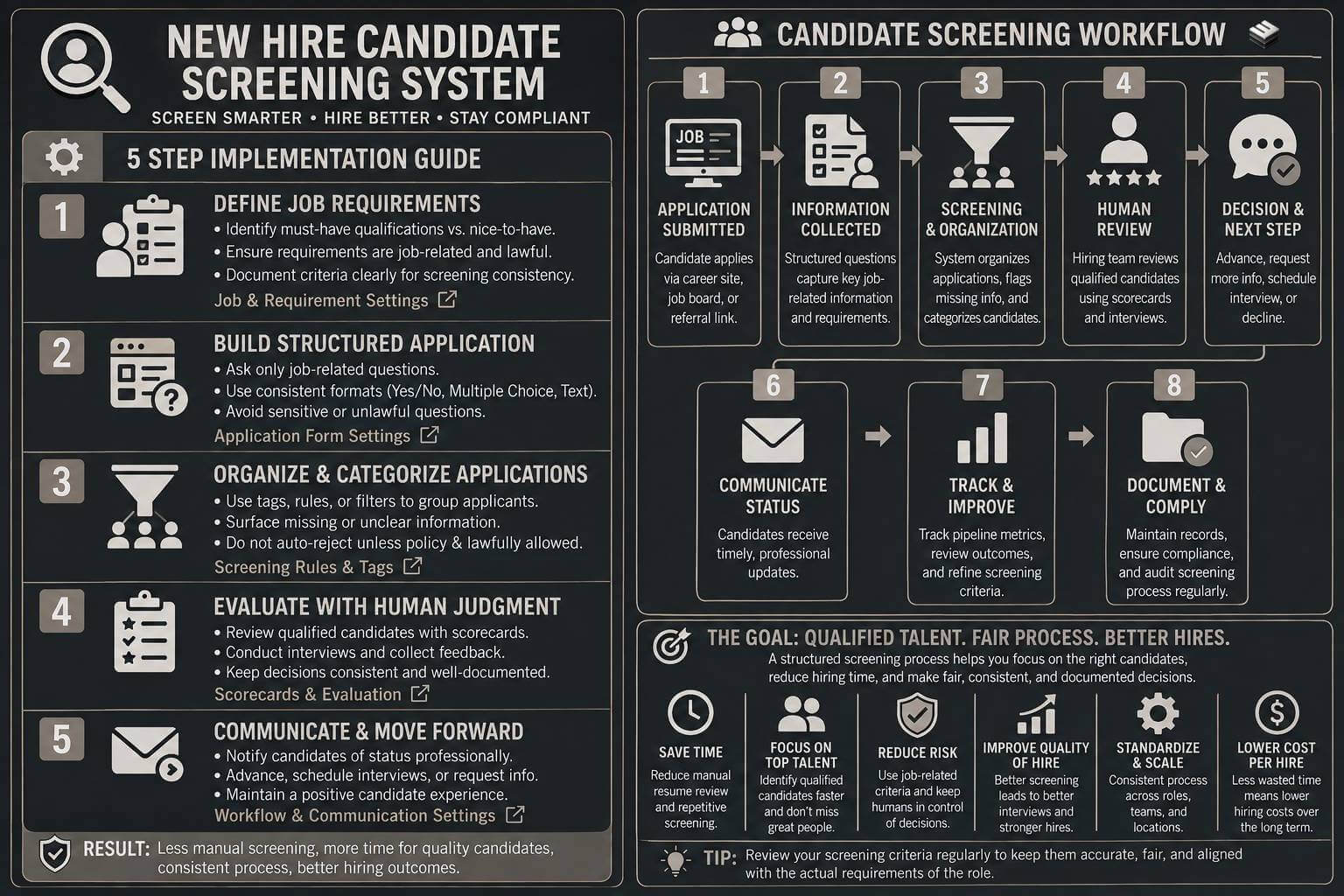
5 Step Implementation Guide
The following implementation example uses Greenhouse because its application questions, application rules and structured scorecards make the separation between initial screening and later human evaluation particularly clear.
It is an implementation example, not a preferred Stax.
Step 1: Define The Actual Job Requirements
Before configuring screening automation, define what the position genuinely requires.
Separate requirements from preferences.
A required professional license is different from a preferred software platform.
A legally required credential is different from a manager simply preferring a particular educational background.
Greenhouse’s structured hiring guidance recommends defining the skills, qualifications and attributes needed for success before building the interview process. (Greenhouse Support)
Step 2: Create Structured Application Questions
Translate appropriate requirements into clear application questions.
Greenhouse supports custom job post questions using formats including Yes or No and selection based responses. Those structured responses can later support application rules. (Greenhouse Support)
Keep questions directly connected to the work.
Do not collect information simply because software makes it possible to collect it.
Step 3: Use Low Risk Organization First
Where possible, begin with categorization rather than automatic rejection.
For example, Greenhouse Auto Tag can apply candidate tags based on answers to custom application questions. Recruiters can then filter those records for review. (Greenhouse Support)
This creates administrative efficiency while preserving human review.
Step 4: Build The Human Evaluation Process
Create a structured scorecard around the qualifications and attributes the hiring team actually intends to evaluate.
Greenhouse scorecards are designed so candidates can be reviewed against predetermined criteria rather than each interviewer inventing a different evaluation method. (Greenhouse Support)
Determine who reviews initial applications, who resolves ambiguous responses, and who has authority to advance or reject candidates.
Step 5: Test The System Before Using It On Real Applicants
Create test applications representing different situations.
One should clearly document the required criteria.
Another should have missing information.
Another should contain an ambiguous response.
Another should demonstrate that a candidate could perform the role but needs clarification or accommodation around the screening process.
Verify that the system organizes these records correctly without making unsupported assumptions.
Then periodically review actual screening outcomes.
Employment selection procedures should not simply be configured once and forgotten. The EEOC recommends keeping selection procedures aligned with changing job requirements and understanding their effectiveness and limitations. (EEOC)
Candidate Screening Time Exposure
The economic problem is skilled management time being consumed by repetitive initial application sorting.
Consider a business receiving 100 applications for a position.
If initial manual screening takes an average of four minutes per application:
100 applications × 4 minutes = 400 minutes
That is approximately 6.7 hours of initial review before interviews, reference checks, candidate communication or deeper evaluation begin.
If structured screening reduces the repetitive administrative portion to two hours of organized human review, approximately 4.7 management hours become available for higher value hiring work.
At an illustrative management labor value of $40 per hour:
4.7 hours × $40 = approximately $188 of management time per hiring cycle
That calculation does not attempt to value hiring quality. It only measures one visible operational cost.
| Input | Illustrative Example |
|---|---|
| Applications | 100 |
| Manual review time each | 4 minutes |
| Initial manual screening | 6.7 hours |
| Organized human review | 2 hours |
| Management time redirected | 4.7 hours |
| Example management labor value | $40 per hour |
| Example time value | Approximately $188 |
The actual value depends on applicant volume, hiring frequency, manager compensation and the screening process being replaced.
WIZESTAX Diagnostic Scorecard
| Category | Assessment |
|---|---|
| Economic Problem | Excessive human time spent on repetitive initial applicant sorting |
| Automation Potential | Moderate |
| Human Judgment Required | Very high |
| Data Sensitivity | Very high |
| Governance Requirement | High |
| Maintenance Requirement | High |
| Primary Value | More structured use of hiring attention |
| Primary Risk | Unfair or discriminatory screening criteria |
Common Mistakes
| Mistake | Result |
|---|---|
| Letting AI rank candidates automatically | Opaque assumptions can influence consequential decisions |
| Treating missing information as disqualification | Potentially qualified candidates can be incorrectly removed |
| Screening for preferences as if they were requirements | Candidate pool becomes unnecessarily narrow |
| Using protected characteristics or proxies | Creates serious fairness and legal risk |
| Asking inappropriate medical questions before an offer | Can conflict with ADA restrictions |
| Automatically rejecting ambiguous responses | Human context disappears |
| Using different standards for different applicants | Screening becomes inconsistent |
| Never auditing screening outcomes | Problematic criteria can remain hidden |
| Assuming the software vendor owns the hiring risk | The employer still controls how the selection process is used |
The EEOC specifically warns that algorithmic tools can screen out people with disabilities who could perform the job with or without reasonable accommodation. Employers should also have a process for providing reasonable accommodations when algorithmic tools are part of employment decisions. (EEOC)
Related WIZESTAX Categories
| Category | Different Problem |
|---|---|
| Candidate Interview Scheduling System | Coordinates interviews after candidates enter the interview process |
| New Hire Onboarding Completion System | Manages requirements after a person is hired |
| Employee Certification Expiration System | Monitors credentials belonging to existing employees |
| Employee Document Collection System | Collects required workforce documentation |
| Candidate Follow Up System | Prevents applicant communication from becoming stalled |
| Employee Training Reminder System | Tracks required learning after hiring |
New Hire Candidate Screening System owns the period between receiving an application and deciding which candidates require deeper human evaluation. Its purpose is not to predict who will become the best employee. Its purpose is to remove repetitive administrative work so the hiring team can spend more attention making that judgment responsibly.
Get New WIZESTAX Blueprints Every Monday
Subscribe to receive new WIZESTAX Blueprints covering Customer Retention, Marketing, Sales, Finance, Workforce and Operations directly to your inbox.