Supplier Reliability Tracking System
Identify Supplier Performance Problems Before They Become Recurring Operational Disruptions
A supplier can appear reliable until individual problems begin forming a pattern. One shipment arrives late. Another arrives incomplete. Product quality varies between orders. An expected item is unavailable. Staff resolve each incident separately, and the business continues ordering without a clear picture of how consistently the supplier is actually performing.
The Supplier Reliability Tracking System converts those individual events into a documented supplier history. Delivery timing, order completeness, quality problems, responsiveness and other relevant performance signals can be recorded consistently so the business can distinguish an isolated problem from a supplier relationship that is becoming operationally unreliable.
This Blueprint does not assume that one late shipment or defective item makes a supplier unreliable. Its purpose is to create enough consistent performance information for purchasing decisions to reflect actual supplier history rather than memory or isolated experiences.
Which Stax Fits Your Business
| Business Need | Stax | Software | Cost |
|---|---|---|---|
| Configurable supplier database with custom performance tracking | Starter Stax | Airtable | Varies by plan and users |
| Collaborative vendor tracking with simple ratings and shared accountability | Growth Stax | monday.com | Varies by plan and users |
| Supplier performance connected directly with purchasing and receiving activity | Pro Stax | Precoro | Confirm current pricing with provider |
Pricing and capabilities change over time and should be confirmed directly with each software provider before purchase.
Software Linx
Starter
Growth
Pro
Blueprint Overview
| Metric | Value |
|---|---|
| Category | Supply Chain |
| Business Problem | Supplier performance problems remain fragmented until they disrupt operations |
| Primary Objective | Create a consistent record of supplier reliability |
| Core Signals | Delivery timing, order completeness, quality, responsiveness and recurring exceptions |
| Setup Time | Approximately 60 to 120 minutes |
| Difficulty | Intermediate |
| Maintenance | Ongoing performance recording and periodic review |
| Best For | Businesses that repeatedly purchase materials, inventory, equipment or services from outside suppliers |
| Primary Output | Supplier performance history and reliability status |
The Hidden Revenue Leak
| Without This Blueprint | With This Blueprint |
|---|---|
| Supplier problems are remembered informally | Performance events become part of a supplier record |
| Late deliveries are treated as isolated incidents | Delivery consistency can be reviewed over time |
| Quality problems remain scattered across orders | Recurring quality problems become easier to identify |
| Staff may have different opinions about the same supplier | Defined criteria create a more consistent evaluation |
| Purchasing decisions rely heavily on price or habit | Reliability history can contribute to supplier selection |
| Supplier problems become visible after operations are affected | Deteriorating performance can receive earlier management attention |
Supplier reliability should normally be evaluated across multiple completed orders or service events rather than inferred from one exception.
Business Impact Snapshot
| Area | Potential Impact |
|---|---|
| Purchasing | Supplier history becomes available when deciding where to place future orders |
| Operations | Recurring delivery and fulfillment problems become easier to identify |
| Quality | Defects and unacceptable deliveries can be associated with the responsible supplier |
| Staff Time | Employees spend less time reconstructing supplier history from memory and messages |
| Continuity | Increasing supplier problems can be investigated before dependence becomes more costly |
| Management | Supplier decisions can use documented performance rather than informal impressions |
Real World Example
A small remodeling company regularly purchases materials from several suppliers.
One supplier has competitive pricing and has been used for years. During a two month period, however, several orders arrive later than expected. One delivery is missing part of the order, and another contains damaged material.
Each problem is resolved individually. No single incident seems serious enough to reconsider the relationship.
The reliability system records each completed order and its exceptions. When the supplier’s recent history is reviewed, management can see that delivery and fulfillment problems are occurring more frequently than they were previously.
That does not automatically mean the supplier should be replaced.
It gives the business documented information to investigate the pattern, discuss the problems with the supplier, compare alternatives or reduce dependence if necessary.
The value of the system is turning disconnected supplier incidents into usable operational history.
WIZESTAX Stax Options
Starter Stax
Airtable
Best For
Small businesses that want to build their own supplier reliability database and define performance criteria around the way they actually purchase.
| Function | Software |
|---|---|
| Supplier Database | Airtable |
| Order History | Linked Records |
| Performance Collection | Forms |
| Reliability Review | Views And Interfaces |
| Exception Monitoring | Filters |
| Internal Alerts | Airtable Automations |
Airtable provides a vendor management template designed to centralize vendor information and evaluate performance using factors including quality of service, delivery success and complaint history. Its forms, interfaces, linked records, filters and automations allow businesses to build a more customized supplier tracking architecture.
Advantages
| Benefit |
|---|
| Performance criteria can be customized to the business |
| Supplier and performance records can remain connected |
| Existing vendor management templates reduce initial design work |
| Forms can standardize performance data collection |
| Automations can create internal notifications when defined conditions are met |
Limitations
| Limitation |
|---|
| The business must design meaningful reliability criteria |
| Purchasing transactions may need to be entered or integrated separately |
| Poorly structured records can produce inconsistent evaluations |
| Automation limits and capabilities vary by plan |
| It is not a dedicated procurement platform |
Growth Stax
monday.com
Best For
Businesses that want supplier information, staff ownership and straightforward vendor ratings in a collaborative workspace.
| Function | Software |
|---|---|
| Vendor List | monday.com |
| Service Rating | Vendor List Template |
| Supplier Status | Status Fields |
| Staff Responsibility | Board Ownership |
| Performance Notes | Vendor Records |
| Internal Workflow | monday.com Work Management |
monday.com’s vendor template provides shared vendor records, a service rating system and status information that can identify vendors the business has stopped using. This creates a comparatively simple architecture for teams that want supplier reliability visible to multiple employees without implementing a dedicated procurement platform.
Advantages
| Benefit |
|---|
| Familiar collaborative board structure |
| Vendor information can be visible across the team |
| Simple service ratings make supplier quality easier to scan |
| Supplier status can prevent continued use of unsuitable vendors |
| Responsibility for supplier issues can remain visible |
Limitations
| Limitation |
|---|
| Reliability metrics require deliberate configuration |
| A simple rating can hide important differences between delivery, quality and responsiveness |
| Purchasing and receiving data may live elsewhere |
| Manual updates can reduce data quality |
| Less specialized than procurement software |
Pro Stax
Precoro
Best For
Businesses that want supplier reliability connected directly with purchasing, receiving, supplier records and procurement reporting.
| Function | Software |
|---|---|
| Supplier Records | Supplier Management |
| Purchase History | Purchase Orders |
| Delivery Evidence | Receipts |
| Supplier Collaboration | Supplier Portal |
| Performance Analysis | Reports And Dashboards |
| Procurement Control | Precoro |
Precoro connects supplier management with purchase orders, receipts, invoices, purchasing history and reporting. Its current product documentation specifically describes tracking what has been delivered and what remains pending, analyzing delivery trends and supplier performance, and identifying suppliers that deliver on time and in full.
Advantages
| Benefit |
|---|
| Supplier reliability can use actual procurement records |
| Purchase orders and receipts provide operational evidence |
| Delivery performance can be analyzed over time |
| Supplier information remains connected with purchasing activity |
| Reporting supports broader supplier evaluation |
Limitations
| Limitation |
|---|
| More infrastructure than very small businesses may need |
| Implementation requires a more structured purchasing process |
| Staff must consistently record receipts and procurement activity |
| Supplier performance should still be interpreted in context |
| Broader procurement functionality increases implementation complexity |
How The Three Stax Differ
| Stax | Primary Approach |
|---|---|
| Airtable | Configurable supplier reliability database |
| monday.com | Collaborative vendor tracking and ratings |
| Precoro | Procurement connected supplier performance |
These are different implementation architectures rather than rankings.
Airtable gives the business greater freedom to design its own reliability model. monday.com emphasizes shared visibility and straightforward vendor management. Precoro connects supplier performance more directly with the purchasing and receiving activity that produces the underlying evidence.
Copy And Paste Supplier Reliability Alert
“Supplier reliability warning for {{supplier_name}}. Recent performance has moved outside the normal range. Review delivery timing, order completeness, quality issues, recent exceptions and previous supplier history before deciding whether purchasing changes are appropriate.”
Copy And Paste Supplier Review Request
“Please review the recent performance history for {{supplier_name}}. Confirm whether the recorded delivery, fulfillment and quality issues are accurate, identify any recurring pattern and document any action that should be considered before the next order.”
Copy And Paste AI Prompt
You are assisting a small business with supplier reliability analysis.
Review the supplier performance information provided and identify meaningful changes or recurring problems.
Consider delivery timing, order completeness, damaged or defective items, quality consistency, responsiveness, unresolved issues and other relevant supplier performance signals.
Do not assume that one late delivery, incomplete order or quality problem makes a supplier unreliable.
Separate isolated exceptions from recurring patterns that deserve management attention.
Explain which evidence caused the supplier to be flagged.
Do not invent supplier information.
Do not automatically recommend terminating a supplier relationship.
If the available information is insufficient, state that additional performance history is required.
Step By Step Implementation Guide
The following setup demonstrates one implementation path using Airtable.
It is not a WIZESTAX recommendation or preferred Stax.
Airtable is used here because its configurable vendor management structure provides a practical example of turning supplier records and individual performance events into a repeatable reliability tracking process. Airtable’s own vendor management template explicitly supports monitoring vendor performance and supplier evaluation.
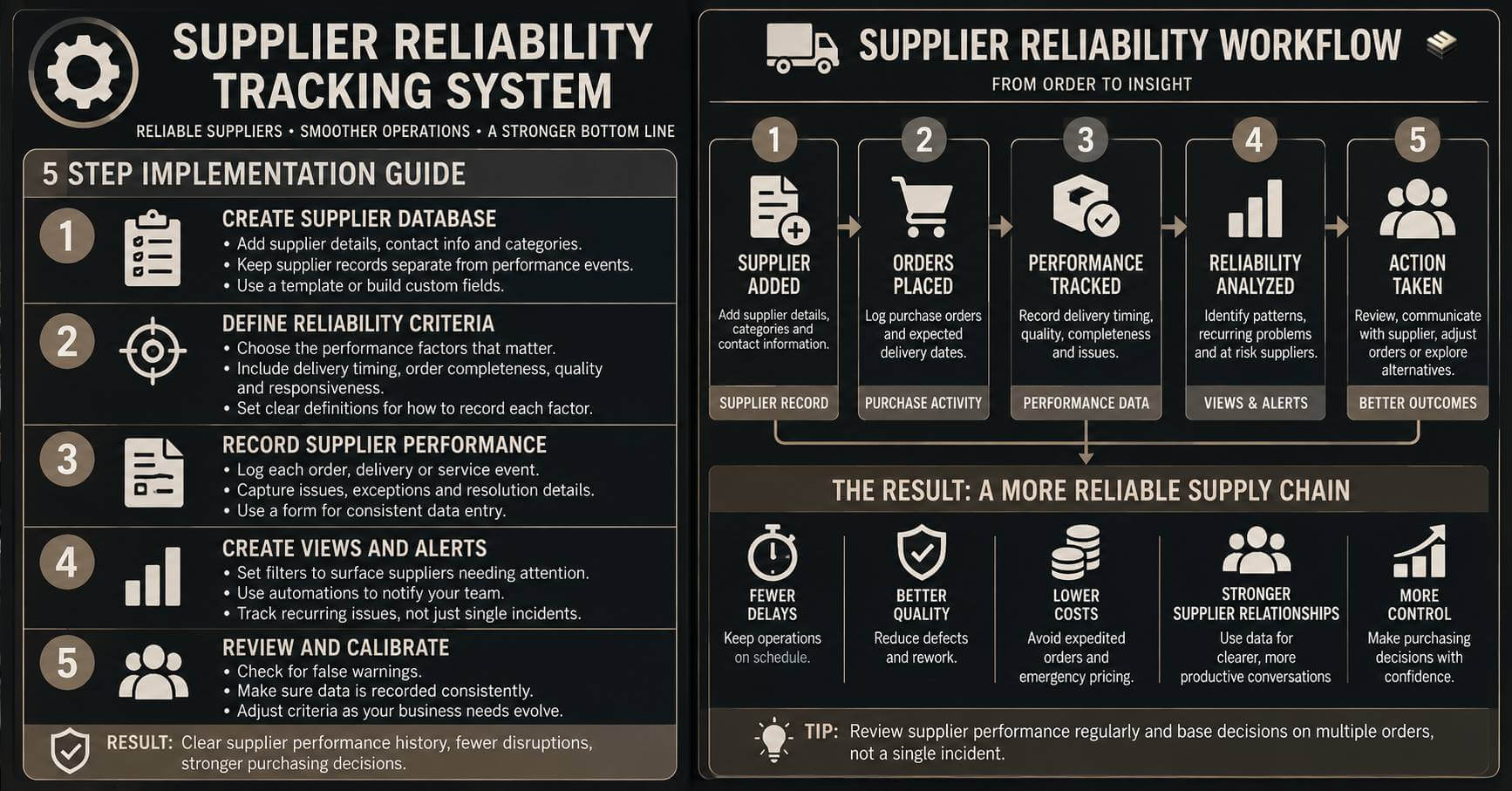
Step 1: Create The Supplier Database
Create one supplier record for every supplier the business wants to monitor.
Include useful identifying information such as supplier name, category, primary contact, products or services supplied and current relationship status.
Avoid placing the entire performance history directly into the supplier record. Supplier information and individual performance events should remain distinguishable.
Airtable Vendor Management Portal Template
Step 2: Define Reliability Criteria
Determine which supplier behaviors actually affect the business.
A business that depends on scheduled material deliveries may care heavily about delivery timing and completeness. Another may be more exposed to product defects or inconsistent quality.
Create fields for the criteria that matter and define how employees should record them.
The goal is consistent evidence, not an arbitrary universal supplier score.
Step 3: Record Supplier Performance Events
Create a related table for orders, deliveries or supplier performance events.
Each record should connect to the appropriate supplier and contain the information required for later evaluation.
A form can make this easier for employees by collecting information in the same format each time. Airtable supports forms for record creation and automations triggered by form submissions.
Step 4: Create Reliability Views And Alerts
Create filtered views that surface suppliers or performance events requiring attention.
For example, the business could create a review condition for repeated late deliveries, recurring quality problems or another meaningful threshold.
Airtable supports conditional filtering and automations that can run when records meet defined conditions. Custom notifications can then be sent internally by email, Slack or Microsoft Teams.
Airtable Automation Documentation
Step 5: Review And Calibrate The System
Periodically compare the recorded reliability status with actual supplier performance.
Look for false warnings.
Check whether employees are recording exceptions consistently.
Determine whether the criteria reflect genuine operational consequences.
A supplier handling hundreds of orders may naturally have more exceptions than one handling five. Reliability should therefore be interpreted in relation to order volume, severity and business impact rather than simply counting incidents.
Operational Exposure Snapshot
The primary economic value of this system is not simply administrative time saved.
It is operational exposure created by unreliable supplier performance that becomes easier to identify.
| Affected Orders Per Month | Average Operational Cost Per Supplier Failure | Monthly Exposure Represented |
|---|---|---|
| 2 | $250 | $500 |
| 5 | $250 | $1,250 |
| 10 | $250 | $2,500 |
Illustrative scenario using an average operational impact of $250 for each affected order. Exposure represented is not guaranteed savings. Actual consequences can include staff time, expedited purchasing, schedule disruption, replacement materials, customer delays and other costs that vary considerably by business.
WIZESTAX Diagnostic Scorecard
| Category | Assessment |
|---|---|
| Economic Problem | Supplier failures can create operational costs before reliability deterioration is recognized |
| Signal Quality Required | Moderate To High |
| Automation Potential | Moderate |
| Human Judgment Required | Moderate To High |
| Data Dependency | Moderate To High |
| Scalability | High |
| Primary Value | Consistent supplier performance visibility |
| Primary Risk | Treating isolated incidents or raw incident counts as proof of supplier unreliability |
Common Mistakes
| Mistake | Result |
|---|---|
| Treating one late delivery as proof of unreliability | Good suppliers can be incorrectly penalized |
| Tracking incidents without order volume | High volume suppliers can appear worse simply because they handle more orders |
| Combining every reliability factor into one unexplained rating | Staff cannot determine what is actually deteriorating |
| Recording only severe supplier failures | Smaller recurring problems remain invisible |
| Allowing employees to define problems differently | Supplier comparisons become inconsistent |
| Ignoring the severity of individual failures | Minor delays and major disruptions receive equal weight |
| Never reviewing the criteria | Reliability measurements stop reflecting actual operational needs |
Related WIZESTAX Categories
| Category | Related Business Problem |
|---|---|
| Supply Chain | Supplier Cost Increase Detection |
| Supply Chain | Supplier Delivery Performance |
| Procurement | Purchase Price Variance |
| Procurement | Vendor Contract Renewal |
| Compliance | Vendor Document Collection |
| Compliance | Vendor Insurance Expiration |
| Operations | Job Material Shortage Alert |
These remain separate problems.
The Supplier Reliability Tracking System measures the broader consistency and dependability of the supplier relationship across relevant performance signals. Supplier Cost Increase Detection identifies changing supplier economics. Supplier Delivery Performance focuses specifically on delivery execution. Purchase Price Variance identifies differences between expected and actual purchasing costs. Vendor Contract Renewal manages agreement timing. Vendor Document Collection and Vendor Insurance Expiration address documentation and compliance. Job Material Shortage Alert identifies shortages affecting individual jobs.
Each Blueprint therefore owns a different economic or operational leak.
Get New WIZESTAX Blueprints Every Monday
Subscribe to receive new WIZESTAX Blueprints covering Customer Retention, Marketing, Sales, Finance and Operations directly to your inbox.