Equipment Downtime Prevention System
Schedule Maintenance Before Equipment Problems Become Business Interruptions
Equipment rarely fails according to a convenient business schedule. A refrigerator stops cooling during service. A compressor goes down during production. A work truck develops a problem on the morning of a scheduled job. A machine that has been making an unusual sound for weeks finally stops running.
The immediate repair receives attention because it has to. What often remains invisible is the maintenance history leading up to the failure. The Equipment Downtime Prevention System creates a structured maintenance process around the equipment a business depends on. Assets are documented, preventive maintenance is scheduled, inspections are recorded, usage or condition information can trigger additional work, and recurring equipment problems become part of a visible maintenance history.
The purpose is not to assume every equipment failure can be prevented. Components can fail unexpectedly even when equipment is properly maintained. The system is designed to reduce preventable downtime by moving appropriate maintenance activity from reactive response toward planned intervention.
Which Stax Fits Your Business
| Business Need | Stax | Software | Cost |
|---|---|---|---|
| Straightforward work orders and scheduled preventive maintenance | Starter Stax | MaintainX | Free Basic plan, Essential $20 per user monthly when billed annually |
| Flexible preventive maintenance triggers and maintenance analysis | Growth Stax | Fiix | Free option available, paid plans vary |
| Asset centered preventive maintenance and work order management | Pro Stax | Limble CMMS | Quote based pricing |
MaintainX currently offers a free Basic plan with limited repeating work orders. Its Essential plan is $20 per user per month when billed annually, while Premium is $65 and adds capabilities including meter based maintenance, parts inventory, purchasing, time and cost tracking, and more advanced analytics.
Fiix currently offers a free version as well as paid maintenance management tiers. Current pricing and requirements should be confirmed directly with the provider before purchase.
Software Linx
Starter
Growth
Pro
Pricing and capabilities change over time and should be confirmed directly with each software provider before implementation.
Blueprint Overview
| Metric | Value |
|---|---|
| Category | Operations |
| Business Problem | Critical equipment receives maintenance too late or primarily after problems occur |
| Primary Objective | Reduce preventable equipment downtime through planned maintenance |
| Core Signals | Maintenance due dates, equipment usage, inspections, work history, recurring failures and equipment condition |
| Setup Time | Approximately 90 to 180 minutes for an initial small asset group |
| Difficulty | Intermediate |
| Maintenance | Ongoing work order completion, inspection records and schedule calibration |
| Best For | Businesses dependent on vehicles, machinery, refrigeration, production equipment or other operational assets |
| Primary Output | Preventive maintenance schedule and equipment intervention workflow |
The Hidden Operational Leak
| Without This Blueprint | With This Blueprint |
|---|---|
| Maintenance happens primarily after equipment problems | Appropriate maintenance is scheduled before expected service intervals |
| Service dates live in calendars or memory | Maintenance schedules remain connected with equipment records |
| Small warning signs are handled informally | Inspections and work requests create documented evidence |
| Previous repairs are difficult to reconstruct | Each asset develops a maintenance history |
| Repeated failures appear unrelated | Recurring equipment problems become easier to identify |
| Downtime begins before management responds | Maintenance work can occur before some preventable failures interrupt operations |
Preventive maintenance cannot eliminate every breakdown. The goal is to reduce the portion of downtime that reasonably could have been avoided through inspections, servicing, component replacement or earlier intervention.
Business Impact Snapshot
| Area | Potential Impact |
|---|---|
| Operations | Fewer preventable interruptions to normal work |
| Maintenance | More work can be planned instead of performed during emergencies |
| Labor | Employees spend less time waiting for unavailable equipment |
| Customers | Equipment failures are less likely to disrupt scheduled service |
| Asset Life | Appropriate maintenance can help equipment remain serviceable longer |
| Management | Maintenance history provides better information about repair and replacement decisions |
Real World Example
A neighborhood bakery depends on a commercial dough mixer every morning.
The mixer has operated reliably for years, so maintenance is mostly informal. Staff clean it daily, but mechanical inspections and scheduled servicing depend on somebody remembering.
Over several months, employees occasionally notice vibration and a change in operating noise. The machine continues working, so production continues.
Eventually the mixer fails during morning preparation.
The bakery now has two problems.
The equipment requires repair, and production capacity has disappeared during one of the most important parts of the workday.
An Equipment Downtime Prevention System would not guarantee that the failure never happened.
It would create an equipment record, establish an appropriate maintenance schedule, give employees a consistent way to report unusual operating conditions and preserve previous maintenance activity.
If the vibration or changing noise had triggered an inspection earlier, the business might have had an opportunity to investigate the equipment before production stopped.
That opportunity is the value of the system.
WIZESTAX Stax Options
Starter Stax
MaintainX
Best For
Small businesses that want to move maintenance schedules, work orders and equipment records out of notebooks, calendars and employee memory.
| Function | Software |
|---|---|
| Equipment Records | MaintainX Assets |
| Maintenance Scheduling | Maintenance Plans And Repeating Work Orders |
| Maintenance Execution | Work Orders |
| Inspection Procedures | Procedures And Checklists |
| Usage Monitoring | Meters |
| Maintenance Analysis | Reporting And Asset History |
MaintainX is a cloud based CMMS that centralizes maintenance data and workflows. It supports preventive and reactive maintenance, work orders, equipment health information, parts inventory, checklists and reporting. Its maintenance plans can generate future work orders according to defined recurrence rules.
MaintainX also supports fixed maintenance intervals and, for eligible customers, usage based or combined time and usage scheduling. Its documentation notes that usage based maintenance plan scheduling remains in beta for select customers as of the current documentation.
Advantages
| Benefit |
|---|
| Free entry level plan provides a low barrier to testing digital maintenance |
| Work orders connect maintenance activity with equipment |
| Preventive maintenance can follow recurring schedules |
| Maintenance history remains associated with assets |
| Higher plans support meter based maintenance and deeper asset reporting |
Limitations
| Limitation |
|---|
| Basic plan limits repeating work orders |
| More advanced maintenance capabilities require higher plans |
| Maintenance schedules still require appropriate intervals |
| Staff must consistently complete and document work |
| Software cannot determine every impending equipment failure |
Growth Stax
Fiix CMMS
Best For
Businesses that want maintenance schedules capable of responding to different maintenance triggers and more detailed maintenance analysis.
| Function | Software |
|---|---|
| Asset Management | Fiix CMMS |
| Preventive Maintenance | Scheduled Maintenance |
| Maintenance Triggers | Date, Time, Meter, Event And Condition |
| Technician Work | Work Orders |
| Troubleshooting | Failure Codes And Work History |
| Maintenance Analysis | Reports And Fiix Foresight |
Fiix supports preventive maintenance work orders triggered by date, time, meter readings, events or equipment conditions. Work orders can include procedures, task lists, photographs and suggested parts, while reporting can track completion rates, repair dates, costs and follow up activity.
Advantages
| Benefit |
|---|
| Multiple maintenance trigger types support different equipment needs |
| Meter based scheduling can better reflect equipment usage |
| Condition based maintenance can support connected equipment |
| Work history provides evidence about recurring equipment problems |
| Reporting can identify maintenance activity associated with continued failures |
Limitations
| Limitation |
|---|
| More configuration is required than a simple maintenance calendar |
| Condition based maintenance may require sensors or integrations |
| Maintenance data quality depends on technician participation |
| Poorly designed PM schedules can create unnecessary maintenance |
| Advanced analysis does not guarantee prediction of equipment failure |
Pro Stax
Limble CMMS
Best For
Businesses that want an asset centered maintenance operation with recurring preventive maintenance, work orders and historical maintenance visibility.
| Function | Software |
|---|---|
| Asset Records | Limble CMMS |
| Preventive Maintenance | PM Tasks |
| Reactive Maintenance | Work Orders |
| Work Requests | Maintenance Requests |
| Maintenance History | Asset And Task Records |
| Parts And Vendors | Parts And Vendor Management |
Limble supports work requests, work orders and preventive maintenance tasks within its CMMS. Its work order system allows teams to schedule, assign and monitor maintenance work while connecting recurring preventive tasks with related assets and parts.
Advantages
| Benefit |
|---|
| Maintenance revolves around identifiable equipment assets |
| Recurring PM tasks support planned maintenance |
| Work orders create a documented maintenance history |
| Maintenance requests provide a path for reported equipment problems |
| Parts and vendor information can remain connected with maintenance activity |
Limitations
| Limitation |
|---|
| Requires an organized asset inventory |
| Maintenance schedules still need to reflect actual equipment requirements |
| More system than a business with only a few simple assets may need |
| Staff participation determines the quality of maintenance history |
| Current pricing requires confirmation with Limble |
How The Three Stax Differ
| Stax | Primary Approach |
|---|---|
| MaintainX | Accessible digital preventive maintenance and work order system |
| Fiix | Trigger driven preventive maintenance and deeper maintenance analysis |
| Limble CMMS | Asset centered CMMS and recurring maintenance management |
These are different implementation architectures rather than rankings.
MaintainX provides a relatively accessible path from informal maintenance into structured work orders and preventive schedules. Fiix provides more emphasis on different maintenance triggers and analysis. Limble centers the workflow around assets, recurring PM tasks, work requests and maintenance history.
The appropriate architecture depends on the number and complexity of the assets, the maintenance team, the importance of equipment usage information and the consequences of downtime.
Copy And Paste Maintenance Alert
“Preventive maintenance notice for {{equipment_name}}. Scheduled maintenance is approaching or a defined maintenance condition has been reached. Review current equipment status, operating history, outstanding work and required service before determining the appropriate maintenance action.”
Copy And Paste Equipment Issue Report
“Equipment issue reported for {{equipment_name}}. Observed condition: {{issue_description}}. Please review recent maintenance history, current usage, previous related issues and scheduled maintenance before deciding whether the equipment should remain in normal operation.”
Copy And Paste AI Prompt
You are assisting a small business with equipment maintenance analysis.
Review the equipment information provided and identify maintenance conditions that deserve human review.
Consider scheduled maintenance, equipment usage, inspection results, previous work orders, recurring failures, reported operating changes and relevant manufacturer maintenance requirements.
Separate isolated observations from recurring equipment patterns.
Identify overdue preventive maintenance and repeated reactive repairs.
Do not assume that every unusual reading means equipment is about to fail.
Do not invent maintenance history or manufacturer requirements.
Do not recommend bypassing safety procedures or continuing to operate equipment when qualified inspection is required.
Do not automatically recommend repair or replacement.
If the available information is insufficient to determine the appropriate maintenance response, state that qualified inspection or additional equipment information is required.
Step By Step Implementation Guide
The following setup demonstrates one implementation path using MaintainX.
It is not a WIZESTAX recommendation or preferred Stax.
MaintainX is used here because its asset records, work orders and maintenance plans provide a clear example of how a business can move from informal maintenance into a scheduled preventive maintenance workflow.
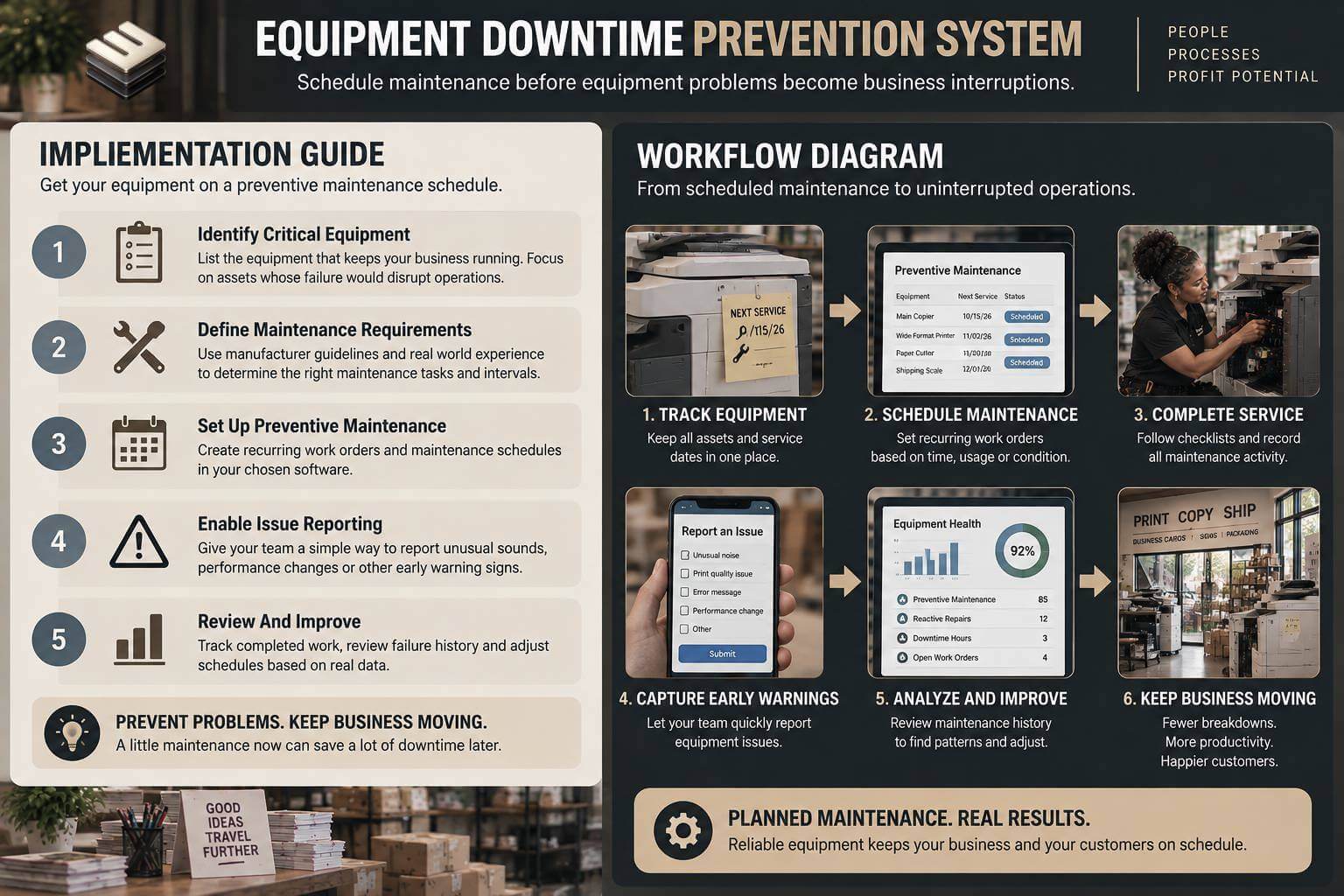
Step 1: Identify The Equipment That Matters
Do not begin by entering every physical object the business owns.
Start with equipment whose failure would materially affect operations.
For each asset, record information needed to identify and maintain it, such as equipment name, location, model information and relevant maintenance documentation.
Prioritize assets according to their operational importance.
A backup office printer and the only refrigeration unit in a restaurant should not automatically receive the same maintenance priority.
Step 2: Establish The Maintenance Requirements
Determine what preventive maintenance is actually appropriate for each asset.
Use manufacturer documentation, qualified service information, warranty requirements and relevant operating experience where applicable.
Define the recurring inspection, cleaning, lubrication, adjustment, component replacement or other maintenance tasks that should occur.
Avoid inventing arbitrary service intervals simply because software makes recurring schedules easy to create.
Step 3: Build The Preventive Maintenance Schedule
Create the maintenance plan and connect it with the appropriate asset.
MaintainX maintenance plans use work order templates to generate future work orders according to the schedule. Plans can follow fixed intervals or scheduling based on previous completion, depending on configuration.
MaintainX maintenance plan instructions
Where equipment usage matters more than calendar time, determine whether meter based maintenance is appropriate and available on the selected plan. MaintainX currently lists meter based maintenance in Premium, while some newer usage based maintenance plan functionality remains in beta.
Step 4: Create A Path For Early Warning Signs
Scheduled maintenance is only one part of downtime prevention.
Employees operating the equipment often encounter warning signs between service intervals.
Create a simple process for reporting unusual vibration, temperature, sound, leakage, reduced output, error messages or other equipment specific abnormalities.
MaintainX supports customizable work request portals associated with assets and locations, including access through QR codes.
MaintainX work request management
The goal is to make reporting easier than ignoring the problem.
Step 5: Review Maintenance And Failure History
Periodically review preventive and reactive maintenance together.
Look for equipment receiving repeated reactive repairs, overdue preventive work, recurring failure types or unusually high maintenance costs.
MaintainX reports can separate preventive from reactive work orders, while higher level reporting can provide equipment health and maintenance information.
If the same asset repeatedly fails despite completed preventive maintenance, the correct response may be to change the maintenance plan, investigate a different failure mechanism or evaluate whether continued repair remains economically sensible.
The system should learn from the equipment history rather than simply repeat the same maintenance forever.
Downtime Exposure Snapshot
The primary economic value of this system is productive capacity that becomes unavailable when critical equipment unexpectedly stops operating.
| Unplanned Downtime | Estimated Business Impact Per Hour | Operational Exposure |
|---|---|---|
| 2 hours | $250 | $500 |
| 8 hours | $250 | $2,000 |
| 20 hours | $250 | $5,000 |
Illustrative scenario using an estimated $250 of business impact per downtime hour. Operational exposure is not guaranteed savings. Actual consequences may include lost production, idle labor, emergency service, delayed jobs, spoiled inventory, customer disruption and other costs specific to the equipment and business.
WIZESTAX Diagnostic Scorecard
| Category | Assessment |
|---|---|
| Economic Problem | Preventable equipment failures interrupt productive business activity |
| Signal Quality Required | Moderate To High |
| Automation Potential | High |
| Human Judgment Required | Moderate To High |
| Data Dependency | Moderate To High |
| Scalability | High |
| Primary Value | Moving appropriate maintenance activity ahead of equipment interruption |
| Primary Risk | Assuming scheduled maintenance can prevent every equipment failure |
Common Mistakes
| Mistake | Result |
|---|---|
| Treating preventive maintenance as a calendar reminder only | Equipment history remains fragmented |
| Scheduling every asset identically | Maintenance does not reflect actual equipment requirements |
| Ignoring equipment usage | High use equipment may receive maintenance too late |
| Creating excessive preventive work | Time and parts are spent without corresponding reliability benefit |
| Failing to record reactive repairs | Recurring failure patterns remain hidden |
| Making equipment issue reporting difficult | Early warning signs remain informal |
| Closing work orders without useful information | Maintenance history becomes unreliable |
| Assuming maintenance eliminates failure | Unexpected breakdown risk is underestimated |
| Never reviewing the PM program | Ineffective maintenance schedules continue indefinitely |
Related WIZESTAX Categories
| Category | Related Business Problem |
|---|---|
| Operations | Recurring Task Failure Alert |
| Operations | Operational Exception Dashboard |
| Operations | Business KPI Anomaly Alert |
| Field Operations | Job Material Shortage Alert |
| Inventory | Stockout Risk Warning |
| Procurement | Vendor Contract Renewal |
| Workforce | Employee Certification Expiration |
These remain separate problems.
The Equipment Downtime Prevention System owns the operational loss created when critical physical equipment becomes unavailable and appropriate maintenance could reasonably have reduced that risk.
Recurring Task Failure Alert identifies repeated failures in business processes regardless of equipment. Operational Exception Dashboard surfaces unusual operational conditions across the business. Stockout Risk Warning addresses unavailable inventory rather than unavailable equipment. Employee Certification Expiration protects against workers losing required credentials.
This Blueprint remains specifically centered on keeping business critical equipment available through better maintenance timing, equipment history and earlier intervention.
Get New WIZESTAX Blueprints Every Monday
Subscribe to receive new WIZESTAX Blueprints covering Customer Retention, Marketing, Sales, Finance and Operations directly to your inbox.