

Lost Sale Reason Analysis System
Turn Closed Lost Deals Into Structured Sales Intelligence
A lost sale contains information that can disappear almost as quickly as the opportunity itself. One prospect chooses a competitor. Another decides the price is too high. A third postpones the purchase. Another discovers that the product does not provide something the business needs.
If those outcomes are simply marked Closed Lost, the business knows what happened financially but learns very little about why it happened. The Lost Sale Reason Analysis System creates a structured process for recording why opportunities are lost and analyzing those reasons across multiple sales outcomes.
Instead of leaving important information inside salesperson memory, scattered notes or inconsistent descriptions, the business creates a small set of meaningful loss categories. Individual deals can still contain supporting context, but the structured reason allows recurring patterns to become measurable.
The objective is not to assume that every lost sale could have been prevented. Some prospects are poor fits. Some budgets disappear. Competitors sometimes provide a better solution. Timing changes.
The purpose is to distinguish those outcomes so management can understand what is repeatedly happening after opportunities reach the sales process.
This is distinct from the Quote Acceptance Friction Detection System, which examines obstacles affecting quote acceptance, and the Sales Pipeline Bottleneck Detection System, which examines where opportunities slow down. This Blueprint analyzes the reason recorded after an opportunity is actually lost.
Which Stax Fits Your Business
| Business Need | Stax | Software | Cost |
|---|---|---|---|
| Straightforward CRM collection and reporting of predefined lost reasons | Starter Stax | Pipedrive | Varies by plan and users |
| CRM based loss reporting connected with deal owners, teams and pipeline value | Growth Stax | HubSpot Sales Hub | Varies by edition and users |
| Flexible independent loss analysis using structured records and custom dashboards | Pro Stax | Airtable | Varies by plan and users |
Pricing and capabilities change over time and should be confirmed directly with each software provider before purchase.
Software Linx
Starter
Growth
Pro
Blueprint Overview
| Metric | Value |
|---|---|
| Category | Sales Operations |
| Business Problem | Lost opportunities close without producing consistent information about why the sale was lost |
| Primary Objective | Capture structured loss reasons and identify recurring patterns |
| Core Signals | Loss reason, deal value, salesperson, customer type, competitor, sales stage and supporting notes |
| Setup Time | Approximately 60 to 120 minutes |
| Difficulty | Intermediate |
| Maintenance | Periodic reason and reporting review |
| Best For | Businesses managing enough sales opportunities to identify recurring loss patterns |
| Primary Output | Structured loss reason and trend analysis |
The Hidden Revenue Leak
| Without This Blueprint | With This Blueprint |
|---|---|
| Lost deals are recorded primarily as outcomes | Lost deals also contribute diagnostic information |
| Salespeople describe losses differently | Consistent categories make outcomes easier to compare |
| Recurring objections remain scattered across notes | Common loss reasons become measurable |
| Competitor losses are difficult to quantify | Competitor related losses can be separated and reviewed |
| Management relies heavily on individual recollection | Historical deal records provide evidence |
| Sales changes may be based on isolated examples | Repeated patterns can receive greater attention |
A loss reason should describe what is known about the sales outcome rather than what the salesperson assumes happened. When the cause is unclear, the system should allow that uncertainty to remain visible.
Business Impact Snapshot
| Area | Potential Impact |
|---|---|
| Sales Intelligence | Repeated loss patterns become easier to identify |
| Pricing | Price related losses can be separated from other objections |
| Competitive Visibility | Competitor related losses become measurable |
| Qualification | Poor fit opportunities can be distinguished from viable opportunities |
| Product Feedback | Missing capability patterns can become visible |
| Management | Sales decisions can use accumulated outcome data rather than individual anecdotes |
Real World Example
A commercial cleaning company closes 35 opportunities as lost during a quarter.
Historically, salespeople enter short notes such as “not interested,” “went another way,” “too expensive,” or simply “lost.”
Management knows the company failed to win the contracts, but the records do not provide enough consistency to identify what happened across the group.
The business introduces structured loss reasons.
During the next quarter, each lost opportunity receives a defined category along with an optional note explaining the circumstances.
After several months, the company reviews the results.
Price appears frequently, but it is not the only pattern. Several prospects selected competitors because those companies offered weekend service coverage. Another group postponed projects because their budgets had changed. Several opportunities were poor fits from the beginning.
Those findings lead to different questions.
The company can investigate whether weekend coverage deserves operational consideration. It can examine whether price objections cluster around particular services. It can also review why poor fit prospects progressed so far into the pipeline.
The system does not prove what the business should change.
It turns individual losses into structured evidence that can support further investigation.
WIZESTAX Stax Options
Starter Stax
Pipedrive
Best For
Small sales teams that want lost reason collection directly inside a focused sales CRM.
| Function | Software |
|---|---|
| CRM | Pipedrive |
| Deal Outcome | Lost Deal Status |
| Loss Classification | Predefined Lost Reasons |
| Supporting Context | Additional Comments |
| Analysis | Insights |
| Historical Review | Deal List And Reports |
Pipedrive currently supports both freeform and predefined lost reasons. Administrators can create predefined reasons so salespeople choose from consistent categories when marking deals lost. Additional comments can still be stored with the deal. (Pipedrive Support)
Advantages
| Benefit |
|---|
| Loss reasons are captured during the normal deal closing process |
| Predefined categories improve consistency |
| Additional comments preserve deal specific context |
| Lost reasons can appear in deal lists |
| Insights can be used to analyze lost reason data |
Limitations
| Limitation |
|---|
| Poorly designed categories still produce weak information |
| Salespeople must select reasons accurately |
| Too many categories can reduce consistency |
| Freeform reasons alone are harder to aggregate |
| A recorded reason does not necessarily prove the underlying cause |
Pipedrive specifically describes lost reason tracking as a way to identify trends such as customer groups that rarely close or competitors drawing business away. (Pipedrive Support)
Growth Stax
HubSpot Sales Hub
Best For
Businesses wanting lost sale analysis connected with broader CRM reporting, deal ownership and sales team performance.
| Function | Software |
|---|---|
| CRM | HubSpot Smart CRM |
| Deal Outcome | Closed Lost |
| Loss Information | Closed Lost Reason |
| Analysis | Sales Analytics |
| Comparison | Deal Owner And Team |
| Economic Context | Deal Value |
HubSpot’s current Sales Analytics suite includes a Deal loss reasons report. It can show the number and value of Closed Lost deals according to the Closed lost reason property and analyze those results by deal owner or team. (HubSpot Knowledge Base)
Advantages
| Benefit |
|---|
| Loss reasons remain connected with CRM deal records |
| Reporting can include the value associated with lost deals |
| Results can be examined by owner or team |
| Loss analysis can sit beside broader sales analytics |
| Useful for organizations already operating within HubSpot |
Limitations
| Limitation |
|---|
| Reporting availability varies by subscription |
| Unstructured reason entries can make aggregation less reliable |
| Larger CRM environments require stronger data governance |
| Deal value associated with a loss reason does not prove recoverable revenue |
| Reporting reveals patterns but does not establish causation |
HubSpot’s reporting documentation confirms that its Deal loss reasons report uses the Closed lost reason property and can display both deal count and value. (HubSpot Knowledge Base)
Pro Stax
Airtable
Best For
Businesses that want to analyze lost sales independently from their CRM or combine loss information from multiple sources into a custom analysis system.
| Function | Software |
|---|---|
| Analysis Workspace | Airtable |
| Loss Categories | Single Select Fields |
| Deal Records | Airtable Records |
| Supporting Context | Structured Fields And Notes |
| Analysis | Interface Dashboard |
| Visualization | Charts, Counts And Lists |
Airtable single select fields provide predefined options that can be sorted, filtered, grouped and analyzed, making them suitable for standardized loss categories. (Airtable Help Center)
Airtable Interface dashboards can then summarize underlying records using numbers, charts and lists. Dashboard charts support categories, values and filtering, allowing a business to examine lost sale records from different perspectives. (Airtable Help Center)
Advantages
| Benefit |
|---|
| Highly customizable loss classification |
| Can analyze records exported from different sales systems |
| Dashboards can combine counts, charts and detailed records |
| Additional fields can capture competitor, service, customer type and deal value |
| Useful when the CRM reporting structure is too restrictive |
Limitations
| Limitation |
|---|
| Airtable does not automatically create good loss data |
| Information may need to be imported or connected from another system |
| Custom architecture requires initial design |
| Duplicate records can distort analysis |
| More flexibility creates greater responsibility for data consistency |
This architecture is intentionally different from the first two Stax. Airtable can function as an independent analysis layer rather than replacing the business CRM.
How The Three Stax Differ
| Stax | Primary Approach |
|---|---|
| Pipedrive | Capture and analyze predefined lost reasons directly inside a focused sales CRM |
| HubSpot Sales Hub | Analyze Closed Lost reasons alongside deal value, owners and teams |
| Airtable | Build a custom independent loss analysis database and dashboard |
These are different implementation architectures rather than rankings.
Pipedrive keeps the process relatively close to the salesperson marking the deal lost.
HubSpot places loss analysis inside a broader sales analytics environment.
Airtable separates the analytical architecture from the CRM and provides greater freedom over how lost sale information is categorized and displayed.
The appropriate architecture depends on the existing sales system, the number of lost opportunities being analyzed, the amount of supporting context required and whether the business needs CRM native reporting or a separate analytical layer.
Copy And Paste Lost Sale Record
“Deal: {{deal_name}}
Loss reason: {{loss_reason}}
Competitor involved: {{competitor}}
Customer explanation: {{customer_explanation}}
Deal value: {{deal_value}}
Additional context: {{salesperson_notes}}
Record only information supported by the sales conversation. If the actual reason is unknown, record it as unknown rather than inferring a cause.”
Copy And Paste Sales Loss Review
“Review the lost opportunities from {{review_period}}.
Identify loss reasons that appear repeatedly, then separate the frequency of each reason from the value of the opportunities associated with it.
Review supporting notes before drawing conclusions.
Highlight patterns that deserve further investigation without assuming that every lost opportunity could have been prevented.”
Copy And Paste AI Prompt
You are assisting a small business with lost sale reason analysis.
Review the Closed Lost opportunities provided.
Group opportunities using the business’s existing loss reason categories.
Consider deal value, customer type, product or service, salesperson, competitor information, sales stage and supporting notes when those fields are available.
Identify loss reasons that occur repeatedly.
Separate frequency from economic value. A reason associated with many small opportunities may differ from one associated with a few large opportunities.
Do not assume that a salesperson’s interpretation is the confirmed reason unless the customer provided supporting information.
Do not invent missing loss reasons.
Do not assume every lost sale was preventable.
Identify inconsistent or vague records that may weaken the analysis.
Explain which patterns appear repeatedly and which observations require additional investigation.
If the available sample is too small to support a meaningful pattern, state that clearly.
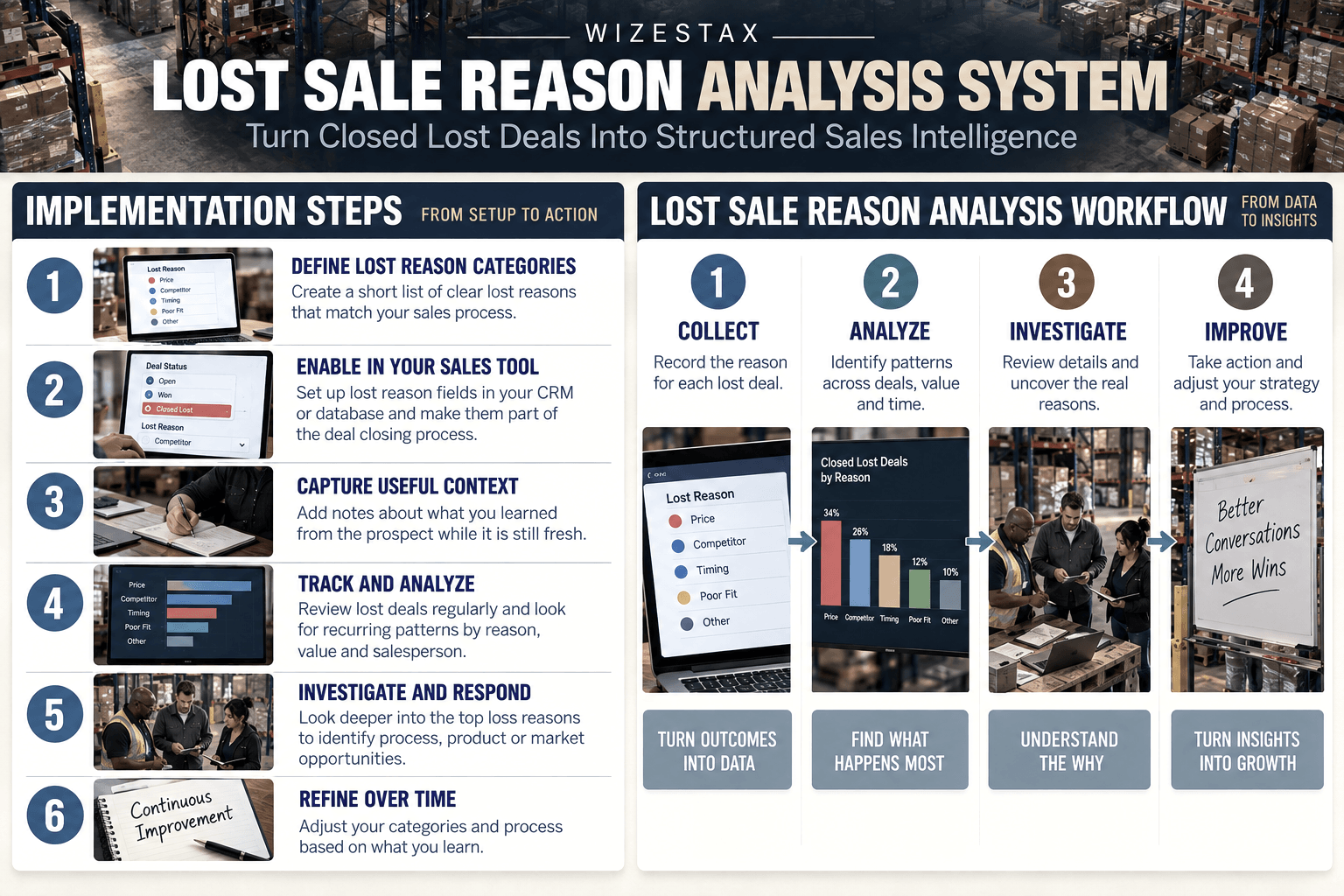
Step By Step Implementation Guide
The following setup demonstrates one implementation path using Pipedrive.
It is not a WIZESTAX recommendation or preferred Stax.
Pipedrive is used here because its predefined lost reasons provide a direct example of capturing structured information at the moment a salesperson marks a deal lost, while its Insights feature provides a practical way to analyze that information afterward. (Pipedrive Support)
Step 1: Review Existing Lost Deals
Begin by reviewing a sample of recent lost opportunities.
Look for the explanations salespeople already provide.
The objective is not to create a category for every individual situation. It is to identify recurring explanations that can form a manageable classification system.
Step 2: Define The Loss Categories
Create a small set of reasons that describe materially different outcomes.
For example, the business might distinguish price, competitor, timing, budget unavailable, poor fit, missing capability and customer decision unknown.
Categories should describe meaningful causes rather than vague outcomes such as “did not close.”
Include an unknown option so employees are not forced to invent certainty.
Step 3: Enable Predefined Lost Reasons
In Pipedrive, open Company Settings and locate Lost Reasons.
Create the approved reason categories.
Pipedrive allows administrators to configure predefined reasons that become selectable when users mark deals lost. The system can also allow freeform reasons when circumstances fall outside the predefined list. (Pipedrive Support)
Step 4: Preserve Supporting Context
A category provides consistency, but individual context still matters.
If the salesperson selects Competitor, the supporting note might identify which competitor was chosen and what the customer said influenced the decision.
If the salesperson selects Price, the note might explain whether the customer explicitly described the offer as too expensive or whether budget disappeared entirely.
Pipedrive allows additional comments when a deal is marked lost and stores those comments as a note on the deal. (Pipedrive Support)
Step 5: Make Loss Recording Part Of Deal Closure
When an opportunity reaches a genuine lost outcome, record the reason while the sales conversation is still recent.
Avoid waiting until a quarterly pipeline cleanup when employees may no longer remember the circumstances accurately.
The objective is to capture the best information available at the time of closure.
Step 6: Build The Lost Reason Report
Open Pipedrive Insights and create a deal performance report.
Filter the report using lost reasons.
Pipedrive currently supports lost reason analysis through Insights, allowing businesses to examine their own lost deal information rather than relying only on individual deal records. (Pipedrive Support)
Step 7: Compare Frequency And Value
Do not evaluate loss reasons only by the number of deals.
One category may contain 20 small opportunities.
Another may contain 4 opportunities worth considerably more.
Review both the frequency of the reason and the opportunity value associated with it.
Neither number alone establishes how much revenue could have been recovered.
Step 8: Investigate Patterns
When a loss reason appears repeatedly, examine the underlying records.
A high number of price losses could reflect pricing, poor qualification, customer segment, packaging, competitor positioning or another factor.
The category identifies where investigation should begin.
It does not automatically identify the solution.
Step 9: Maintain The Categories
Review the classification system periodically.
If an existing category is rarely used, determine whether it remains necessary.
If employees repeatedly select Other for the same circumstance, the business may need a new category.
Avoid allowing the list to grow indefinitely. The system becomes harder to analyze when employees must choose among many overlapping reasons.
Lost Pipeline Value Snapshot
The economic value of this system is not the assumption that lost sales could have been recovered.
Instead, the analysis shows how much recorded opportunity value is associated with different loss categories.
| Lost Reason | Lost Opportunities | Recorded Opportunity Value |
|---|---|---|
| Price | 8 | $16,000 |
| Competitor | 5 | $14,000 |
| Timing | 7 | $9,000 |
| Poor Fit | 6 | $7,000 |
| Unknown | 4 | $4,000 |
| Total | 30 | $50,000 |
Illustrative scenario only. Recorded opportunity value is not revenue that would otherwise have been earned and is not automatically recoverable. Loss reason data identifies where further investigation may be worthwhile.
This distinction matters.
If competitor related losses represent fewer opportunities but a large amount of pipeline value, management may choose to investigate those records more closely.
If poor fit losses are frequent, the more relevant question may be whether qualification is allowing unsuitable opportunities to progress too far.
The system creates evidence for those questions without deciding the answer in advance.
WIZESTAX Diagnostic Scorecard
| Category | Assessment |
|---|---|
| Economic Problem | Lost sales can disappear from the pipeline without producing structured information about why they were lost |
| Signal Quality Required | Moderate To High |
| Automation Potential | Moderate |
| Human Judgment Required | Moderate To High |
| Data Dependency | High |
| Scalability | High |
| Primary Value | Recurring sales loss patterns become measurable |
| Primary Risk | Inaccurate or overly broad loss reasons create misleading conclusions |
Common Mistakes
| Mistake | Result |
|---|---|
| Recording every lost deal simply as Closed Lost | The outcome is known but the reason remains invisible |
| Allowing only unrestricted free text | Similar losses become difficult to aggregate |
| Creating too many categories | Employees interpret overlapping options differently |
| Removing the unknown option | Salespeople may guess when the real reason is unclear |
| Treating salesperson assumptions as confirmed customer explanations | Analysis gains false certainty |
| Counting losses without considering deal value | Frequency becomes the only measure of importance |
| Treating associated pipeline value as recoverable revenue | The economic significance is overstated |
| Automatically changing pricing because price appears frequently | A symptom is treated as a confirmed cause |
| Never reviewing supporting notes | Important context behind the category is lost |
| Never updating the reason structure | Categories stop reflecting the actual sales process |
Get New WIZESTAX Blueprints Every Monday
Subscribe to receive new WIZESTAX Blueprints covering Customer Retention, Marketing, Sales, Finance and Operations directly to your inbox.