

Customer Acquisition Cost Tracking System
Know What It Actually Costs To Acquire A New Customer
A business can generate new customers while still having poor visibility into what those customers cost to acquire. Advertising expenses may live inside advertising platforms. Marketing software appears in recurring expenses. Sales labor is tracked through payroll. Agency fees, content production and other acquisition expenses may sit somewhere else entirely. Meanwhile, new customer counts are recorded in a CRM, booking platform, ecommerce system or accounting software.
When those numbers remain separated, the business may know how much it spent on advertising without knowing its actual customer acquisition cost.
The Customer Acquisition Cost Tracking System brings acquisition expenses and new customer counts into a consistent measurement process so the business can understand how much it is spending to produce each new customer.
Customer acquisition cost is generally calculated by dividing sales and marketing costs during a defined period by the number of new customers acquired during that same period. (HubSpot)
This Blueprint does not assume that a low acquisition cost is always good or that a high acquisition cost is always bad. Customer value, margins, sales cycles and acquisition strategy also matter. Its purpose is to make the cost visible enough for the business to evaluate it.
Which Stax Fits Your Business
| Business Need | Stax | Software | Cost |
|---|---|---|---|
| Focused CAC and KPI monitoring using connected business data | Starter Stax | Databox | Varies by plan and features |
| Blended marketing, CRM and financial analysis across multiple systems | Growth Stax | Zoho Analytics | Varies by plan and users |
| Full lifecycle marketing measurement with customer journey and revenue attribution | Pro Stax | HubSpot Marketing Hub | Varies by edition and features |
Pricing and capabilities change over time and should be confirmed directly with each software provider before purchase.
Software Linx
Starter
Growth
Pro
Blueprint Overview
| Metric | Value |
|---|---|
| Category | Marketing And Finance |
| Business Problem | The business acquires customers without consistently measuring the full cost of acquisition |
| Primary Objective | Calculate and monitor customer acquisition cost over consistent periods |
| Core Inputs | Sales costs, marketing costs and new customers acquired |
| Setup Time | Approximately 60 to 120 minutes |
| Difficulty | Intermediate |
| Maintenance | Monthly review and periodic cost validation |
| Best For | Businesses investing consistently in sales and marketing |
| Primary Output | Customer acquisition cost and acquisition cost trend |
The Hidden Revenue Leak
| Without This Blueprint | With This Blueprint |
|---|---|
| Advertising spend is mistaken for total acquisition cost | Broader sales and marketing costs can be included |
| Customer growth is viewed without its acquisition expense | New customer growth can be compared with acquisition cost |
| Costs remain scattered across different systems | Relevant acquisition costs are brought into one measurement process |
| Marketing efficiency is judged primarily from activity metrics | Acquisition spending can be connected with paying customers |
| Changes in acquisition cost are difficult to see | CAC can be monitored over consistent periods |
| Budget decisions rely on incomplete cost information | Management has a clearer acquisition cost baseline |
CAC should use a consistent definition. Changing which expenses or customers are included from one period to another can make the trend misleading.
Business Impact Snapshot
| Area | Potential Impact |
|---|---|
| Cost Visibility | Acquisition spending becomes easier to understand |
| Budgeting | Marketing and sales budgets can be reviewed against customer growth |
| Management | Changes in acquisition efficiency become visible |
| Profitability | Acquisition cost can be evaluated alongside customer value and margin |
| Marketing | Channel and campaign analysis gains broader financial context |
| Planning | Growth targets can account for the resources required to acquire customers |
Real World Example
A local service company spends $4,000 during one month on advertising, marketing software, outsourced content and sales activity related to acquiring customers.
During the same month, the business acquires 20 new customers.
Its measured customer acquisition cost for that period is:
$4,000 ÷ 20 = $200 per new customer
The following month, acquisition spending rises to $5,000 and the business acquires 20 new customers again.
Customer volume has not changed, but measured acquisition cost has increased to:
$5,000 ÷ 20 = $250 per new customer
That change does not automatically mean the business should reduce marketing.
The system simply makes the change visible.
Management can then investigate whether costs increased, conversion weakened, the customer mix changed or another part of the acquisition process affected the result.
WIZESTAX Stax Options
Starter Stax
Databox
Best For
Businesses that already collect sales and marketing information in several systems and primarily need a straightforward dashboard for calculating and monitoring CAC and related KPIs.
Databox supports calculated metrics including customer acquisition cost and can combine connected data into KPI dashboards. (Databox)
| Function | Software |
|---|---|
| KPI Dashboard | Databox |
| Acquisition Cost Calculation | Calculated Metrics |
| Data Sources | Connected Business Platforms |
| Trend Monitoring | Databox Dashboards |
| Performance Review | Goals And KPI Monitoring |
Advantages
| Benefit |
|---|
| Focused approach to KPI monitoring |
| CAC can be created as a calculated metric |
| Multiple business metrics can appear together |
| Historical trends can make changes easier to identify |
| Suitable for businesses that do not need a complete CRM replacement |
Limitations
| Limitation |
|---|
| Accurate CAC still depends on complete cost information |
| Some calculated metric capabilities depend on plan |
| Data may require preparation before sources can be compared correctly |
| It does not replace the systems where sales and marketing activity originates |
Growth Stax
Zoho Analytics
Best For
Businesses that need to combine marketing spend, CRM activity, financial information and customer outcomes from several systems.
Zoho Analytics supports data blending across marketing platforms, CRMs, finance systems and other sources. Zoho specifically describes combining marketing spend with CRM sales data and provides marketing reporting that includes CAC by channel. (Zoho)
| Function | Software |
|---|---|
| Business Intelligence | Zoho Analytics |
| Marketing Data | Marketing Connectors |
| Customer Data | CRM Integration |
| Financial Data | Finance Integrations |
| CAC Calculation | Custom Reports And KPI Widgets |
| Monitoring | Dashboards And Alerts |
Advantages
| Benefit |
|---|
| Marketing and customer data can be blended |
| Financial information can contribute to acquisition analysis |
| Custom formulas support business specific CAC definitions |
| Dashboards can compare acquisition performance across periods |
| Suitable for businesses using several separate software systems |
Limitations
| Limitation |
|---|
| More setup is required than a focused KPI dashboard |
| Data sources must use compatible definitions and time periods |
| Advanced integrations may depend on plan |
| Poor source data can still produce misleading acquisition metrics |
Pro Stax
HubSpot Marketing Hub
Best For
Businesses that want customer acquisition measurement connected directly with CRM records, marketing interactions, customer journeys and closed revenue.
HubSpot provides marketing analytics across channels and supports customer journey analytics and multi touch revenue attribution for connecting marketing activity with closed revenue. (HubSpot)
| Function | Software |
|---|---|
| CRM | HubSpot Smart CRM |
| Marketing Analytics | HubSpot Marketing Hub |
| Customer Journey | Journey Analytics |
| Revenue Attribution | Multi Touch Revenue Attribution |
| Reporting | Marketing Dashboards |
| Customer Outcomes | Closed Deal And Revenue Data |
Advantages
| Benefit |
|---|
| Marketing activity and customer records can remain connected |
| Customer journeys can be analyzed across multiple interactions |
| Revenue attribution provides deeper context around acquisition |
| Channel and campaign reporting can connect activity with business outcomes |
| Suitable for businesses with more complex acquisition journeys |
Limitations
| Limitation |
|---|
| Advanced reporting capabilities depend on qualifying plans |
| Higher complexity than many small businesses require |
| Attribution does not eliminate the need for a consistent CAC definition |
| Complete acquisition costs may still require information from outside the marketing platform |
How The Three Stax Differ
| Stax | Primary Approach |
|---|---|
| Databox | Focused CAC and KPI monitoring |
| Zoho Analytics | Cross system data blending and acquisition analysis |
| HubSpot Marketing Hub | Full customer journey and revenue attribution |
These are different implementation architectures rather than rankings.
The appropriate architecture depends on where the business currently stores acquisition expenses, how many marketing and sales systems are involved, how complex the customer journey is and how much attribution detail management actually needs.
Copy And Paste CAC Review Alert
“Customer acquisition cost for {{period}} is {{cac}}. This represents {{total_acquisition_cost}} in measured sales and marketing costs divided by {{new_customers}} new customers. Review any significant change in acquisition cost before adjusting budgets.”
Copy And Paste Monthly CAC Review
“Review customer acquisition cost for the current period against previous periods. Confirm that the same expense categories and customer definition were used before interpreting any increase or decrease.”
Copy And Paste AI Prompt
You are assisting a small business with customer acquisition cost analysis.
Review the sales costs, marketing costs and new customer information provided.
Calculate customer acquisition cost using:
Total sales and marketing acquisition costs divided by new customers acquired during the same period.
Identify which expenses were included in the calculation.
Confirm that the customer count represents new paying customers rather than leads, inquiries or other conversions.
Compare the result with previous periods only when the underlying definitions are consistent.
Identify meaningful changes that deserve investigation.
Do not assume that a higher customer acquisition cost automatically means marketing is performing poorly.
Consider changes in customer value, margins, sales cycle, marketing investment and customer mix when relevant.
Do not invent missing expenses or customer information.
If the available information is insufficient to calculate a reliable customer acquisition cost, state what information is missing.
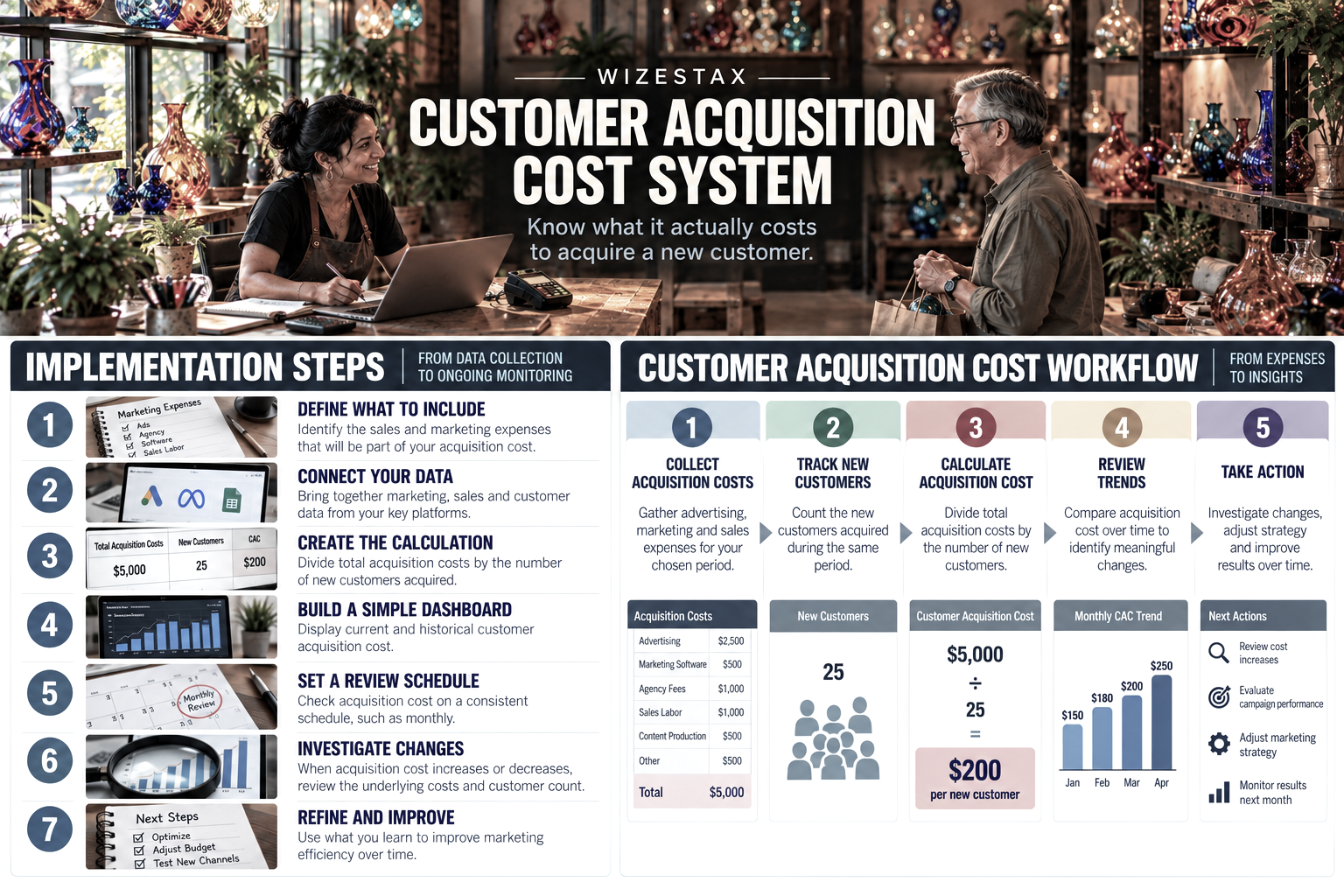
Step By Step Implementation Guide
The following setup demonstrates one implementation path using Zoho Analytics.
It is not a WIZESTAX recommendation or preferred Stax.
Zoho Analytics is used here because its data blending architecture provides a practical example of bringing marketing spend and customer outcome data together. Zoho documents the ability to combine marketing data with CRM information and financial sources for cross functional analysis. (Zoho)
Step 1: Define What Counts As A New Customer
Choose one consistent definition of a new customer.
For a service business, this might be a customer who completed and paid for their first job.
For an ecommerce business, it might be a customer who completed their first purchase.
For a subscription business, it might be a customer whose first paid subscription began during the measurement period.
Do not count leads, inquiries or other conversions as customers unless they match the business definition being measured.
Step 2: Define Acquisition Costs
Identify the sales and marketing expenses that will be included.
These may include advertising, sales labor, marketing labor, agencies, contractors, marketing software, content production and other resources used to acquire customers.
HubSpot’s current CAC definition similarly includes sales and marketing expenses divided by customers acquired during the same period. (HubSpot)
The important requirement is consistency.
If software costs are included this month but excluded next month, the resulting trend will not represent the same measurement.
Step 3: Connect The Data Sources
Open Zoho Analytics.
Connect the systems containing relevant marketing expenses.
Connect the CRM or customer system containing new customer records.
Connect financial data when acquisition expenses are stored in accounting or expense software.
Zoho Analytics can blend marketing information with CRM data and supports integrations with marketing, financial and other business applications. (Zoho)
Step 4: Create The CAC Calculation
Create a calculated metric using:
Customer Acquisition Cost = Total Acquisition Costs ÷ New Customers Acquired
Use the same date period for both values.
For example:
$6,000 acquisition costs ÷ 30 new customers = $200 CAC
Create a dashboard showing the current result and historical periods.
Step 5: Validate The Calculation
Select several recent periods and verify the underlying numbers manually.
Confirm that advertising expenses are complete.
Confirm that recurring marketing costs have been included according to the chosen definition.
Confirm that existing customers have not been counted as new customers.
Confirm that the cost period matches the customer acquisition period.
The purpose of validation is to establish confidence in the measurement before management begins using it for decisions.
Step 6: Monitor The Trend
Review CAC on a consistent schedule.
A monthly review may be appropriate for many small businesses.
Look for meaningful changes rather than reacting to every fluctuation.
When CAC changes, investigate the components separately.
Did acquisition spending change?
Did the number of new customers change?
Did the sales cycle change?
Did customer mix change?
Did the business make a deliberate investment that temporarily increased acquisition spending?
The metric identifies the change. Human review determines what the change means.
Acquisition Cost Snapshot
| Monthly Acquisition Costs | New Customers | Measured CAC |
|---|---|---|
| $2,500 | 25 | $100 |
| $5,000 | 25 | $200 |
| $10,000 | 25 | $400 |
Illustrative scenario only. Measured CAC does not by itself determine profitability, customer quality or whether acquisition spending should increase or decrease.
WIZESTAX Diagnostic Scorecard
| Category | Assessment |
|---|---|
| Economic Problem | Customer growth can occur without visibility into the resources required to produce it |
| Signal Quality Required | High |
| Automation Potential | Moderate To High |
| Human Judgment Required | Moderate |
| Data Dependency | High |
| Scalability | High |
| Primary Value | Acquisition cost visibility |
| Primary Risk | Incomplete costs or inconsistent customer definitions producing misleading CAC |
Common Mistakes
| Mistake | Result |
|---|---|
| Counting advertising spend as the entire acquisition cost | CAC may exclude significant sales and marketing expenses |
| Counting leads instead of new customers | Acquisition cost can appear artificially low |
| Comparing different measurement periods | Costs and customers may not correspond |
| Changing included expenses between periods | CAC trends become inconsistent |
| Treating CAC as a complete profitability metric | Customer value and margins are ignored |
| Looking only at company wide CAC | Important differences between acquisition sources can remain hidden |
| Reacting to every monthly fluctuation | Normal variation can trigger unnecessary changes |
Get New WIZESTAX Blueprints Every Monday
Subscribe to receive new WIZESTAX Blueprints covering Customer Retention, Marketing, Sales, Finance and Operations directly to your inbox.