
Local Search Visibility Monitoring System
Detect Changes In How Easily Nearby Customers Can Find Your Business In Local Search
Local businesses can lose search visibility gradually without realizing it. A business may still appear when the owner searches its name, while becoming harder to find when nearby customers search for the actual service they need. Visibility can also vary considerably by keyword and physical search location, so checking a handful of searches manually can give an incomplete picture.
The Local Search Visibility Monitoring System creates a repeatable way to monitor where a business appears across important local searches, identify meaningful visibility changes and investigate those changes before they quietly affect customer discovery.
The purpose is not to treat every ranking movement as a problem. Local rankings vary by location, query and search environment. BrightLocal’s current local tracking tools, for example, measure localized organic results, Local Pack results and Maps visibility, including grid based measurements showing how rankings differ across geographic points. (BrightLocal Help Center)
Which Stax Fits Your Business
| Business Need | Stax | Software | Cost |
|---|---|---|---|
| Focused local ranking and geographic visibility monitoring | Starter Stax | BrightLocal | Varies by plan and locations |
| Local visibility combined with listings management | Growth Stax | Semrush Local | Varies by plan and locations |
| Direct measurement of Google Search and Maps discovery | Pro Stax | Google Business Profile | No separate software purchase required |
Pricing and capabilities change over time and should be confirmed directly with each software provider before purchase.
Software Linx
Starter: BrightLocal
Growth: Semrush
Blueprint Overview
| Metric | Value |
|---|---|
| Category | Marketing |
| Business Problem | Local search visibility can weaken without the business recognizing the change |
| Primary Objective | Monitor meaningful changes in local search visibility |
| Core Signals | Local rankings, Maps visibility, search terms, profile views and customer interactions |
| Setup Time | Approximately 60 to 120 minutes |
| Difficulty | Intermediate |
| Maintenance | Weekly or monthly review |
| Best For | Businesses that depend on customers within a defined geographic market |
| Primary Output | Local visibility baseline and investigation trigger |
The Hidden Revenue Leak
| Without This Blueprint | With This Blueprint |
|---|---|
| Visibility is checked manually | Search performance is monitored consistently |
| Business name searches create false confidence | Service based searches receive attention |
| Geographic differences remain hidden | Visibility can be examined across the service area |
| Ranking declines can continue unnoticed | Meaningful changes trigger investigation |
| Search position is viewed without customer behavior | Rankings and profile interactions can be considered together |
| Owners react to individual searches | Decisions use a repeatable baseline |
A ranking decline does not automatically mean that something is wrong. Search location, competition, query differences and normal movement can affect what appears. The objective is to identify patterns worth investigating rather than react to every change.
Business Impact Snapshot
| Area | Potential Impact |
|---|---|
| Customer Discovery | Changes in local visibility become easier to identify |
| Marketing | Search performance can be monitored consistently |
| Geographic Coverage | Weak visibility areas become more apparent |
| Google Business Profile | Search and Maps interactions receive greater context |
| Management | Local search review becomes repeatable |
| Planning | Visibility changes can be investigated before making larger marketing decisions |
Real World Example
A family dental practice serves customers across several nearby neighborhoods.
The owner occasionally searches the practice name and sees the business near the top of Google, creating the impression that local visibility is strong.
A monitoring system tells a different story.
The practice remains highly visible close to its office but appears much less consistently several miles away for searches related to services such as emergency dentistry and dental implants.
At the same time, one important service keyword has been gradually losing position across several search locations.
The system does not automatically explain why the change occurred.
It identifies where and for which searches visibility has changed, giving the business a specific issue to investigate.
WIZESTAX Stax Options
Starter Stax
BrightLocal
Best For
Local businesses that primarily need detailed monitoring of rankings across specific keywords and geographic areas.
| Function | Software |
|---|---|
| Local Rankings | Local Rank Tracker |
| Geographic Visibility | Local Search Grid |
| Google Maps Monitoring | Local Search Grid |
| Organic Search Monitoring | Local Rank Tracker |
| Competitive Context | Competitor Tracking |
| Reporting | Location Reports |
BrightLocal’s Local Rank Tracker monitors localized organic and local search results, while Local Search Grid measures rankings at individual points across a geographic area. Its current platform also provides location level visibility summaries. (BrightLocal Help Center)
Advantages
| Benefit |
|---|
| Rankings can be monitored at a local level |
| Geographic differences become visible |
| Maps and organic visibility can be examined separately |
| Historical movement helps distinguish trends from individual changes |
| Competitor visibility provides additional context |
Limitations
| Limitation |
|---|
| Rankings do not directly measure revenue |
| Keyword selection affects the usefulness of the system |
| Geographic grids require interpretation |
| Ranking changes do not explain their own cause |
| Customer outcomes still need separate measurement |
Growth Stax
Semrush Local
Best For
Businesses that want local ranking monitoring combined with broader management of their online business information.
| Function | Software |
|---|---|
| Local Visibility | Semrush Local |
| Map Rankings | Map Rank Tracker |
| Business Listings | Listing Management |
| Listing Accuracy | Listings Monitoring |
| Competitive Context | Local Competitor Data |
| Location Management | Semrush Local |
Semrush Local currently combines local ranking tools with listing management. Its Listing Management system distributes and maintains business information across supported directories, while its local search tools provide map based ranking monitoring and visibility comparisons. (Semrush)
Advantages
| Benefit |
|---|
| Rankings and business listings can be managed together |
| Map visibility can be monitored geographically |
| Listing inconsistencies become easier to identify |
| Competitor visibility provides context |
| Multiple local search functions remain in one environment |
Limitations
| Limitation |
|---|
| Broader functionality can add complexity |
| Available features depend on subscription |
| Rankings still require interpretation |
| Listing accuracy does not guarantee strong rankings |
| Search visibility does not directly establish customer acquisition |
Pro Stax
Google Business Profile
Best For
Businesses that want direct first party information about how customers discover and interact with their profile on Google Search and Maps.
| Function | Software |
|---|---|
| Local Presence | Google Business Profile |
| Search Discovery | Performance |
| Search Terms | Search Queries |
| Profile Visibility | Views |
| Customer Intent | Calls, Directions And Website Clicks |
| Maps Activity | Business Profile Performance |
Google Business Profile Performance currently reports how customers discover a verified profile through Search and Maps. Available metrics can include searches, profile views, calls, direction requests, website clicks and other interactions depending on the business. (Google Help)
Advantages
| Benefit |
|---|
| Information comes directly from Google |
| Search terms provide discovery context |
| Search and Maps views can be monitored |
| Customer interactions add context beyond rankings |
| No separate rank tracking subscription is required |
Limitations
| Limitation |
|---|
| It does not provide the same geographic rank grid as dedicated local SEO tools |
| Performance metrics do not show every competitive ranking relationship |
| Available metrics vary by business |
| Profile interactions do not establish completed sales |
| Additional tools may be necessary for deeper ranking analysis |
How The Three Stax Differ
| Stax | Primary Approach |
|---|---|
| BrightLocal | Detailed local ranking and geographic visibility monitoring |
| Semrush Local | Local visibility monitoring combined with listings management |
| Google Business Profile | First party Search and Maps discovery and interaction measurement |
These are different implementation architectures rather than rankings.
The appropriate architecture depends on whether the business primarily needs geographic rank monitoring, broader local presence management or direct visibility into how customers interact with its Google Business Profile.
Copy And Paste Local Visibility Alert
Local search visibility review for {{business_name}}. During {{period}}, visibility for {{keyword_or_service}} changed across {{location_or_service_area}}. Review the ranking trend, geographic pattern, Business Profile information, website visibility and competitive changes before making adjustments.
Copy And Paste Monthly Visibility Review
Review local search visibility for {{business_name}} during {{period}} using the same keywords, geographic area and measurement method as the previous period. Identify meaningful changes in Maps visibility, organic rankings, Business Profile discovery and customer interactions. Separate persistent patterns from isolated ranking movement before identifying areas that require investigation.
Copy And Paste AI Prompt
You are assisting a small business with local search visibility analysis.
Review the local search information provided.
Compare the same keywords and geographic areas across consistent measurement periods.
Identify meaningful changes in local rankings, Maps visibility and Business Profile discovery.
Separate branded searches from searches for actual products or services where possible.
Examine geographic patterns rather than relying on one search location.
Consider customer interactions such as calls, website clicks and direction requests when available.
Do not assume that every ranking decline represents a problem.
Do not assume that ranking first for the business name means the business has strong local search visibility.
Do not assume that ranking changes establish why visibility changed.
Do not invent missing information.
If the available information is insufficient to identify a meaningful visibility change, state what additional information is required.
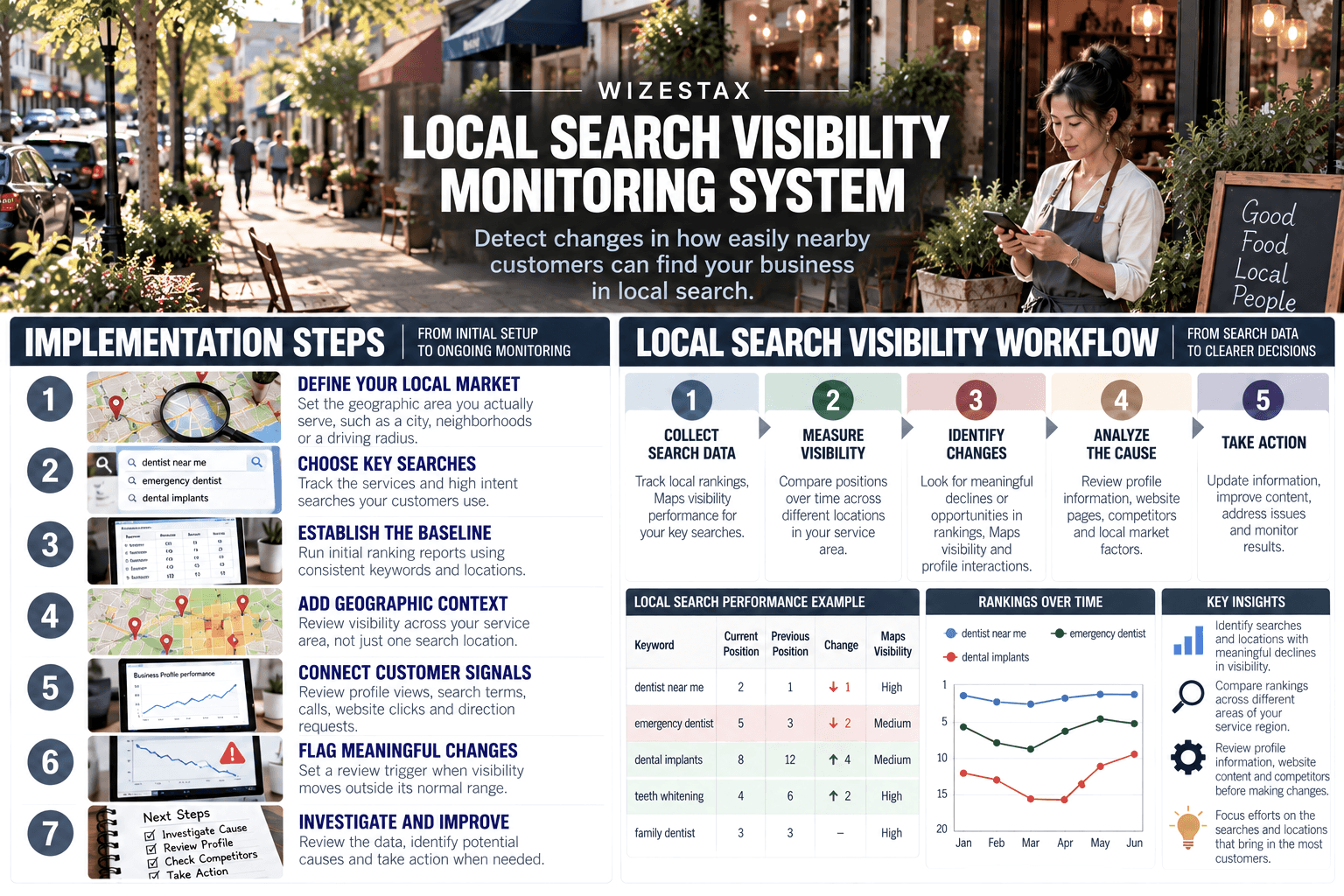
Step By Step Implementation Guide
The following setup demonstrates one implementation path using BrightLocal.
It is not a WIZESTAX recommendation or preferred Stax.
BrightLocal is used here because its Local Rank Tracker and Local Search Grid provide a direct example of monitoring search visibility across keywords and physical locations. BrightLocal currently supports localized rank tracking across Google organic results, Google local results and Maps related visibility. (BrightLocal Help Center)
Step 1: Define The Local Market
Establish the geographic area the business actually serves.
This could be a city, several neighborhoods, a group of ZIP codes or a practical driving radius around the business.
The measurement area should reflect where customers realistically come from rather than the largest territory the business would like to reach.
Step 2: Choose Meaningful Searches
Identify the searches customers might use when they need the business.
Include important products, services and high intent searches rather than monitoring only the company name.
A plumber, for example, might monitor searches related to emergency plumbing, drain cleaning and water heater repair.
Step 3: Establish The Baseline
Run the initial ranking reports using consistent locations and keywords.
Record where the business appears in local results and organic search.
BrightLocal’s Local Rank Tracker can preserve historical ranking information, while Local Search Grid shows how visibility changes from one geographic point to another. (BrightLocal Help Center)
Step 4: Add Geographic Context
Review visibility across the service area rather than relying on one ranking position.
A business may rank strongly near its physical location and considerably lower farther away.
The grid becomes a map of the business’s actual search footprint rather than a single ranking number.
Step 5: Connect Customer Discovery Signals
Review Google Business Profile performance alongside ranking information.
Relevant signals may include profile views, search terms, calls, website clicks and direction requests when available. Google allows profile owners and managers to review these interactions over selected date ranges. (Google Help)
Step 6: Flag Meaningful Changes
Create a review trigger when visibility moves materially outside its normal range.
Examples could include an important service disappearing from strong positions across several locations, a sustained decline across multiple report periods, or visibility weakening while nearby competitors become more prominent.
The alert should trigger investigation rather than an automatic website or profile change.
Step 7: Investigate The Cause
When a meaningful change appears, review the surrounding evidence.
Check the Business Profile, website pages, listing accuracy, reviews, competitors, geographic pattern and recent business changes.
Then determine whether corrective action is warranted.
The purpose is to move from “I think fewer people are finding us” to a specific visibility pattern the business can actually investigate.
Local Search Visibility Snapshot
| Tracked Searches | Searches Showing Meaningful Decline | Searches Requiring Review |
|---|---|---|
| 20 | 2 | 10% |
| 40 | 6 | 15% |
| 60 | 12 | 20% |
Illustrative scenario only. A ranking decline does not establish lost customers, lost revenue or an SEO problem. Search location, competition, customer behavior and other factors can influence visibility.
WIZESTAX Diagnostic Scorecard
| Category | Assessment |
|---|---|
| Economic Problem | Nearby customers can become less likely to discover a business while the visibility decline remains unnoticed |
| Signal Quality Required | High |
| Automation Potential | High |
| Human Judgment Required | Moderate To High |
| Data Dependency | High |
| Scalability | High |
| Primary Value | Earlier detection of meaningful changes in local search visibility |
| Primary Risk | Reacting to normal ranking variation as though it represents a persistent problem |
Common Mistakes
| Mistake | Result |
|---|---|
| Searching only the business name | Branded visibility creates false confidence |
| Checking rankings from one location | Geographic differences remain hidden |
| Tracking too many irrelevant keywords | Important visibility signals become harder to interpret |
| Reacting to individual ranking changes | Normal variation creates unnecessary action |
| Ignoring Maps visibility | A major part of local discovery remains unmonitored |
| Measuring rankings without customer interactions | Search position receives too much weight |
| Changing measurement methods repeatedly | Historical comparisons become unreliable |
Get New WIZESTAX Blueprints Every Monday
Subscribe to receive new WIZESTAX Blueprints covering Customer Retention, Marketing, Sales, Finance and Operations directly to your inbox.