Chargeback Prevention System
Reduce Preventable Payment Disputes Before Revenue Is Reversed
A chargeback can begin long before a business receives a dispute notification. A customer may not recognize the business name on a card statement. An online order may contain fraud signals that were never reviewed. Delivery records may be incomplete. A cancellation policy may be unclear. A customer experiencing a service problem may contact their bank before contacting the business. By the time the chargeback arrives, the transaction has already become a financial dispute.
The Chargeback Prevention System creates controls around payment acceptance, customer communication, transaction records, fulfillment evidence and suspicious activity so preventable disputes can be addressed earlier.
This Blueprint does not assume that every chargeback can be prevented. Customers retain legitimate dispute rights, fraud cannot be eliminated, and issuing banks ultimately determine dispute outcomes. The objective is to reduce avoidable exposure while improving the records available when a legitimate transaction is challenged.
Which Stax Fits Your Business
| Business Need | Stax | Software | Cost |
|---|---|---|---|
| Payment controls and dispute management for a general small business | Starter Stax | Square | Varies by payment product |
| Ecommerce fraud review connected directly with orders and fulfillment | Growth Stax | Shopify | Varies by plan and payment configuration |
| Configurable fraud detection and payment risk controls | Pro Stax | Stripe | Varies by payment volume and services |
Pricing, eligibility and capabilities change over time and should be confirmed directly with each provider.
Software Linx
Starter
Growth
Pro
Blueprint Overview
| Metric | Value |
|---|---|
| Category | Finance |
| Business Problem | Preventable payment disputes reverse revenue and consume staff time |
| Primary Objective | Reduce avoidable chargeback exposure before a dispute occurs |
| Core Signals | Payment risk, authorization, customer identity, fulfillment, communication, policies and dispute history |
| Setup Time | Approximately 60 to 120 minutes |
| Difficulty | Intermediate |
| Maintenance | Periodic review and calibration |
| Best For | Businesses accepting credit card payments |
| Primary Output | Safer transaction handling and stronger dispute records |
The Hidden Revenue Leak
| Without This Blueprint | With This Blueprint |
|---|---|
| Suspicious transactions may be processed normally | Higher risk transactions can receive additional review |
| Customers may not recognize statement charges | Business and payment information can be made clearer |
| Fulfillment evidence is assembled after a dispute | Relevant records are preserved during normal operations |
| Policies may be difficult for customers to find | Refund, return and cancellation terms remain visible |
| Customer problems can escalate directly to banks | Accessible support creates another path toward resolution |
| Chargebacks are handled individually | Dispute reasons can be reviewed for recurring patterns |
Chargebacks are not exclusively a fraud problem. Shopify identifies dispute sources including unrecognized business names, delivery problems, damaged or misrepresented products, fraudulent transactions, and subscription cancellation issues.
Business Impact Snapshot
| Area | Potential Impact |
|---|---|
| Revenue Protection | Some preventable reversals may be avoided |
| Fraud Exposure | Suspicious payments receive additional scrutiny |
| Customer Communication | Buyers have clearer information about charges and policies |
| Documentation | Transaction evidence becomes easier to retrieve |
| Operations | Staff have a defined process for risky payments |
| Management | Dispute patterns become measurable rather than isolated incidents |
Real World Example
A custom furniture company receives a $2,800 online order from a new customer.
The order contains unusual characteristics compared with normal purchases. The shipping and billing information differ, and the transaction is substantially larger than the company’s typical online order.
Without a defined process, the order might simply enter production.
Instead, the payment system flags the transaction for review.
The company checks the available payment information, verifies the order according to its established process and preserves the customer’s communications, order details and delivery records.
The transaction may ultimately be legitimate.
The purpose of the system is not to automatically reject unusual customers. It is to prevent a higher risk transaction from receiving exactly the same treatment as an ordinary one.
WIZESTAX Stax Options
Starter Stax
Square
Best For
Small businesses already processing payments through Square that want payment risk controls and dispute management within the same ecosystem.
| Function | Software |
|---|---|
| Payment Processing | Square |
| Risk Monitoring | Risk Manager |
| Transaction Rules | Risk Manager Rules |
| Authentication | 3D Secure |
| Dispute Management | Square Disputes |
| Evidence | Transaction Records And Business Documentation |
Advantages
| Benefit |
|---|
| Risk controls remain connected with payment processing |
| Rules can trigger alerts or decline qualifying transactions |
| 3D Secure can add cardholder authentication |
| AVS and CVV information can contribute to risk rules |
| Disputes can be reviewed from Square Dashboard |
Square’s Risk Manager currently allows businesses to create rules that trigger alerts, decline payments or invoke 3D Secure based on specified payment conditions.
Limitations
| Limitation |
|---|
| Risk evaluation cannot eliminate disputes |
| Aggressive rules can interfere with legitimate transactions |
| Some businesses may need more specialized fraud infrastructure |
| Nonfraud disputes require different prevention methods |
| Human review remains necessary for ambiguous transactions |
Growth Stax
Shopify
Best For
Ecommerce businesses that need chargeback prevention connected directly with online orders, fraud analysis, fulfillment and customer communication.
| Function | Software |
|---|---|
| Commerce Platform | Shopify |
| Fraud Screening | Fraud Analysis |
| Workflow Automation | Shopify Flow |
| Payment Controls | Shopify Payments |
| Fulfillment Evidence | Order And Tracking Records |
| Dispute Management | Shopify Admin |
Advantages
| Benefit |
|---|
| Fraud analysis is attached directly to ecommerce orders |
| Suspicious orders can be reviewed before fulfillment |
| High risk workflows can be automated |
| Shipping and customer records remain connected with the order |
| Chargeback activity can be monitored for recurring patterns |
Shopify recommends reviewing suspicious orders before fulfillment, making contact information and policies easy to find, responding promptly to customer problems, and using tracking and delivery confirmation when possible.
Shopify Flow can also be used to flag, hold or cancel orders matching high risk patterns.
Limitations
| Limitation |
|---|
| Primarily appropriate for commerce businesses |
| Fraud analysis does not guarantee that an order is fraudulent |
| Cancellation of legitimate orders can create lost sales |
| Third party payment providers can have different dispute processes |
| Some fraud protection capabilities depend on payment configuration |
Pro Stax
Stripe
Best For
Businesses with larger online payment volumes, custom checkout environments or a need for more configurable fraud and payment risk infrastructure.
| Function | Software |
|---|---|
| Payments | Stripe Payments |
| Fraud Prevention | Stripe Radar |
| Authentication | 3D Secure |
| Risk Rules | Radar Rules |
| Dispute Management | Stripe Disputes |
| Evidence | Payment And Customer Records |
Advantages
| Benefit |
|---|
| Fraud prevention operates directly within payment infrastructure |
| Risk controls can be configured around transaction characteristics |
| Additional authentication can be introduced where appropriate |
| Suitable for custom online payment environments |
| Payment and dispute information remain connected |
Limitations
| Limitation |
|---|
| More configuration than some small businesses require |
| Fraud rules require calibration |
| Excessively restrictive controls can reject legitimate customers |
| Fraud prevention does not eliminate service or fulfillment disputes |
| Chargeback outcomes remain outside the merchant’s direct control |
How The Three Stax Differ
| Stax | Primary Approach |
|---|---|
| Square | Small business payment controls and transaction risk management |
| Shopify | Ecommerce order, fraud and fulfillment prevention |
| Stripe | Configurable online payment risk infrastructure |
These are different implementation architectures rather than rankings, following the WIZESTAX master model.
The appropriate architecture depends on how the business accepts payments, whether transactions occur online or in person, average transaction value, fulfillment requirements and how much payment infrastructure the business needs.
Copy And Paste High Risk Transaction Alert
Payment review required for {{customer_name}}. Transaction {{transaction_id}} has triggered one or more risk conditions. Review the payment information, customer details, order history and fulfillment status before deciding whether additional verification is appropriate.
Copy And Paste Customer Verification Message
Hi {{first_name}}, we are completing a routine review of your order before processing it. We may need to confirm a few order details before fulfillment. Please reply to this message or contact us at {{business_contact}} if you have any questions. Thank you.
Copy And Paste AI Prompt
You are assisting a small business with payment dispute prevention.
Review the transaction information provided and identify factors that deserve additional review.
Consider payment verification, transaction amount, customer history, billing and shipping information, fulfillment records, customer communication and available fraud signals.
Do not assume that an unusual transaction is fraudulent.
Separate ordinary transaction variation from circumstances that deserve staff attention.
Explain which information caused the transaction to be flagged.
Do not invent customer, payment or fulfillment information.
Do not automatically cancel transactions or accuse customers of fraud.
If the available information is insufficient, state that additional review is required.
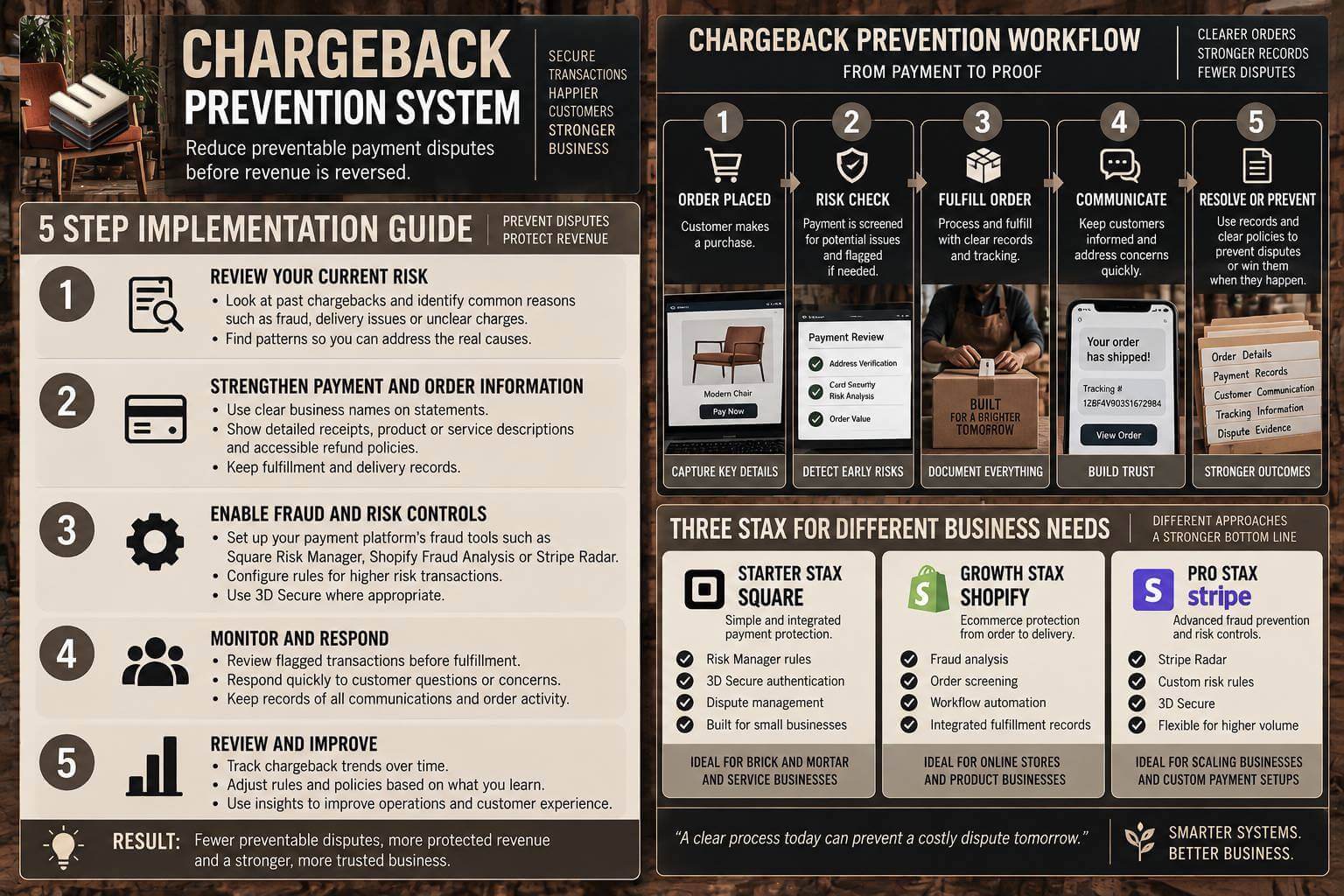
Step By Step Implementation Guide
The following setup demonstrates one implementation path using Square Risk Manager.
It is not a WIZESTAX recommendation or preferred Stax.
Square is used because Risk Manager provides a relatively clear example of converting payment risk conditions into alerts, authentication requirements or transaction actions.
Step 1: Review Existing Chargeback Causes
Before creating rules, review previous disputes.
Separate fraudulent transactions from delivery problems, service disagreements, subscription issues, refund disputes and charges customers simply did not recognize.
The purpose is to identify where the business is actually losing control rather than assuming every chargeback has the same cause.
Step 2: Strengthen Transaction Records
Make sure receipts clearly identify what customers purchased.
Keep business information recognizable and policies accessible.
For physical goods, retain shipping and delivery records. For services, preserve contracts, invoices, authorization records and relevant customer communication.
Square notes that itemized receipts can help customers recognize transactions and can also contribute evidence if a dispute occurs.
Step 3: Enable Risk Manager
Open Square Dashboard.
Navigate to Payments & invoices, then Risk Manager.
Choose Get Started and activate Risk Manager for the appropriate business locations.
Step 4: Create Risk Rules
Identify payment conditions that justify additional attention.
Square currently allows Risk Manager rules to consider factors including its risk evaluation, AVS mismatches, invalid CVV information and suspicious transaction amounts.
Choose an appropriate response for each condition.
A rule can generate an alert, invoke 3D Secure or decline a transaction.
Avoid treating every imperfect signal as fraud. An address mismatch, for example, can have legitimate explanations.
Step 5: Add Authentication Where Appropriate
For qualifying online transactions, consider whether 3D Secure is appropriate.
3D Secure introduces additional cardholder authentication and can provide protection against certain fraud chargeback liability, although Square cautions that additional verification can also reduce payment completion or increase issuer declines.
The objective is therefore calibrated protection rather than maximum friction.
Step 6: Monitor And Adjust
Review risk alerts, accepted transactions, rejected transactions and subsequent disputes.
If legitimate customers are repeatedly being blocked, the controls may be too aggressive.
If similar fraudulent transactions continue getting through, additional controls may be warranted.
Also review chargebacks by reason. A business experiencing mostly delivery disputes needs a different operational response from one experiencing unauthorized card transactions.
Revenue Exposure Snapshot
Chargeback exposure becomes clearer when disputed transaction value is considered alongside frequency.
| Monthly Chargebacks | Average Disputed Transaction | Monthly Revenue Disputed | Annualized Exposure |
|---|---|---|---|
| 2 | $150 | $300 | $3,600 |
| 5 | $150 | $750 | $9,000 |
| 10 | $150 | $1,500 | $18,000 |
| 20 | $150 | $3,000 | $36,000 |
Illustrative scenario using an average disputed transaction value of $150. Annualized exposure assumes the same monthly pattern continues for twelve months. It is not a prediction of losses or recoverable revenue.
WIZESTAX Diagnostic Scorecard
| Category | Assessment |
|---|---|
| Economic Problem | Revenue can be reversed after a payment has already been accepted |
| Signal Quality Required | High |
| Automation Potential | High |
| Human Judgment Required | Moderate To High |
| Data Dependency | High |
| Scalability | High |
| Primary Value | Reduced exposure to preventable payment disputes |
| Primary Risk | Blocking legitimate customers through overly aggressive controls |
Common Mistakes
| Mistake | Result |
|---|---|
| Treating every chargeback as fraud | Operational causes remain unresolved |
| Automatically rejecting unusual transactions | Legitimate sales can be lost |
| Using unclear billing information | Customers may not recognize legitimate charges |
| Failing to preserve fulfillment records | Evidence is harder to assemble later |
| Hiding refund or cancellation policies | Customer disagreements can escalate |
| Ignoring customer support problems | Resolvable issues can become bank disputes |
| Applying excessive fraud controls | Checkout friction and false declines increase |
| Never reviewing chargeback reasons | The business cannot identify recurring causes |
Related WIZESTAX Categories
| Category | Related Business Problem |
|---|---|
| Finance | Refund Pattern Detection System |
| Marketing | Customer Acquisition Cost Tracking System |
| Operations | Warranty Claim Tracking System |
| Operations | Return Visit Prevention System |
| Customer Service | Customer Complaint Pattern Detection System |
| Finance | Business KPI Anomaly Alert System |
These remain separate problems. Chargeback Prevention System addresses revenue exposed to payment disputes. Refund Pattern Detection System examines recurring refund behavior. Customer Complaint Pattern Detection System identifies recurring service problems. Warranty Claim Tracking System manages warranty obligations. Each owns a separate financial or operational leak.