
Customer Churn Warning System
Identify Customers At Risk Of Leaving Before The Business Actually Loses Them
Customer churn often becomes visible only after revenue has already disappeared. A recurring customer stops booking. A subscriber cancels. A regular buyer suddenly goes quiet. An account that once engaged consistently begins interacting less often. The warning signs can appear much earlier. Purchase frequency may decline. Expected appointments may be missed. Engagement can fall. Support problems can remain unresolved. Communication patterns can change. The time between purchases can become unusually long. The Customer Churn Warning System brings relevant signals together so the business can identify deteriorating customer relationships while there is still time to investigate what changed.
This Blueprint does not assume that every declining signal means a customer will leave. Its purpose is to create an early warning system that gives the business better information before customer loss becomes permanent.
Which Stax Fits Your Business
| Business Need | Stax | Software | Cost |
|---|---|---|---|
| Configurable customer health scoring inside a traditional CRM | Starter Stax | Zoho CRM | Varies by edition and users |
| Straightforward monitoring of customer activity and relationship touchpoints | Growth Stax | Pipedrive | Varies by plan and users |
| Dedicated customer success monitoring using broader customer data | Pro Stax | HubSpot Service Hub | Varies by plan and users |
Pricing and capabilities change over time and should be confirmed directly with each software provider before purchase.
Software Linx
Starter
Growth
Pro
Blueprint Overview
| Metric | Value |
|---|---|
| Category | Customer Retention |
| Business Problem | Customer deterioration is discovered after revenue is lost |
| Primary Objective | Identify meaningful churn signals earlier |
| Core Signals | Purchase behavior, engagement, service activity, support history and relationship health |
| Setup Time | Approximately 60 to 120 minutes |
| Difficulty | Intermediate |
| Maintenance | Periodic calibration |
| Best For | Repeat, recurring, subscription and account based businesses |
| Primary Output | Customer risk status and staff alert |
The Hidden Revenue Leak
| Without This Blueprint | With This Blueprint |
|---|---|
| Customer loss appears after revenue disappears | Warning signals can surface before confirmed churn |
| Declining activity is scattered across customer records | Relevant activity contributes to customer health |
| Staff rely on memory to notice unusual behavior | Defined signals make deterioration easier to identify |
| Unresolved problems remain disconnected from retention | Service problems can contribute to risk status |
| Quiet customers receive little attention | Accounts showing meaningful changes can be reviewed |
| Intervention begins after cancellation or disappearance | Staff can investigate while the relationship still exists |
Customer health should normally be based on multiple relevant signals rather than a single customer action.
Business Impact Snapshot
| Area | Potential Impact |
|---|---|
| Detection | Earlier visibility into deteriorating customer relationships |
| Staff Attention | Customer review can focus on accounts showing meaningful changes |
| Customer Service | Unresolved problems become easier to connect with retention risk |
| Revenue Protection | Investigation can begin before confirmed customer loss |
| Customer Data | Existing behavioral information becomes operationally useful |
| Management | Customer health becomes a repeatable process rather than an informal judgment |
Real World Example
A residential service company has a customer who normally schedules service every three months.
The customer has booked consistently for two years.
The normal service interval passes without another appointment. Recent communications receive less engagement than usual. The customer’s previous support issue also took longer than normal to resolve.
None of those events proves that the customer intends to leave.
Together they represent a meaningful change from the customer’s established behavior.
The system changes the customer’s risk status and creates an internal alert.
A staff member reviews the account, checks the customer’s history and determines whether personal contact is appropriate.
The value of the system is not predicting customer behavior with certainty. It is making meaningful deterioration visible before the customer disappears.
WIZESTAX Stax Options
Starter Stax
Zoho CRM
Best For
Businesses that want configurable customer scoring within a CRM and already maintain useful customer activity records.
| Function | Software |
|---|---|
| CRM | Zoho CRM |
| Customer Records | Zoho CRM |
| Scoring | Zia Scores |
| Segmentation | CRM Filters |
| Internal Response | CRM Automation |
Advantages
| Benefit |
|---|
| Customer scoring inside the CRM |
| Multiple customer signals can contribute to analysis |
| Customer records remain centralized |
| Scoring can support segmentation and internal processes |
Limitations
| Limitation |
|---|
| Useful scoring depends on useful customer data |
| Initial configuration requires thought |
| Capabilities depend on the Zoho edition |
| Poor scoring criteria can create misleading alerts |
Growth Stax
Pipedrive
Best For
Businesses that primarily need visibility into declining activity, missed customer touchpoints and overdue relationship activity.
| Function | Software |
|---|---|
| CRM | Pipedrive |
| Customer Monitoring | Activities |
| Relationship Tracking | Customer Pipelines |
| Internal Response | Automations |
| Follow Up Management | Activities And Reminders |
Advantages
| Benefit |
|---|
| Straightforward customer activity visibility |
| Customer lifecycle stages can be represented visually |
| Activities create clear staff responsibilities |
| Automations can create alerts and recurring actions |
Limitations
| Limitation |
|---|
| Less specialized than a dedicated customer success platform |
| More sophisticated health models require additional configuration |
| Automation availability depends on plan |
| Customer data quality still determines usefulness |
Pro Stax
HubSpot Service Hub
Best For
Businesses with larger customer portfolios, recurring revenue, dedicated customer success responsibilities or enough customer data to support more detailed health monitoring.
| Function | Software |
|---|---|
| CRM | HubSpot Smart CRM |
| Customer Success | Customer Success Workspace |
| Risk Monitoring | Health Scores |
| Service Signals | Support History |
| Behavioral Signals | Customer Activity And Usage Data |
| Internal Response | Customer Success Workflows |
Advantages
| Benefit |
|---|
| Dedicated customer success workspace |
| Configurable health scores |
| Customer service context can contribute to health analysis |
| Customer records and health information remain connected |
| Suitable for larger customer portfolios |
Limitations
| Limitation |
|---|
| Higher software cost |
| More configuration than many small businesses require |
| Customer Success Management requires qualifying Service Hub plans |
| Effective scoring still depends on meaningful customer data |
How The Three Stax Differ
| Stax | Primary Approach |
|---|---|
| Zoho CRM | Configurable CRM based customer scoring |
| Pipedrive | Activity and relationship monitoring |
| HubSpot Service Hub | Dedicated customer success health monitoring |
These are different implementation architectures rather than rankings.
The appropriate architecture depends on the information the business already collects, the complexity of its customer relationships, the number of accounts being monitored and how much customer success infrastructure is actually necessary.
Copy And Paste Customer Risk Alert
“Customer health warning for {{customer_name}}. Recent activity has moved outside the normal range for this account. Review purchase history, recent communication, unresolved service issues and current engagement before deciding whether outreach is appropriate.”
Copy And Paste Customer Check In
“Hi {{first_name}}, I wanted to check in and make sure everything has been going well with us. If there is anything you need help with or anything we could improve, please reply here. We would be glad to hear from you.”
Copy And Paste AI Prompt
You are assisting a small business with customer health analysis.
Review the customer information provided and identify meaningful changes from the customer’s normal behavior.
Consider purchase frequency, time since last purchase, recurring appointment behavior, recent communication, customer engagement, unresolved support issues, complaints and other relevant relationship signals.
Do not assume that one missed purchase, unopened message or support request means the customer will leave.
Separate normal variation from patterns that deserve staff attention.
Explain which signals caused the customer to be flagged.
Do not invent customer information.
Do not automatically send discounts, promotions or retention offers.
If the available information is insufficient, state that additional review is required.
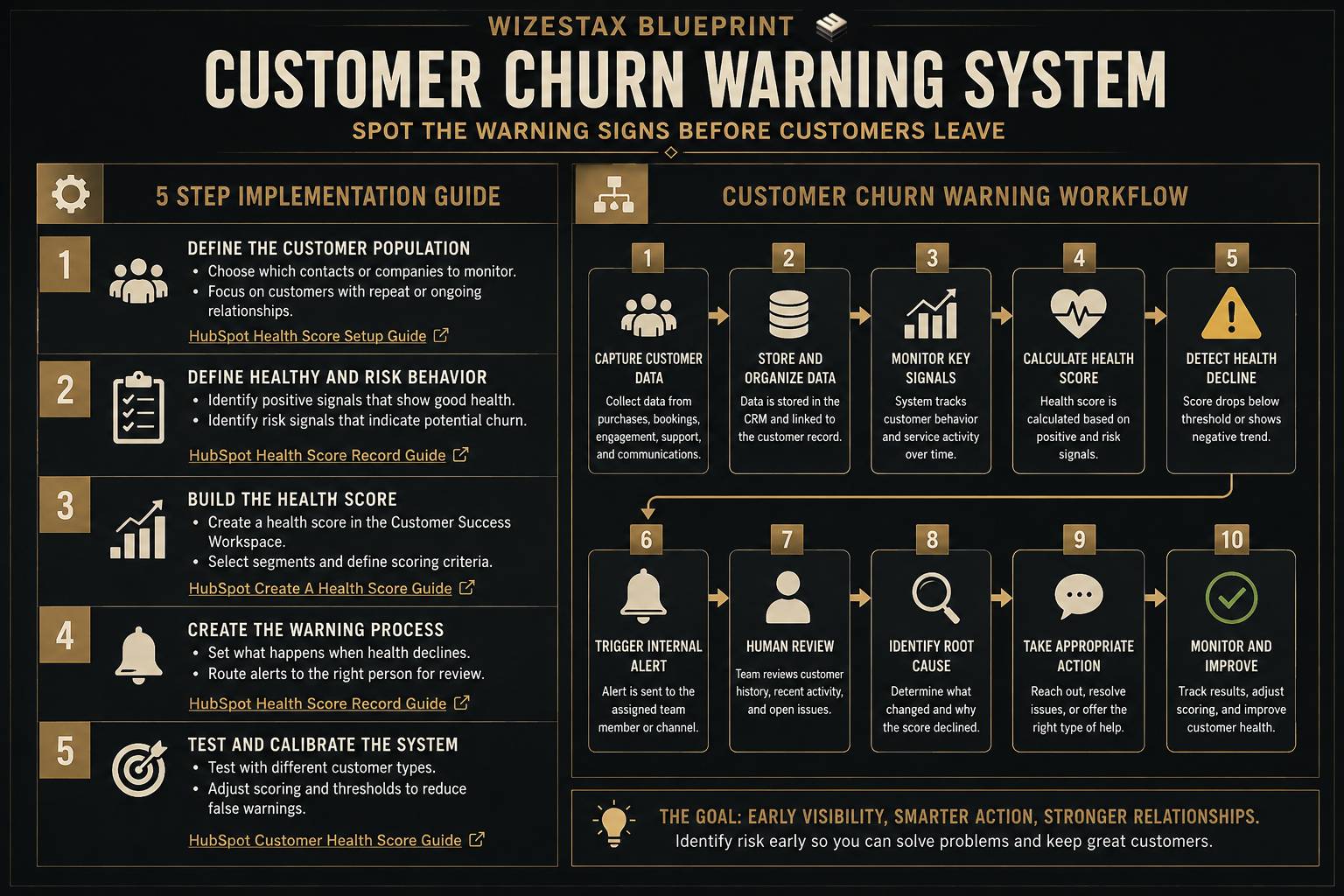
Step By Step Implementation Guide
The following setup demonstrates one implementation path using HubSpot Service Hub.
It is not a WIZESTAX recommendation or preferred Stax.
HubSpot is used here because its customer health scoring system provides a practical example of how customer attributes and behavioral activity can be converted into an internal warning process.
Step 1: Define The Customer Population
Determine which contacts or companies should be monitored.
A local service business might monitor recurring customers.
A subscription company might monitor active subscribers.
An account based business might monitor companies with active contracts.
The monitored population should contain customers whose normal behavior can be meaningfully compared over time.
HubSpot Health Score Setup Guide
Step 2: Define Healthy And Risk Behavior
Identify customer behaviors that actually matter to the business.
Positive signals could include completed appointments, recent purchases, successful meetings, positive feedback or normal engagement.
Risk signals could include unresolved support tickets, poor feedback, declining activity, missed recurring behavior or unusually long periods without meaningful interaction.
The purpose is to identify changes that deserve investigation without treating ordinary customer variation as evidence of churn.
HubSpot Health Score Record Guide
Step 3: Build The Health Score
Open the Customer Success Workspace.
Open Workspace Settings.
Select Health Scores.
Create a new health score.
Choose whether the score applies to contacts or companies.
Select the appropriate customer segments.
Create the scoring criteria using the customer properties and behavioral events that matter to the business.
Once activated, the resulting health information becomes part of the customer monitoring process.
HubSpot Create A Health Score Guide
Step 4: Create The Warning Process
Decide what happens when customer health deteriorates.
The first response should normally be internal review rather than automatic customer messaging.
The assigned employee can inspect the account history, determine which signals changed and decide whether intervention is appropriate.
The warning process should make the reason for the changing customer health visible whenever possible.
HubSpot Health Score Record Guide
Step 5: Test And Calibrate The System
Test the scoring model against several types of customers.
Review healthy long term customers.
Review customers who previously left.
Review irregular purchasers.
Review customers with unresolved complaints.
Review customers whose behavior changes seasonally.
Look specifically for false warnings.
A customer who naturally buys twice per year should not be flagged simply because another customer buys every month.
Customer health criteria should reflect the actual business model and customer lifecycle rather than applying one universal definition of healthy behavior.
HubSpot Customer Health Score Guide
Revenue At Risk Snapshot
The primary economic value of this system is not simply administrative labor saved.
It is revenue exposed to customer churn that becomes visible earlier.
| Customers Flagged Monthly | Average Annual Customer Value | Revenue Represented |
|---|---|---|
| 5 | $1,000 | $5,000 |
| 10 | $1,000 | $10,000 |
| 25 | $1,000 | $25,000 |
Illustrative scenario using an average annual customer value of $1,000. Revenue represented is not revenue saved. Customer retention cannot be guaranteed.
WIZESTAX Diagnostic Scorecard
| Category | Assessment |
|---|---|
| Economic Problem | Customer revenue can disappear before relationship deterioration is recognized |
| Signal Quality Required | High |
| Automation Potential | Moderate To High |
| Human Judgment Required | Moderate |
| Data Dependency | High |
| Scalability | High |
| Primary Value | Earlier detection and prioritization |
| Primary Risk | False warnings created by weak signals or poor thresholds |
Common Mistakes
| Mistake | Result |
|---|---|
| Treating one behavior as proof of churn | Healthy customers can be incorrectly flagged |
| Using identical thresholds for every customer | Normal customer differences become false warnings |
| Tracking signals unrelated to retention | The system produces noise |
| Automatically sending discounts when risk increases | Customers receive unnecessary offers |
| Ignoring unresolved service problems | Risk is detected without investigating the cause |
| Never recalibrating the system | Warning rules become less useful over time |
| Hiding the reason behind a risk status | Staff cannot properly evaluate the warning |
Related WIZESTAX Categories
| Category | Related Business Problem |
|---|---|
| Customer Retention | Customer Purchase Frequency Decline |
| Customer Retention | Customer Spend Decline |
| Customer Service | Customer Complaint Pattern Detection |
| Customer Service | Repeat Complaint Escalation |
| Operations | Service Agreement Usage Tracking |
| Finance | Customer Segment Profitability |
These remain separate problems. The Customer Churn Warning System identifies the broader risk that an existing customer relationship is deteriorating. Purchase Frequency Decline measures a specific change in buying cadence. Customer Spend Decline identifies falling customer value. Complaint Pattern Detection identifies recurring service problems. Each Blueprint therefore owns a different economic or operational leak.
Get New WIZESTAX Blueprints Every Monday
Subscribe to receive new WIZESTAX Blueprints covering Customer Retention, Marketing, Sales, Finance and Operations directly to your inbox.