

Lead Source Profitability System
Identify Which Lead Sources Produce Profitable Customers, Not Just More Leads
A business can know exactly where its leads come from and still make poor marketing decisions. Google may generate 80 leads while referrals generate 20. Paid advertising may create more appointments than organic search. A marketplace may consistently fill the pipeline.
Those numbers show activity. They do not show which source produces the strongest financial result. One source may generate inexpensive leads that rarely become customers. Another may produce fewer leads but much larger jobs. A third may create plenty of revenue while consuming so much advertising spend and sales time that its actual contribution is weak.
The Lead Source Profitability System connects acquisition source with closed business outcomes and source costs so management can compare what each channel actually produces. The goal is not perfect attribution. It is better economic visibility.
Which Stax Fits Your Business
| Business Need | Stax | Software | Cost |
|---|---|---|---|
| Straightforward source tracking through the sales pipeline | Starter Stax | Pipedrive | Paid plans |
| CRM based source, deal and revenue reporting | Growth Stax | HubSpot | Free and paid tools, advanced attribution requires eligible paid plans |
| Flexible source profitability analysis across CRM and financial data | Pro Stax | Airtable | Free and paid plans |
Pricing and capabilities change over time and should be confirmed directly with each provider before purchase.
Software Linx
Starter
Growth
Pro
Blueprint Overview
| Metric | Value |
|---|---|
| Category | Marketing |
| Business Problem | Lead volume can hide large differences in source profitability |
| Primary Objective | Connect acquisition source with customer revenue and source cost |
| Core Signals | Lead source, conversion status, closed revenue, acquisition spend and customer value |
| Setup Time | Approximately 2 to 4 hours |
| Difficulty | Intermediate |
| Maintenance | Monthly source review |
| Best For | Businesses acquiring customers through several measurable channels |
| Primary Output | Profitability comparison by lead source |
The Hidden Revenue Leak
| Without This Blueprint | With This Blueprint |
|---|---|
| Marketing is judged primarily by lead volume | Sources can be compared using business outcomes |
| Cheap leads appear automatically attractive | Conversion and revenue are considered |
| High volume channels receive more budget | Financial performance can influence allocation |
| Closed sales lose their original source | Source data remains connected to the opportunity |
| Marketing cost sits separately from sales results | Cost and attributed revenue can be reviewed together |
| Management relies on impressions or inquiries | Management can compare sources closer to the actual sale |
Lead source tracking becomes much more valuable when the source remains attached to the opportunity through the sales process. Pipedrive, for example, currently preserves lead source fields as leads become deals and supports source performance analysis through Insights. (Pipedrive Support)
Business Impact Snapshot
| Area | Potential Impact |
|---|---|
| Marketing Budget | More spending can be directed toward economically stronger sources |
| Acquisition Cost | Expensive sources become easier to identify |
| Sales Efficiency | Lead quality can be compared rather than assumed |
| Revenue Visibility | Closed revenue remains connected to acquisition source |
| Planning | Channel decisions use historical outcomes |
| Profitability | Marketing activity can be evaluated closer to its actual financial contribution |
Real World Example
A residential landscaping company generates leads from Google Ads, referrals, organic search and a local home services marketplace.
At the end of the month, the marketplace appears to be the strongest source because it generated 42 leads.
Referrals generated only 14.
If management looks only at lead volume, the marketplace appears to deserve more attention.
The company connects each lead source to the final sales outcome.
The 42 marketplace leads produced six customers and $12,000 in closed revenue. The business also paid $4,200 for the leads.
The 14 referrals produced eight customers and $31,000 in closed revenue with very little direct acquisition expense.
The system does not automatically declare referrals the permanent winner. The sample may change over time, fulfillment costs may differ and some channels contribute earlier in the customer journey.
But management can now see something lead counts alone could not show.
The largest source of leads was not necessarily the strongest source of business.
WIZESTAX Stax Options
Starter Stax
Pipedrive
Best For
Small sales teams that want lead source information to remain attached to opportunities as they move through the pipeline.
| Function | Software |
|---|---|
| Lead Capture | Pipedrive |
| Source Recording | Lead Source Fields |
| Deal Tracking | Pipedrive |
| Won And Lost Outcomes | Deals |
| Source Analysis | Insights |
| Revenue Tracking | Deal Value |
Advantages
Pipedrive provides dedicated source fields for leads and deals, can populate source information manually or automatically depending on how the record enters the CRM, and preserves the information through the opportunity lifecycle. Its current documentation specifically describes using Insights to compare sources, won deals and ROI related performance. (Pipedrive Support)
Limitations
Source data alone does not establish profitability. Marketing spend and other acquisition costs still need to be connected to the analysis. Multi touch customer journeys can also make a single source field incomplete.
Growth Stax
HubSpot
Best For
Businesses already managing marketing and sales activity in one CRM and wanting deeper attribution between interactions, deals and revenue.
| Function | Software |
|---|---|
| Source Tracking | HubSpot |
| CRM | Smart CRM |
| Deal Revenue | Deals |
| Attribution | Attribution Reporting |
| Customer Journey | Journey Reporting |
| Analysis | Reporting |
Advantages
HubSpot currently supports attribution reports that examine how marketing interactions contribute to contacts, deals and revenue. Its source properties can also be used for segmentation, automation and reporting. (HubSpot Knowledge Base)
For businesses with longer buying journeys, this provides more context than assigning every sale to a single source.
Limitations
Advanced attribution capabilities depend on eligible paid subscriptions. Configuration is more involved than basic source tracking, and attribution remains a model for assigning credit rather than an objective measurement of every influence on a purchase. (HubSpot Knowledge Base)
Pro Stax
Airtable
Best For
Businesses that need a flexible profitability model combining lead source, CRM exports, advertising spend and financial information.
| Function | Software |
|---|---|
| Source Register | Airtable |
| Customer Records | Airtable |
| Revenue Data | Imported Or Integrated Data |
| Source Costs | Cost Table |
| Profitability Calculation | Formulas |
| Management View | Interfaces |
Advantages
A flexible database architecture allows the business to define profitability according to its own economics rather than relying entirely on a CRM’s built in attribution model.
The business can maintain separate tables for sources, leads, customers and acquisition costs, then connect those records for analysis.
Limitations
The quality of the output depends heavily on the quality of the inputs. Data synchronization may require integrations or imports, and the business must define its own calculation rules.
How The Three Stax Differ
| Stax | Primary Approach |
|---|---|
| Pipedrive | Track source through the sales pipeline |
| HubSpot | Connect marketing interactions with CRM and revenue attribution |
| Airtable | Build a customized source profitability model |
These are different architectures rather than rankings.
A local service business with four acquisition sources may only need consistent source fields and closed deal values. A business with longer digital customer journeys may need attribution reporting. A company combining information from several systems may need a flexible profitability database.
Copy And Paste Source Review
“Review lead source performance for {{period}} using leads generated, customers acquired, closed revenue and known acquisition cost. Identify large differences between lead volume and financial results. Flag sources with incomplete cost or revenue information rather than estimating missing values.”
Copy And Paste AI Prompt
You are assisting a small business with lead source profitability analysis.
Review the supplied lead source, sales and acquisition cost data.
Compare lead volume, customer conversions, closed revenue and known acquisition costs by source.
Calculate conversion rate and acquisition cost only when the required data is available.
Do not assume that the source generating the most leads is the most profitable.
Do not assign revenue to a source when the attribution information is missing.
Separate direct observations from conclusions that require additional data.
Flag unusually small samples that could produce misleading comparisons.
Do not invent marketing costs, customer values or attribution data.
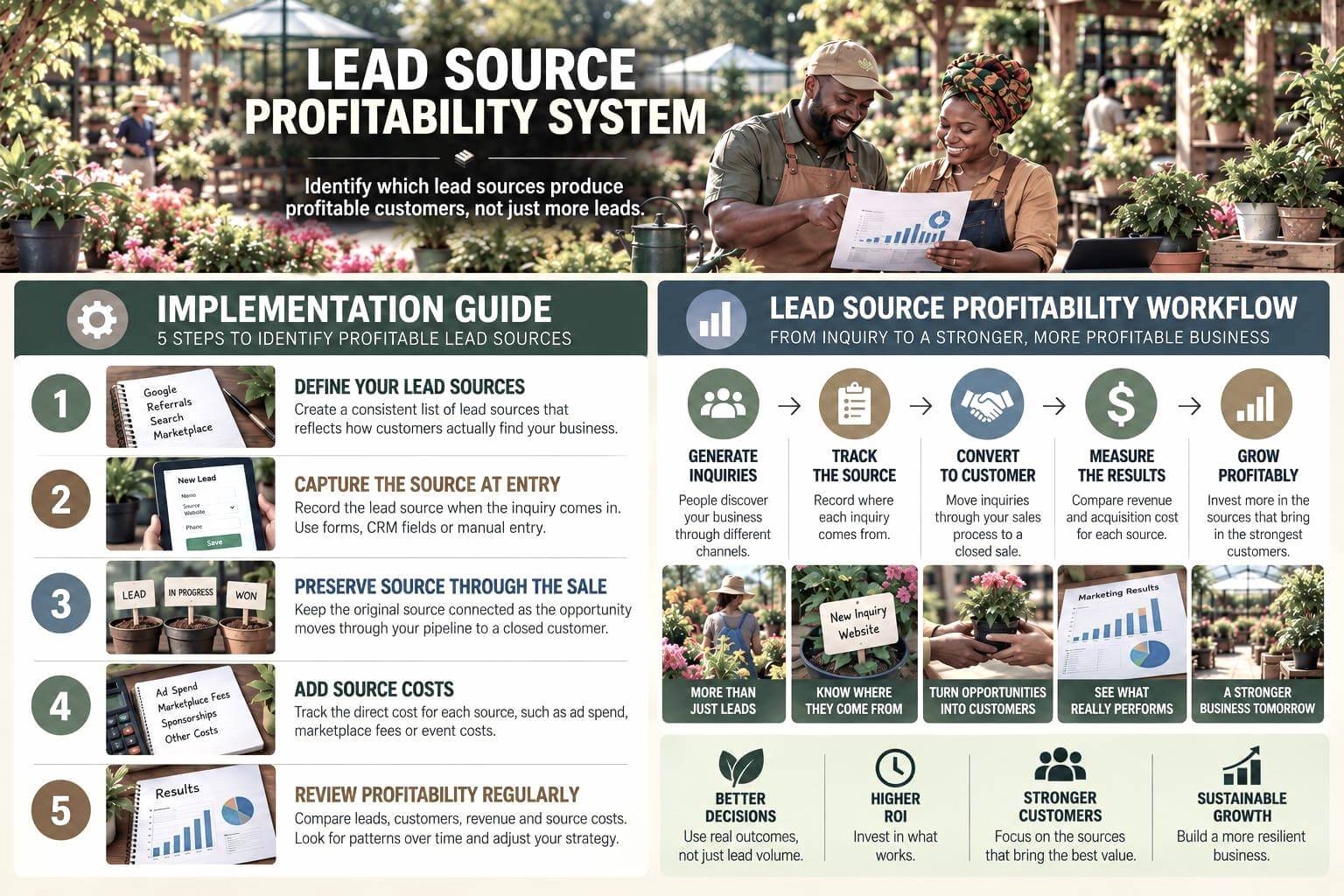
Step By Step Implementation Guide
The following setup demonstrates one implementation path using Pipedrive.
It is not a WIZESTAX recommendation or preferred Stax.
Pipedrive is used because its current source structure provides a straightforward example of carrying acquisition information from the lead into the resulting deal and analyzing source performance afterward. (Pipedrive Support)
Step 1: Standardize Lead Sources
Create a controlled source structure that reflects how customers actually discover the business.
Examples could include Google Ads, Organic Search, Customer Referral, LinkedIn, Marketplace, Direct Outreach and Walk In.
Avoid allowing employees to create slightly different names for the same source.
The goal is consistent data rather than an enormous list of marketing labels.
Step 2: Capture The Source At Entry
Record source information when the lead enters the business.
Where the source can be captured automatically, preserve it.
Where the source must be entered manually, make the field part of the normal intake process.
Pipedrive currently provides source fields for both leads and deals and can populate source information according to how records enter the CRM. (Pipedrive Support)
Step 3: Preserve Source Through The Sale
Do not discard the source after qualification.
The original acquisition information should remain connected as the opportunity moves through the pipeline.
Record whether the opportunity was won or lost and enter the final deal value consistently.
This connects acquisition activity to an actual business outcome instead of stopping measurement at the lead.
Step 4: Add Source Costs
Record the direct acquisition cost associated with each source for the same reporting period.
That might include advertising spend, marketplace fees, sponsorship costs or other measurable acquisition expenses.
Keep cost periods aligned with the reporting period.
Do not treat zero recorded cost as zero actual cost unless that is genuinely known.
Step 5: Review Profitability Regularly
Compare lead count, customers acquired, conversion rate, closed revenue and known acquisition cost.
Look for differences between volume and economic performance.
Review several periods before making large budget decisions because one month can be distorted by a small number of unusually large or small sales.
The system should help management investigate where profitable customers originate, not automatically move marketing money based on a single report.
Lead Source Economics Snapshot
| Metric | Calculation |
|---|---|
| Lead Conversion Rate | Customers Acquired ÷ Leads |
| Cost Per Lead | Source Cost ÷ Leads |
| Customer Acquisition Cost | Source Cost ÷ Customers Acquired |
| Revenue Per Lead | Closed Revenue ÷ Leads |
| Revenue Per Customer | Closed Revenue ÷ Customers Acquired |
| Basic Source Return | (Attributed Revenue − Source Cost) ÷ Source Cost |
Basic source return is not the same as net profit. Labor, fulfillment, overhead, refunds, discounts and other business costs can materially change the economics.
Attribution Matters
Lead source profitability becomes less certain when customers interact with several channels before purchasing.
A customer might discover the business through LinkedIn, later search Google, read several articles and finally submit a form after clicking an email.
Giving all revenue credit to one interaction can oversimplify that journey.
Modern attribution systems address this by assigning credit using defined models. HubSpot currently supports attribution reporting across contacts, deals and revenue, while Zoho’s current documentation illustrates how attribution models can distribute credit across customer touchpoints. (HubSpot Knowledge Base)
For this Blueprint, consistency is more important than pretending attribution can be perfectly objective.
WIZESTAX Diagnostic Scorecard
| Category | Assessment |
|---|---|
| Economic Problem | Lead volume can disguise weak source economics |
| Signal Quality Required | High |
| Automation Potential | High |
| Human Judgment Required | Moderate |
| Data Dependency | Very High |
| Scalability | High |
| Primary Value | Better marketing allocation |
| Primary Risk | Mistaking attribution estimates for exact profitability |
Common Mistakes
| Mistake | Result |
|---|---|
| Ranking sources only by lead count | High volume sources can appear stronger than they are |
| Losing source information after intake | Revenue can no longer be connected reliably |
| Comparing revenue without acquisition cost | Expensive channels can look artificially strong |
| Treating missing cost as zero cost | Profitability becomes overstated |
| Mixing source names | Reporting fragments the same channel into several categories |
| Making decisions from very small samples | Individual deals can distort the result |
| Treating attributed revenue as net profit | Delivery and operating costs are ignored |
| Changing attribution rules between reports | Source comparisons become inconsistent |
Related WIZESTAX Categories
| Category | Related Business Problem |
|---|---|
| Marketing | Customer Referral Source Tracking |
| Marketing | Customer Acquisition Cost Tracking |
| Marketing | Marketing Channel ROI |
| Sales | Sales Pipeline Velocity |
| Sales | Lead Routing |
| Sales | Abandoned Lead Recovery |
| Finance | Customer Profitability |
These remain separate problems. Customer Referral Source Tracking answers where customers came from. Lead Source Profitability System asks what happened economically after those leads entered the business.
That difference matters. A source can be excellent at producing attention and still be weak at producing profitable customers.
Get New WIZESTAX Blueprints Every Monday
Subscribe to receive new WIZESTAX Blueprints covering Customer Retention, Marketing, Sales, Finance and Operations directly to your inbox.