Refund Pattern Detection System
Identify Recurring Refund Patterns Before They Become A Larger Revenue Problem
A single refund is usually a customer service event. A pattern of refunds can indicate something larger. One product may be returned considerably more often than others. A particular service may repeatedly fail to meet customer expectations. Refunds may cluster around certain locations, order types, employees, fulfillment methods or periods of the month. Partial refunds may slowly become routine without anyone examining why they are occurring. When refunds are handled individually, these patterns can remain hidden.
The Refund Pattern Detection System creates a repeatable process for collecting refund information, grouping it by relevant business factors and identifying recurring concentrations that deserve investigation.
The purpose is not to discourage legitimate refunds or make them more difficult for customers to obtain. Refunds can be an appropriate response when something goes wrong. The system instead asks whether repeated refunds are revealing an underlying product, service, communication or operational problem.
Which Stax Fits Your Business
| Business Need | Stax | Software | Cost |
|---|---|---|---|
| Straightforward refund tracking within existing payment activity | Starter Stax | Square | Reporting available with Square account, advanced capabilities may vary |
| Ecommerce refund analysis connected with products, orders and sales | Growth Stax | Shopify | Varies by plan |
| Custom analysis across large or complex payment datasets | Pro Stax | Stripe Sigma | Varies by Stripe usage and Sigma pricing |
Pricing and capabilities change over time and should be confirmed directly with each provider.
Software Linx
Starter
Growth
Pro
Blueprint Overview
| Metric | Value |
|---|---|
| Category | Finance |
| Business Problem | Recurring refund behavior is handled transaction by transaction without identifying the underlying pattern |
| Primary Objective | Identify concentrations and trends within refund activity |
| Core Signals | Refund amount, reason, product, service, customer, employee, location, date and original transaction |
| Setup Time | Approximately 60 to 120 minutes |
| Difficulty | Intermediate |
| Maintenance | Periodic review and classification |
| Best For | Retailers, ecommerce businesses, restaurants and service businesses processing regular refunds |
| Primary Output | Refund pattern report and investigation queue |
The Hidden Revenue Leak
| Without This Blueprint | With This Blueprint |
|---|---|
| Each refund is treated as an isolated event | Refunds are examined collectively |
| Repeated product problems can remain hidden | Refunds can be grouped by product or service |
| Refund reasons may be inconsistent | Standardized reasons create comparable information |
| Management sees lost revenue but not its source | Refund activity can be connected with operational causes |
| Staff behavior is difficult to compare | Refunds can be reviewed by employee or location where appropriate |
| Problems are discovered through complaints | Refund patterns can provide an earlier operational signal |
Square’s current reporting distinguishes itemized returns from amount based refunds and provides refund counts and refund amounts within payment reporting.
Business Impact Snapshot
| Area | Potential Impact |
|---|---|
| Revenue | Repeated sources of refunded revenue become visible |
| Product Quality | Frequently refunded products can receive investigation |
| Service Quality | Repeated service failures can be identified |
| Customer Experience | Underlying causes can be corrected rather than repeatedly refunded |
| Operations | Locations and processes can be compared |
| Management | Refund decisions become a source of diagnostic information |
Real World Example
A specialty outdoor retailer processes refunds throughout the month.
Nothing appears particularly unusual when each refund is handled individually.
During the monthly refund review, however, one hiking boot model appears repeatedly.
The store compares refund reasons and finds that customers frequently report problems with sizing. The pattern is concentrated in online orders rather than purchases made inside the store.
The business investigates further and discovers that the sizing guidance on the product page is creating inaccurate expectations.
The refund system did not determine that the product was defective.
It identified a concentration of similar events that justified investigation.
The business can now correct the product information and monitor whether the refund pattern changes.
WIZESTAX Stax Options
Starter Stax
Square
Best For
Smaller businesses already processing payments through Square that need a straightforward way to make refund activity visible.
| Function | Software |
|---|---|
| Payment Processing | Square |
| Refund Records | Square Transactions |
| Refund Reasons | Square Refund Workflow |
| Refund Totals | Square Reports |
| Transaction Analysis | Square Dashboard |
| Deeper Analysis | CSV Export |
Advantages
| Benefit |
|---|
| Refund information remains connected with payment activity |
| Refund counts and amounts can be reviewed |
| Refund reasons can be captured during the refund process |
| Transactions can be filtered and investigated |
| Data can be exported for additional analysis |
Square’s sales reporting currently includes refund counts and refund amounts, while individual retail refund records can show the reason, amount, date, time and cashier associated with the transaction.
Limitations
| Limitation |
|---|
| Deeper pattern analysis may require exporting information |
| Inconsistent refund reasons reduce diagnostic quality |
| Basic reports may not explain why refunds are occurring |
| Small datasets can make apparent patterns misleading |
| Human investigation is still necessary |
Growth Stax
Shopify
Best For
Ecommerce businesses that want to examine refunds in the context of products, orders and online sales.
| Function | Software |
|---|---|
| Commerce | Shopify |
| Order Records | Shopify Orders |
| Refund Data | Shopify Payments And Finance Reports |
| Product Analysis | Shopify Analytics |
| Sales Analysis | Shopify Reports |
| Investigation | Order And Product Records |
Advantages
| Benefit |
|---|
| Refund activity remains connected with ecommerce orders |
| Product information can provide context for recurring refund behavior |
| Refunded and partially refunded transactions can be isolated |
| Sales reporting can provide additional product and channel context |
| Ecommerce operations remain inside one environment |
Shopify currently separates returns and refunds in its reporting. Its documentation explains that refunded figures can be isolated by adding payment status to Sales over time and filtering for refunded or partially refunded transactions.
Limitations
| Limitation |
|---|
| Primarily appropriate for commerce businesses |
| Returns and refunds represent different reporting concepts |
| Refund data alone does not establish the cause |
| Businesses need consistent product and order information |
| More complex analysis may require additional reporting work |
Pro Stax
Stripe Sigma
Best For
Businesses processing enough transactions to benefit from customizable analysis across payments, customers, refunds and related payment information.
| Function | Software |
|---|---|
| Payments | Stripe |
| Refund Data | Stripe Payment Data |
| Custom Analysis | Stripe Sigma |
| Pattern Detection | Custom Queries |
| Visualization | Sigma Charts |
| Recurring Reporting | Scheduled Reports |
Advantages
| Benefit |
|---|
| Refund information can be analyzed at transaction level |
| Businesses can build custom reports around their own questions |
| Refund information can be combined with other Stripe data |
| Reports can be visualized as charts |
| Reports can be scheduled for recurring delivery |
Stripe states that Sigma can analyze transaction level patterns, create custom metrics and reports, produce charts and schedule reports. Its available data includes payments, customers, subscriptions and refunds.
Limitations
| Limitation |
|---|
| More analytical capability than some small businesses require |
| Useful analysis depends on clean underlying information |
| Payment data may not contain the operational reason behind a refund |
| Custom analysis requires thoughtful query design |
| Patterns still require human interpretation |
How The Three Stax Differ
| Stax | Primary Approach |
|---|---|
| Square | Straightforward payment and refund reporting |
| Shopify | Ecommerce order and product centered analysis |
| Stripe Sigma | Custom transaction level refund analysis |
These are different implementation architectures rather than rankings, consistent with the WIZESTAX master structure.
The appropriate architecture depends on where transactions occur, how frequently refunds happen, how much contextual information accompanies each refund and how sophisticated the analysis needs to become.
Copy And Paste Refund Pattern Alert
Refund pattern detected for {{product_service_or_category}}. During {{review_period}}, {{refund_count}} refunds totaling {{refund_amount}} were recorded. The concentration is higher than the normal comparison period. Review refund reasons, transactions and related operational information before determining whether action is necessary.
Copy And Paste Internal Investigation Message
We identified a recurring refund pattern involving {{product_service_or_category}}. Please review the associated transactions and documented refund reasons. The objective is to determine whether there is a recurring product, service, communication or operational issue rather than evaluating any individual customer refund.
Copy And Paste AI Prompt
You are assisting a small business with refund pattern analysis.
Review the refund information provided and identify recurring concentrations or meaningful changes.
Consider refund reason, amount, product, service, location, employee, customer type, fulfillment method, transaction date and available historical comparisons.
Do not assume that a high refund count automatically indicates poor performance, misconduct or a defective product.
Separate isolated events from recurring patterns.
Explain which information caused a pattern to be flagged.
Do not invent customer, transaction or operational information.
Do not recommend denying legitimate refunds.
If the available data does not establish a likely cause, state that further investigation is required.
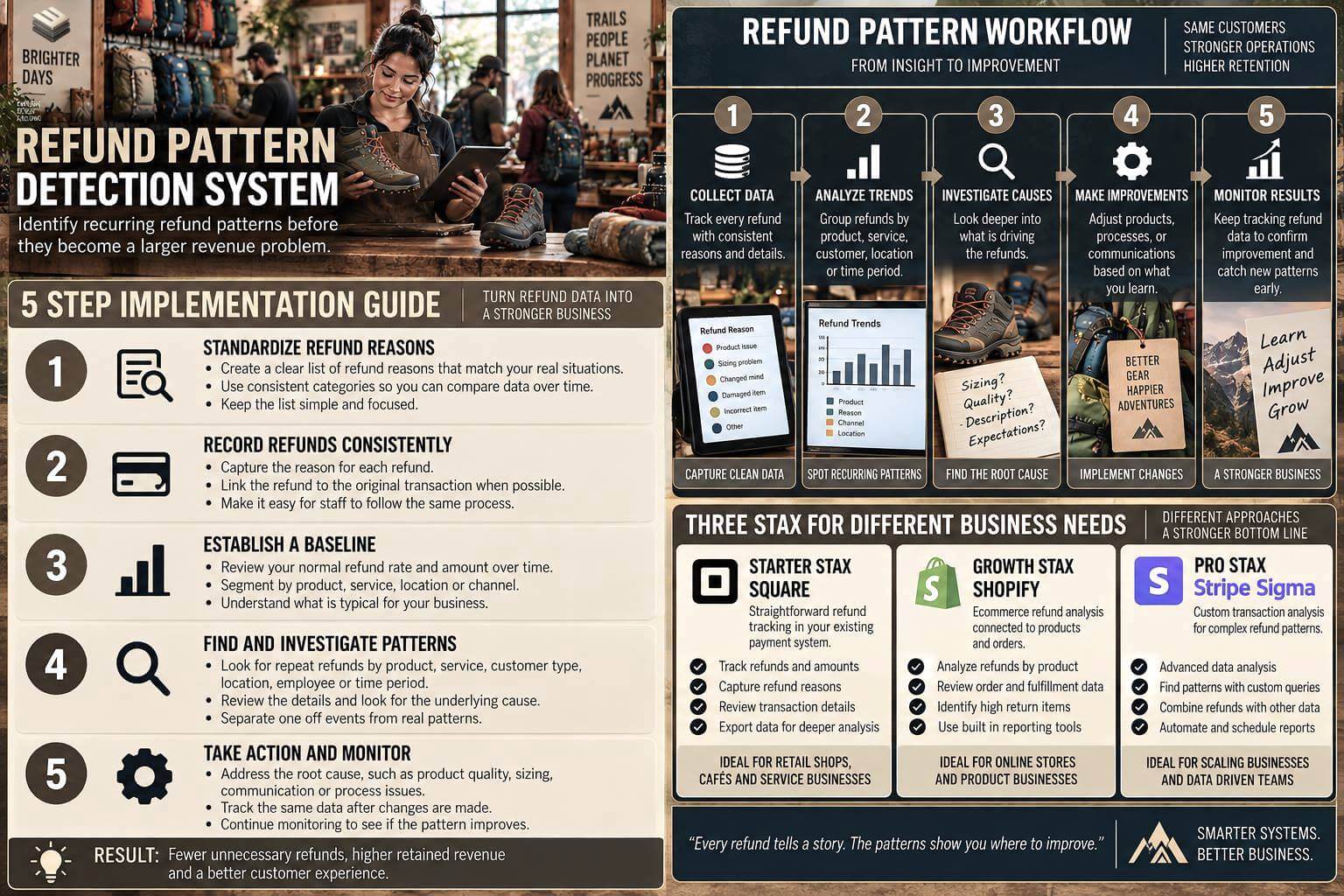
Step By Step Implementation Guide
The following setup demonstrates one implementation path using Square.
It is not a WIZESTAX recommendation or preferred Stax.
Square is used because its current transaction and reporting environment provides a straightforward implementation example for a smaller business.
Step 1: Standardize Refund Reasons
Create a manageable set of refund reasons that reflects how refunds actually occur in the business.
Examples might include incorrect item, product quality, sizing, delivery problem, service issue, duplicate transaction or customer cancellation.
Avoid creating so many categories that employees begin selecting them inconsistently.
The goal is comparable information.
Step 2: Record Refunds Consistently
When processing a refund, connect it with the original transaction whenever possible and select the appropriate reason.
Square currently supports full, partial and itemized refunds and allows a refund reason to be selected during the process.
Consistency matters more than complexity. A sophisticated analysis built on inconsistent refund information will still produce weak conclusions.
Step 3: Establish A Baseline
Determine the business’s normal refund activity.
Track refund count and refunded value over a representative period.
Then add context.
A business processing 20 refunds from 20,000 transactions has a very different pattern from one processing 20 refunds from 200 transactions.
The objective is not to establish a universal acceptable refund rate. It is to understand what is normal for this particular business.
Step 4: Group Refund Activity
Review refunds by the dimensions that matter operationally.
This might include product, service, category, location, employee, reason, fulfillment method or time period.
Square Dashboard supports detailed historical reporting and transaction exports that can be used for deeper analysis.
Look for concentrations rather than isolated events.
Step 5: Investigate The Pattern
When a concentration appears, examine the surrounding business process.
A product refund pattern could originate from quality, sizing, packaging, shipping damage or inaccurate product information.
A service refund pattern could originate from scheduling, communication, execution or mismatched customer expectations.
The refund data identifies where to investigate. It does not automatically determine the cause.
Step 6: Correct And Monitor
Once the business changes the suspected cause, continue monitoring the same refund pattern.
If refunds decline, the intervention may be helping.
If the pattern continues, investigate another possible cause.
This closes the system’s feedback loop. Refund information becomes an operational diagnostic signal rather than simply a record of money returned.
Revenue Exposure Snapshot
Consider a business processing 1,000 transactions per month with an average transaction value of $80.
| Refund Rate | Approximate Refunds | Monthly Revenue Refunded | Annualized Value |
|---|---|---|---|
| 1% | 10 | $800 | $9,600 |
| 2% | 20 | $1,600 | $19,200 |
| 3% | 30 | $2,400 | $28,800 |
| 5% | 50 | $4,000 | $48,000 |
Illustrative scenario only. This assumes 1,000 monthly transactions, an $80 average transaction value and continuation of the same pattern for twelve months. Revenue refunded is not automatically recoverable revenue. Legitimate refunds remain a normal cost of doing business.
WIZESTAX Diagnostic Scorecard
| Category | Assessment |
|---|---|
| Economic Problem | Repeated refunds can remove revenue while hiding the underlying operational cause |
| Signal Quality Required | Moderate To High |
| Automation Potential | Moderate To High |
| Human Judgment Required | High |
| Data Dependency | High |
| Scalability | High |
| Primary Value | Identification of recurring sources of refunded revenue |
| Primary Risk | Drawing conclusions from small or poorly classified datasets |
Common Mistakes
| Mistake | Result |
|---|---|
| Treating every refund as a failure | Legitimate customer service activity becomes distorted |
| Measuring refund dollars without transaction volume | Normal business growth can appear to create a worsening problem |
| Using inconsistent refund reasons | Patterns become unreliable |
| Looking only at total refunds | Product and operational concentrations remain hidden |
| Blaming employees from refund counts alone | Context and transaction mix are ignored |
| Assuming correlation establishes the cause | The wrong process may be changed |
| Making refunds harder for customers | Customer experience deteriorates |
| Correcting a problem without continued monitoring | The business cannot determine whether the pattern changed |
Related WIZESTAX Categories
| Category | Related Business Problem |
|---|---|
| Finance | Chargeback Prevention System |
| Customer Service | Customer Complaint Pattern Detection System |
| Customer Service | Repeat Complaint Escalation System |
| Operations | Warranty Claim Tracking System |
| Operations | Return Visit Prevention System |
| Finance | Customer Segment Profitability System |
These remain separate problems. Refund Pattern Detection System examines recurring patterns in money voluntarily returned by the business. Chargeback Prevention System addresses payment disputes initiated through the customer’s financial institution. Customer Complaint Pattern Detection System examines recurring complaints regardless of whether money is returned. Warranty Claim Tracking System monitors warranty obligations and claims.